

Hanger System for Denim & Casualwear
Denim is the heaviest, dirtiest fabric in apparel — and the wash-and-finishing pipeline is some of the most complex. The CleverMax Hanger System is configured for heavyweight denim and casualwear routing, with handoffs into wet processing, drying, hardware attachment and per-style finishing.
Where production lines lose time
Challenge
Denim production tends to combine heavy denim cutting upstream with a multi-stage wet-processing flow downstream — wash, distress, dry, finish, hardware. Wash-affected pattern matching becomes a real problem when distressing happens at different intensities for different SKUs, because the visual pattern of the finished jean depends on the wash recipe as much as on the cut pattern. Hardware (rivets, buttons, snaps) attachment is typically the slowest step on the line.
Manual bundle transport between dry and wet sides of the line is typically slow because denim work-in-progress is physically heavy. Throughput between wash, dry and finish stations rarely matches naturally, so work-in-progress tends to stack up between the wet side and the dry side. Mid-shift style changes — for example a heavily distressed dark-wash run replaced by a clean light-wash run — historically require manual coordination across multiple operator groups.
CleverMax approach
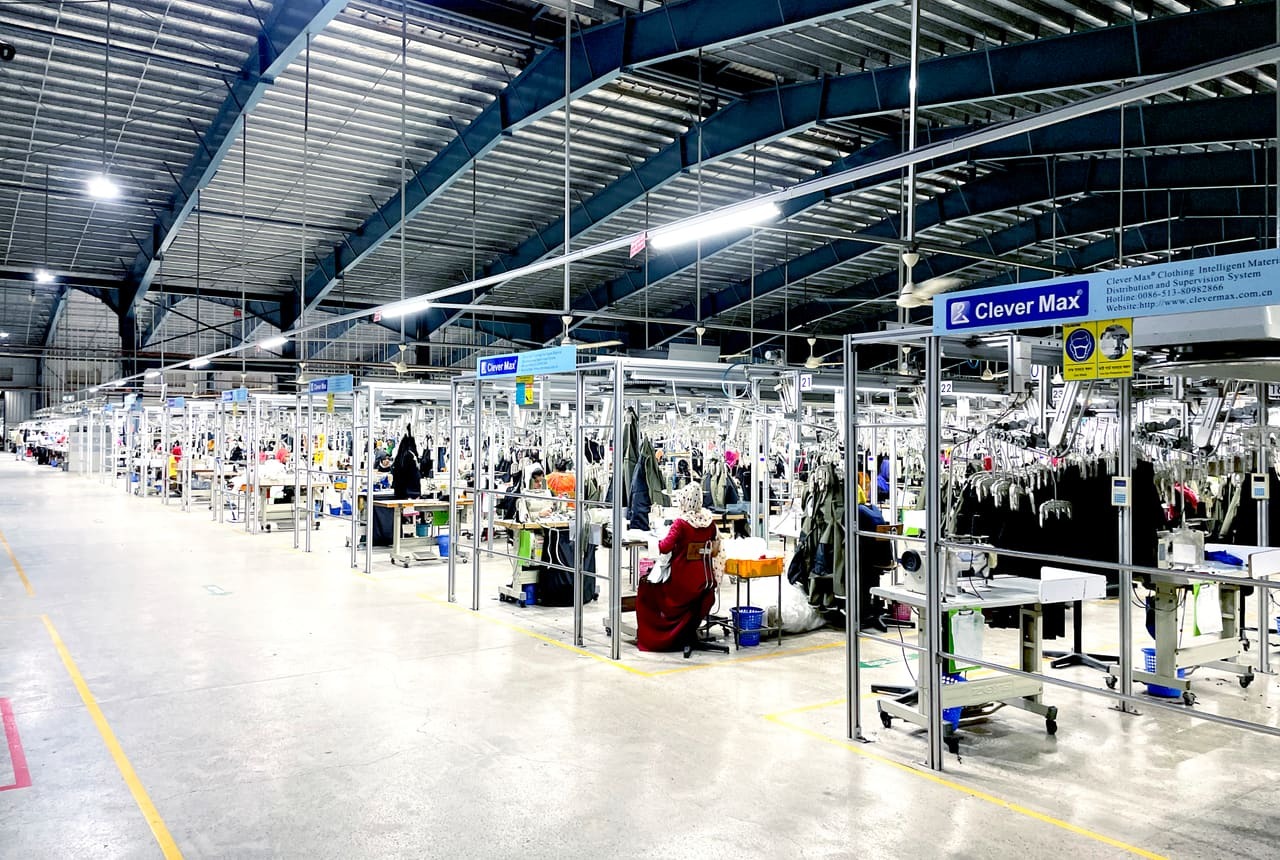
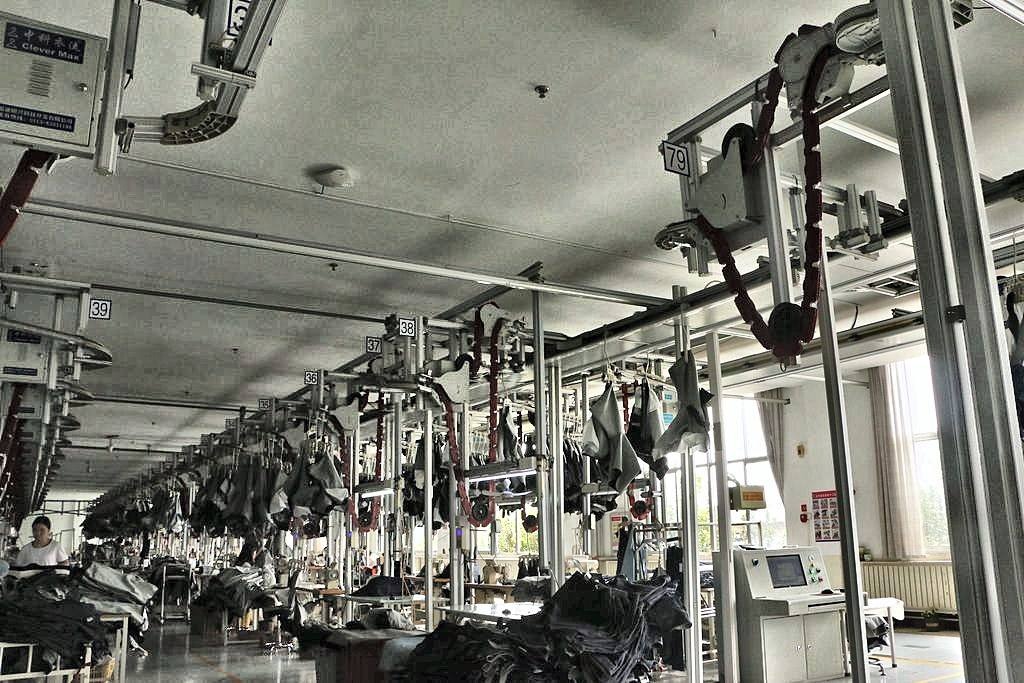
The CleverMax Hanger System uses heavy-payload hangers and reinforced rails to handle wet and dry denim work-in-progress. RFID tags survive wet processing — so every piece carries its wash, distress and finish specification all the way through. The CleverNode Cutting System on the upstream side handles heavy denim cutting and wash-affected pattern pairing, so the matched front-back-pocket grouping is held in the control software from the cutting table onward.
Live data across wash, dry and finish stations means supervisors can rebalance operators when output mix changes — for example, when a heavily distressed dark-wash run replaces a clean light-wash run. The CleverMax Intelligent Warehousing System on the despatch side consolidates the finished jeans into the correct mixed-wash customer carton, so the customer receives a single shipment per work order.
What's inside the deployment


On the Production Floor


Production process with CleverMax
How a typical work order flows from fabric receipt through to finished-goods despatch on this subcategory's line.
- 01
Heavy denim cutting: the CleverNode Cutting System spreads heavy denim and cuts each panel against the parent work order, with wash-affected pattern matching pairing front, back and pocket pieces.
- 02
Sewing and pocket attachment: hangers carry the matched panels through the sewing stations, with the work-order specification (wash recipe, distress level, finish type) visible at every operator screen.
- 03
Wet processing (wash and distress): the hanger system feeds prepared jeans into the wash machine and picks them back up on the drying-output side, with wash-survivable RFID tags maintaining work-order linkage.
- 04
Drying, hardware attachment and finished-edge stitching: finished jeans route through drying, then to hardware stations (rivets, buttons, snaps) and finished-edge stitching for the customer specification.
- 05
Pack and despatch: the warehousing system consolidates mixed-wash finished jeans into the correct customer carton, with the per-shipment audit log generated for retail customers that require it.
Reference customers
Why CleverMax for this line
Denim manufacturing rewards control software that handles the wet-dry boundary as a first-class concept. Wash, distress and finish operations sit between the sewing line and the hardware-attachment line, and they introduce a layer of physical complexity that no other apparel subcategory has. The CleverMax Hanger System uses wash-survivable RFID tagging to maintain work-order linkage across that boundary, which is the change that lets a denim factory run a mixed wash queue at full line speed.
Wash-affected pattern matching is the second meaningful gain. A pair of jeans with mismatched front-back distressing is a customer-facing defect that the wash operator cannot easily detect at the moment of distressing, because the visual pattern depends on the dry. The CleverMax Hanger System holds the matched front-back pairing in the control layer from the cutting table onward, so the wash recipe is applied to a known-matched pair rather than to an arbitrary pair of pieces.
Hardware-attachment is usually the slowest single station on a denim line, and the hanger system's smoothed upstream feed materially improves utilisation on that station. Customers running this configuration generally see hardware-station utilisation move favourably within the first quarter, which combined with the wet-dry rebalance produces the throughput gain that denim manufacturers initially target the platform for.
Frequently asked questions
Can the RFID tags survive wet wash processes?
Yes. We specify wash-survivable RFID tags for denim deployments. Each piece keeps its tag through wash, dry and finish — so the work order stays linked end-to-end.
Does the hanger system feed into wash machines directly?
It feeds the loading bay for wash machines and picks pieces back up at the drying-output side. The wash machine itself is unchanged; the hanger system manages the routing around it.
Can we run a mix of dark and light washes on the same line?
Yes. Per-piece routing means each work order can have its own wash, distress and finish profile. The line runs the mix back-to-back without manual coordination.
Plan your line
Share your SKU mix, station count, and current bottlenecks. Our engineering team will draft a hanger system concept tuned to your factory floor.