


Hanger System for Curtains
Curtains have an unusual problem: each panel is long, drapes awkwardly, and rarely matches the next order in width or length. The CleverMax Hanger System is configured for long-panel curtain routing — clean handoffs between hemming, header-tape sewing, finishing, and packing.
Where production lines lose time
Challenge
Curtain panels tend to be long, often patterned and frequently produced in mixed-width orders. Manual transport between hemming, header-tape and finishing stations tends to crease the panel or, on patterned fabric, disturb the pattern match. Panel-matching errors typically show up at packing or, worse, at the customer.
Curtain orders often change mid-shift — a residential order of standard-width drapery panels can be followed by an oversized commercial order with a completely different header-tape specification. On a paper-routed line that changeover tends to be the slowest part of the day, because operators have to re-read the order spec for every panel.
CleverMax approach
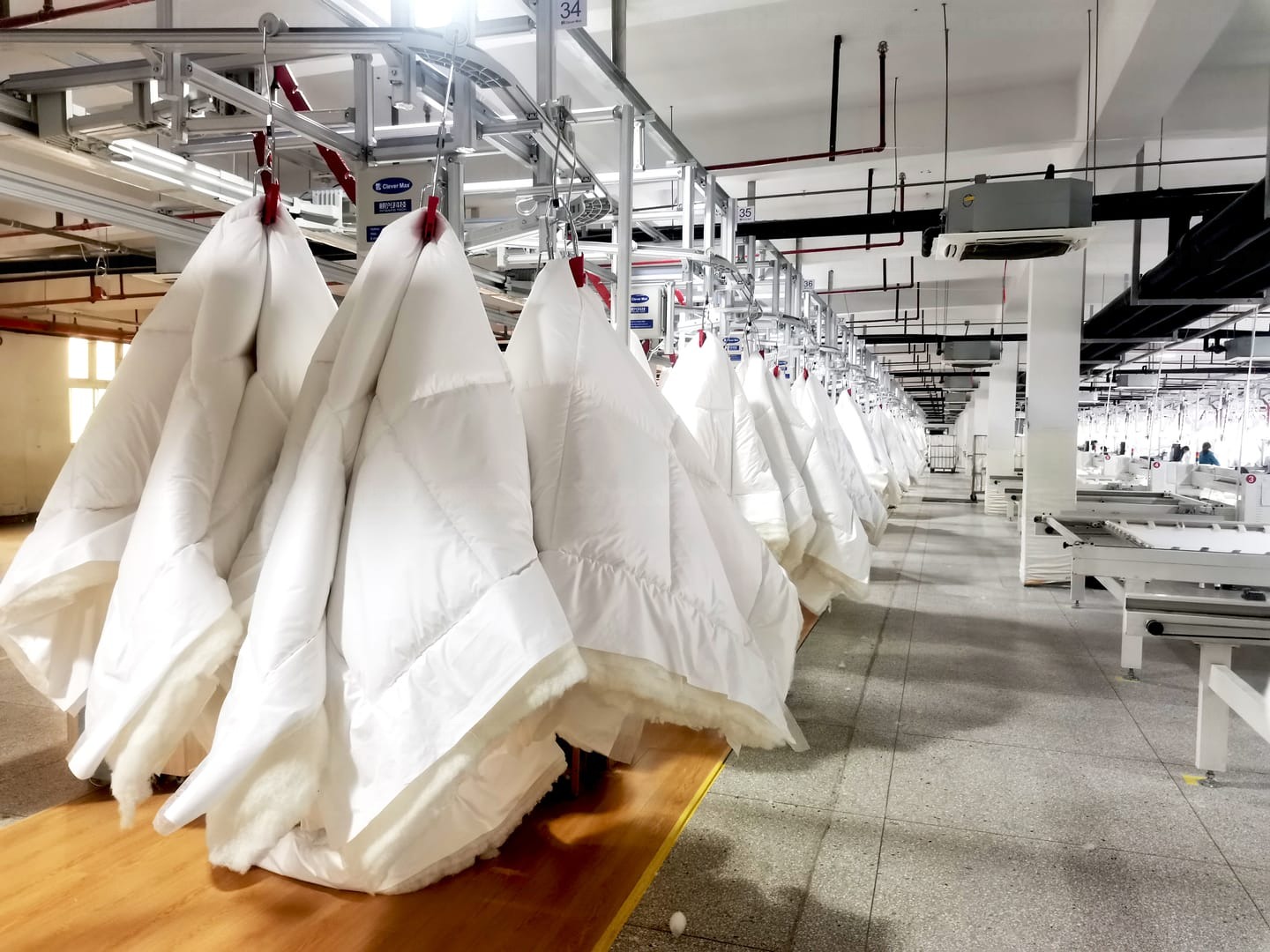
The CleverMax Hanger System carries each curtain panel on a long-format hanger sized to the panel length. RFID tags bind every panel to its work order — including dimensions, fabric SKU, header-tape spec, customer and pattern match target — so the hardware-attachment station applies the correct header tape automatically for that panel rather than for the previous one. The CleverNode Cutting System on the upstream side handles pattern-matched cuts for the curtain panels and pairs them on the cutting table so the matched set stays together.
Live station data tells supervisors which station is the bottleneck for the current SKU mix, so they can rebalance operators in real time — keeping hemming, header-tape, finishing and packing in sync. The CleverMax Intelligent Warehousing System consolidates the panels of a multi-window order into the correct outer carton for the customer, even when individual panels finished the line at different points in the shift.
Heavyweight & Lightweight Curtain Production Lines
Heavyweight Curtains — Hanger System Line
Heavy fabric, dual-hook loads, and multiple operator stations — the CleverMax hanger system keeps drape-length curtains moving at a steady cycle.


Lightweight Curtains — Hanger System Line
Light fabric, fast changeover, small-lot color mixes — the CleverMax hanger system shrinks changeover time while keeping per-piece traceability.


Production process with CleverMax
How a typical work order flows from fabric receipt through to finished-goods despatch on this subcategory's line.
- 01
Fabric receipt and pattern check: roll-stock and pattern-matched cuts are logged into the planning system with width, pattern and customer-spec data.
- 02
Cutting room: the CleverNode Cutting System spreads and cuts each curtain panel against the parent work order, with pattern-match pairing for multi-panel windows.
- 03
Hemming and panel matching: hangers carry each panel through side hemming and bottom-hemming stations, with the matched-panel grouping visible at every operator screen.
- 04
Header tape and hardware attachment: each panel routes to the correct header-tape specification (pinch-pleat, grommet, rod-pocket) and hardware-attachment station for its customer order.
- 05
Pack and despatch: panels are folded with their matched set, packed and consolidated by the warehousing system into the correct customer carton.
What's inside the deployment
- Long-format hangers sized for curtain panel length.
- RFID-tracked routing tied to fabric, dimensions, and customer order.
- Real-time line balancing across hemming, header-tape, finishing, and packing.
- Compatible with mid-shift order-mix changes without re-paperwork.
Why CleverMax for this line
Curtain manufacturing rewards control software that understands the panel-matching problem. A two-panel window has to ship as a matched set, and a four-panel slider order has to ship as four matched panels — and any drift between those panels becomes a customer-facing defect at installation. The CleverMax Hanger System holds the matched-set grouping in the control layer from the cutting table onward, which is the change that has let curtain manufacturers move toward full mixed-width production without the historical penalty.
Mid-shift order-mix changes also become much less painful. Because the routing and the header-tape specification are bound to each panel rather than read from a paper card, an operator at the header-tape station does not have to context-switch when the next panel belongs to a different customer. The panel arrives at their station with the correct specification already loaded onto the operator screen.
Long-panel handling is the third gain. Long-format hangers sized to the panel length keep the panel hanging cleanly between stations, which removes the manual unfolding and refolding step that used to disturb pattern alignment. Customers running this configuration generally see panel-match defects drop into a measurably lower band within the first few months.
Frequently asked questions
Can the hanger system handle very long curtain panels?
Yes. Hangers and rail geometry are sized during engineering against the longest panel in the customer's product mix. We've shipped configurations covering both standard residential and oversized commercial drape lengths.
How does the hanger system handle width and SKU variation per order?
Each curtain panel hangs on a tagged hanger that carries its dimensions, fabric SKU and customer in RFID. The control software routes per-panel rather than per-batch, so a single line can run mixed-width orders back-to-back.
Does this replace our existing sewing operators?
No. The hanger system handles the routing between stations; your sewing operators still run hemming, header-tape and finishing. What changes is the operators stop carrying panels by hand — work comes to them.
Plan your line
Share your SKU mix, station count, and current bottlenecks. Our engineering team will draft a hanger system concept tuned to your factory floor.