

Hanger System for Towels & Fitted Sheets
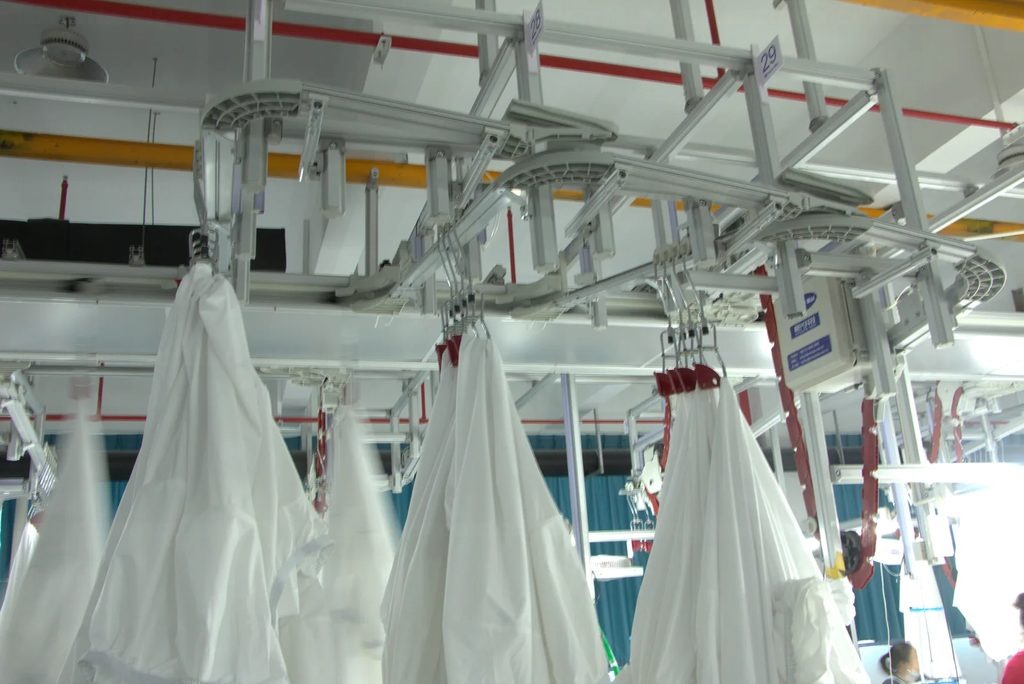
Towels and fitted sheets are short-cycle products with very high throughput — finishing, edge-binding and label sewing all run at speed. The CleverMax Hanger System is configured for high-throughput finishing flow, with clean hand-off into automated packing and display-set consolidation.
Where production lines lose time
Challenge
Towel finishing lines typically run faster than the downstream packing line can absorb. Looping, cutting, edge-binding and label sewing all complete in seconds, so finished pieces tend to stack up between the finishing operation and the packing operation. SKU sorts between bath, hand and face towel sizes, or between queen and king fitted-sheet sizes, usually become the slowest part of the shift.
Quality inspection on a high-speed finishing line is often the largest single weakness. Defects in loop pile, edge stitch or label position tend to flow through the line before they are caught, and end-of-line inspection is expensive both in operator time and in rework cost. Display-set packing (e.g. a three-piece bath set) tends to be performed manually, which adds another bottleneck downstream of the finishing line.
CleverMax approach
The CleverMax Hanger System buffers finished towels and sheets between finishing and packing, smoothing the throughput mismatch. Each piece is tagged by SKU at the looping or cutting station, so the line packs queen-size and king-size fitted sheets, or bath and hand towels, without manual sorting at the packing line. The CleverNode Cutting System on the upstream side handles looping/cutting and large-piece spreading for the fitted-sheet shells against the same work-order ID.
Inline inspection stations sit on the hanger system flow — defects are flagged before the piece reaches packing, with the work-order ID linked back to the operator and station where the defect occurred. The CleverMax Intelligent Warehousing System consolidates packing-ready pieces into the correct display-set carton for retail customers automatically.
What's inside the deployment

Production process with CleverMax
How a typical work order flows from fabric receipt through to finished-goods despatch on this subcategory's line.
- 01
Looping or cutting: large rolls or panels feed the looping or cutting station, with RFID labels applied to each piece against the parent work order.
- 02
Edge binding: each piece routes through the appropriate edge-binding station for its SKU (bath, hand, face for towels; queen, king for fitted sheets).
- 03
Label and care-tag sewing: a multi-position label-sewing station applies the correct care tag and brand label for the customer order.
- 04
Inline inspection: a visual inspection station flags loop, stitch and label defects against operator ID and routes defects to a rework lane.
- 05
Display-set pack and despatch: the warehousing system consolidates finished pieces into the correct display-set carton (e.g. three-piece bath set, queen/king fitted-sheet pair) for the customer.

Why CleverMax for this line
Towel and fitted-sheet manufacturing rewards control software that absorbs the throughput mismatch between finishing and packing. The CleverMax Hanger System acts as a buffered overhead routing layer between the two operations, so the finishing line runs at its natural cadence and the packing line runs at its natural cadence without forcing either to throttle to match. The net effect is usually a noticeable lift in finishing-line utilisation within the first month.
Inline inspection moves quality detection from end-of-line back into the line itself. A defect caught at the edge-binding station is many times cheaper to rework than a defect caught at the packing station, because the piece has not yet absorbed the label-sewing and quality-check operations downstream. Customers running this configuration generally see end-of-line rework rates fall into a measurably lower band over the first season.
Display-set consolidation is the third gain. Retail customers increasingly want pieces packed into ready-to-shelf display sets rather than into bulk cartons, and manual consolidation of those sets is one of the most error-prone parts of the downstream operation. The CleverMax Intelligent Warehousing System handles this consolidation against the work-order ID, so the warehouse becomes a continuation of the line rather than a separate operation.
Frequently asked questions
Can the hanger system keep up with our finishing-line speed?
Yes. The hanger system is sized to match the customer's peak finishing throughput during engineering, with buffer capacity to absorb upstream-downstream mismatches.
Does it integrate with our packing automation?
Yes. The hanger system hands finished pieces off to the packing line in SKU-sorted order, eliminating manual re-sort. We integrate at the work-order layer, so packing knows exactly what order is arriving next.
How does inline inspection work?
Inspection stations sit directly on the hanger system flow. Operators (or vision systems) flag defects against the RFID tag on the hanger, which links back to the work order and the upstream operator. Defective pieces route to a rework lane rather than continuing to packing.
Plan your line
Share your SKU mix, station count, and current bottlenecks. Our engineering team will draft a hanger system concept tuned to your factory floor.