

Volume up 9%, unit price down 10%: where apparel factory margins went
Same workshop, same people, nearly a tenth more work through it this year, and no more money at the end of it. China apparel exports reached 33.01 billion USD in Q1 2025, down 1.9% year on year, with woven garment export volume up 9.2% while unit price fell 10.3%. The gap means the same profit now requires more pieces, and production efficiency becomes the only variable left.
One set of figures in the Q1 2025 apparel export data deserves the attention of anyone running a factory.
Apparel exports totalled 33.01 billion USD, down 1.9% year on year.
A fall of 1.9% is not in itself remarkable. What matters is what happens when the figure is split into volume and unit price.
Volume up, price down
In the same quarter:
Woven garments: export volume up 9.2%, unit price down 10.3%.
Knitted garments: export volume up 9.5%, unit price down 11.2%.
Two categories moving the same way. Close to a tenth more work passing through, at more than a tenth less per piece.
This is not a shortage of orders. The orders are there, and there are more of them than a year ago. What has been squeezed is the price of each one.
What the gap looks like on a factory floor
If unit price drops a tenth and the cost structure stays where it is, a substantial part of the margin goes with it. Holding absolute profit steady then leaves two options.
Make more pieces. Except that capacity has a ceiling. The same floor and the same people are already stretched by the extra tenth that came through this quarter, and going further means more staff, more overtime and more space, which puts cost back up.
Reduce the cost of each piece. How much room this leaves depends on where the cost sits.
In garment manufacturing, fabric and trim track the market and are largely fixed. Labour is fixed too, and rising. The component with real give in it is efficiency, which is to say how many pieces the same people and the same machines turn out in a day.
Where the slack in efficiency hides
On a garment floor, the time actually spent sewing is only a portion of the time a piece spends on the line. The rest goes four ways.
Waiting, because the operation upstream has not finished and the station has nothing to work on.
Carrying, because work in progress moves between stations in somebody's arms, on a trolley, or via a pile in between.
Hunting, because when a style changes or pieces need replacing or reworking, finding that batch means somebody going through the floor to look for it.
Counting, because daily progress, completed quantities per operation and the work-in-progress total all rest on paper tickets and stocktakes.
None of the four adds value to a garment, and all four consume time and people. Which makes them precisely the cost that can be recovered when unit price falls.
What a hanger system is actually squeezing
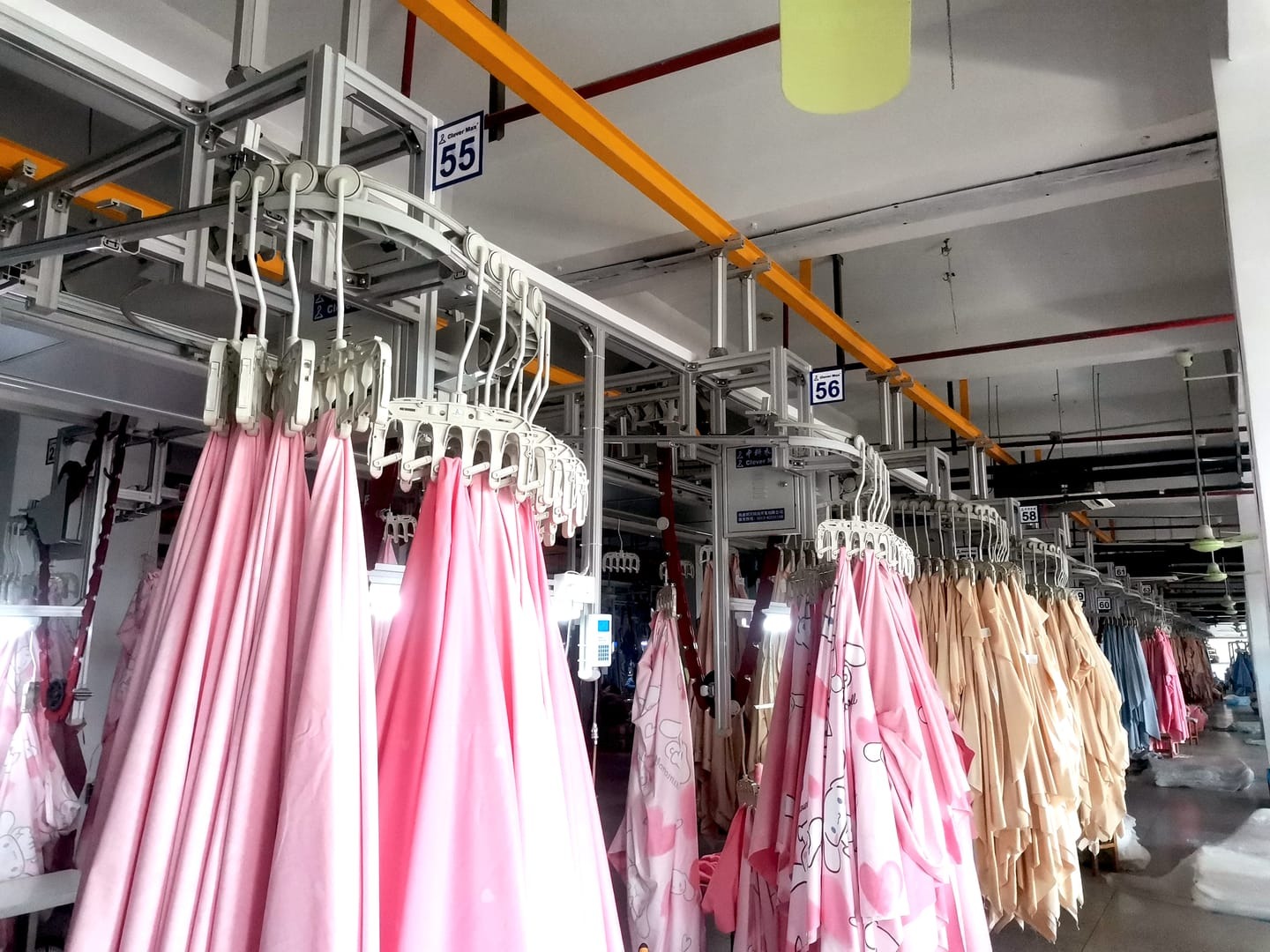
The CleverMax hanger system addresses all four together.
Waiting and carrying go first. Work in progress hangs on a carrier and the system routes it to the next station according to the process path, so nothing is carried by hand, nothing accumulates in between, and the wait between stations compresses to whatever the system's routing allows.
Hunting and counting go with RFID, the technology behind which came out of the research partnership established with the Institute of Software at the Chinese Academy of Sciences in 2005. A tag sits on the carrier and a reader sits at the entrance to each station, so a carrier passing through is read automatically. Where any piece of work in progress is, and how long it has been there, is known to the system throughout, with nothing keyed in by anyone.
The industry ran on barcodes for years, and a barcode has to be scanned by a person, so a missed scan breaks the chain. RFID settles automatic identification, live tracking and the management of several styles running merged all at once.
Captured data then has to reach the people who schedule, which is what the YunDao cloud manufacturing MES platform does. Which station is backing up, which style has fallen behind, how tomorrow should be laid out: all of it becomes a figure that can be looked up rather than a judgement call based on experience.
Act now, or wait for prices to recover
Whether unit prices return to where they were is not something anyone can promise. Volume rising 9% while price falls 10% says plainly enough that the pricing power does not sit with the producer. What sits with the producer is the other side of the equation.
Waiting for prices to recover is one choice and reducing the cost per piece is another. The difference is not that one is safer. It is that the second is the one a factory decides for itself.
There is a lag to account for, though. A retrofit runs through proposal, procurement, installation and commissioning, then the time people need to adapt, then the ramp back up to full output, which usually comes to several months. Since production cannot stop in peak season, the work in practice has to start in a quiet one. The gap between deciding and seeing the result is wider than one quarter.
Which means that a factory waiting for a recovery that does not arrive loses more than the margin on those quarters. It also loses the months it would have taken to act. The first quarter after prices are squeezed is the one with the most time in it.
So the calculation is worth doing now rather than after the next set of customs figures. It is not a complicated one. Count the hours the floor spends each day on waiting, carrying, hunting and counting, multiply by the cost of labour, and see what proportion of the cost of a piece that comes to. If the proportion turns out to be larger than the tenth that came off the price, then whether prices recover has stopped being the most important question on the table.
Sources
Every factual claim above traces to one of the following. Where a source is offline — a certificate, a printed publication — we name it without a link.
- [1] 中国纺织报《一季度我国服装出口330.1亿美元》 2025-05-14 (offline source) accessed 2026-08-27 · Trade press