
Mingxing Tech

News & Insights

What we see on apparel and home textile factory floors: what changed at a customer's plant, where the industry is heading, and how hanger systems actually work.

Filter articles
Topic

33 articles

  1. Industry

    Hanger systems are turning from optional into necessary

    A listed competitor has filed its audited 2025 report: hanger-system revenue of 215 million yuan, up 22.05%, at a gross margin of 35.69%, an improvement of 6.23 points. Buying share with low prices lifts revenue and pulls margin down behind it. These two went up together. Two further sets of figures cover overseas margin and Southeast Asian demand.
  2. Company

    Four CISMA shows on, what visitors ask at the CleverMax stand has changed

    CleverMax appears in the official CISMA exhibitor directory for 2017, 2019, 2023 and 2025. The stand moved from Hall E1 to Hall E2, and what stands on it is still a hanger system. The real signal is in the first thing visitors say. It used to be "what does a line like this cost". Now it is "my floor is chaos, will putting it on a rail sort that out".

  3. Industry

    6.85 million industrial sewing machines in 2024, up 22.32%: an equipment renewal wave already under way

    China produced 6.85 million industrial sewing machines in 2024, up 22.32% year on year, while sector leader Jack reported revenue of 6.094 billion yuan, up 15.11%, against net profit of 812 million yuan, up 50.86%. Output up a fifth and profit up a half do not line up, and the gap says factories are buying more and buying better. What most of them then hit is the same wall.

  4. Industry

    Volume up 9%, unit price down 10%: where apparel factory margins went

    Same workshop, same people, nearly a tenth more work through it this year, and no more money at the end of it. China apparel exports reached 33.01 billion USD in Q1 2025, down 1.9% year on year, with woven garment export volume up 9.2% while unit price fell 10.3%. The gap means the same profit now requires more pieces, and production efficiency becomes the only variable left.

  5. Industry

    Sewing equipment exports up 28.87% in Q1: Southeast Asia is building factories, China is supplying them

    China exported 935 million USD of sewing machinery in Q1 2025, up 28.87% year on year, in the same quarter apparel exports fell 1.9%. Vietnam grew 62.32%, India 46.36%, Pakistan 52.08%, and Belt and Road markets took 73.06% of the total. Overseas capacity is expanding, the equipment it needs comes from China, and what advantage remains for factories in China is not in the machinery.

  6. Technical

    CleverMax releases its ERP project management system: when delivery slips, the workshop is usually not the reason

    When a batch misses its date, the instinct is to go and look at the workshop, where there is usually nothing to see. In 2025 CleverMax released an ERP project management system, connecting YunDao MES production orders to ERP. Progress on the floor has been transparent for years, while what happens between an order arriving and it reaching the line was still living in spreadsheets and chat groups, and no amount of line speed makes up for it.

  7. Policy

    MIIT replies to an NPC proposal: accelerate intelligent textile equipment, keep supporting smart factories

    In its reply to Proposal No. 8998 of the second session of the 14th National People's Congress, MIIT gives a full section to accelerating the intelligent upgrading of textile equipment. The four programmes it lists have already been run, which means each has an administering body, a published list of participants and a door that can be knocked on. Across all four, one role recurs, and the term rules out suppliers who sell single machines.

  8. Technical

    The screen at the workstation: the CleverMax industrial pad joins the hanger system and data finally runs both ways

    In 2024 the CleverMax industrial pad was connected to the hanger system at four kinds of station: preparation, processing, in-line inspection and completion. It reads like a hardware swap, and what it fixes is a direction problem. The system had been reading the stations for years while no station could read the system, so a schedule still reached the floor by somebody walking over and explaining it.

  9. Policy

    Two ministries, one notice: renew ageing equipment and take smart manufacturing into the parks

    The General Offices of MIIT and the Ministry of Commerce have made the renewal of ageing equipment and the raising of enterprise digitalisation the first of five work tasks in the 2024 textile and apparel campaign. Because the task sits under a digital-textiles heading, what gets assessed is not how many machines were replaced but whether the data got connected. In that frame an unconnected new machine counts as the old one.

  10. Policy

    A national target with teeth: 70% of large textile firms digital and networked by 2025

    Four ministries have set a target: by 2025, 70% of large textile enterprises are to be substantially digital and networked. The threshold for "large" is annual main business revenue above 20 million yuan, low enough that an apparel plant of two or three hundred people is on the list. This is not a bonus for the leaders. It is a pass mark that seven in every ten firms are expected to clear.

  11. Industry

    "70% of large manufacturers substantially digital and networked": a 2025 target that starts being answered in 2022

    A workshop that still learns yesterday output from paper tickets collated the next morning does not, by the official 2025 standard, count as digital. The Smart Manufacturing Development Plan for the 14th Five-Year Period, issued jointly by eight ministries, sets the hard targets: by 2025, 70% of large manufacturers substantially digital and networked, over 500 smart demonstration factories built, and over 150 system solution providers cultivated.

  12. Company

    China National Garment Association award: CleverMax brings the 300-operation made-to-measure suit onto an automated line

    On 28 July 2021 the China National Garment Association gave its Recommended Project prize for outstanding new technology to the IoT-based made-to-measure suit system, certificate J202107-KJS00571. Suits are the hardest thing in discrete manufacturing, and the project was approved over near-unanimous internal opposition. The same year CleverMax launched its sixth-generation heavy-duty hanger system, rated above 20kg per carrier.

  13. Industry

    A competitor named CleverMax in its Shanghai Stock Exchange filing: this market has only a handful of players

    The hardest part of buying a hanger system is not comparing specifications but finding a reference point you can trust. On 27 May 2020, Zhejiang Sunrise named CleverMax alongside Sweden ETON and Zhejiang Yina as the sector principal competitors, in a filing answering the Shanghai Stock Exchange. Its weight comes from who wrote it and who read it: a competitor, answering a regulator, on the record.

  14. Industry

    International research: handling takes 80% of apparel production time, and 79% of that handling is still done by hand

    Nobody on a garment floor can say how much of a shift an operator actually spends at the machine. A study from the Wilson College of Textiles at NC State University, written around ITMA 2019, puts the figure at about 80% of overall production time going into handling, with roughly 80% of factory cost tied to it, while in the plants surveyed 79% of assembly handling was still done by hand, not one plant was fully automatic, and only 21% of companies had even semi-automatic systems. An average across plants is not a reading of any particular floor, which is why this piece is about how to take that reading yourself.

  15. Policy

    Garment plants stopped putting up buildings that year and spent the money on the lines inside

    Fixed-asset investment in Chinese apparel fell 1.5% in 2018, while value added in textile machinery rose 9.5% the same year. One shrinking, one growing, and the apparent contradiction says one thing: the money was not going into new buildings. It was going into equipment inside the plants that already existed. A national demonstration list published that autumn confirmed it.

  16. Company

    The fifth generation: dozens of orders on one line, no tangle, no stoppage, no reliance on a supervisor's memory

    CleverMax released its fifth-generation flexible hanger line in 2017 and exhibited at CISMA the same year. The first four generations had settled whether a piece moves by itself, whether the data exists and whether heavier goods stay on the rail. The fifth faced tangle instead, with a style down to a few hundred pieces or a few dozen, dozens of orders live on one line at once, and every style running a different route. The constraint was no longer capacity but scheduling.

  17. Company

    Garments spend more time off the line than on it: in 2016 CleverMax took that time back

    In 2016 the CleverMax home-textile hanger system earned High-Tech Product certification under certificate 160611G0224N, and the same year the intelligent warehousing and overhead storage lines came to market. The second closes the break at the end of the line, where a piece that was a live record while it hung on the rail turns back into a pile somebody has to search the moment it touches the floor, taking a whole line of accumulated data with it.

  18. Technical

    Two people carrying one duvet a dozen metres: the trip a hanger line removes

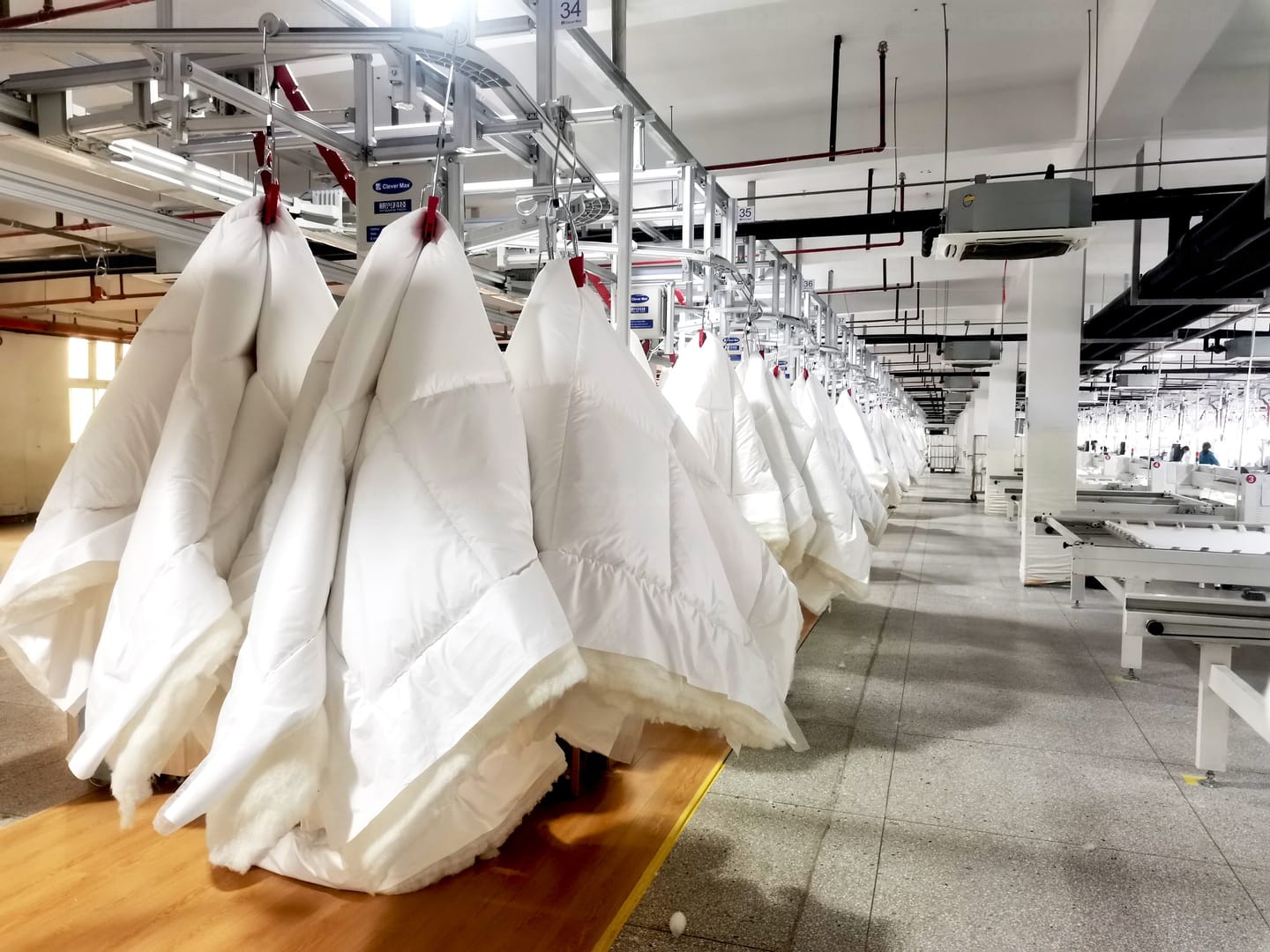
    In 2015 China Home Textile Brand Network reported on the CleverMax home-textile material-distribution and monitoring system. A duvet can weigh more than ten times what a shirt weighs, and every load-bearing number in an apparel hanger system is derived from the weight of apparel, so the whole carrying structure had to be rebuilt. The weight is also why the payback in home textiles arrives faster than in apparel.

  19. Company

    After four generations, the CleverMax apparel hanger system passes High-Tech Product certification

    In 2014 the CleverMax apparel hanger system passed High-Tech Product certification under certificate 140611G0341N, a review concerned less with how a product sells than with who settled its technical approach. Across the eleven years from the first generation to the fourth, each generation took on the half of the problem its predecessor had left standing, while the data backbone all four share came out of a partnership with the CAS Institute of Software that began in 2005.

  20. Policy

    A national plan names computer-controlled automatic hanger systems: the 2012 Textile Industry Five-Year Plan and what it meant for CleverMax

    In January 2012 China's Ministry of Industry and Information Technology issued the Textile Industry Five-Year Plan. Its technology list for apparel names computer-controlled automatic hanger systems (FMS) outright. The same document admits that labour shortage among eastern garment firms had become pronounced. That same year CleverMax filed two invention patents on production-line control.

  21. Policy

    2010, the year garment factories found that hiring more people no longer worked

    In 2010 average annual pay at urban private employers in China rose 14.1%, with the rate of increase 7.5 points higher than the year before. That October the State Council issued its Opinions on Strengthening Vocational Training to Promote Employment, placing the answer in skills and industrial upgrading. For garment factories, this was the year that adding headcount stopped adding up.

  22. Technical

    The tag goes on the carrier, not on the garment: one choice that held for twenty years

    A garment keeps leaving the rail. It comes off to be turned, goes away for rework, gets packed when it is done. Put the tag on the garment and the data chain breaks the moment it leaves. The carrier never leaves, because it is part of the line itself. That small-looking distinction decides whether a tracking system stays reliable for years, and it is the critical step in the patent granted in 2009.

  23. Company

    The fourth generation moves into home textiles: one duvet invalidates every number on the line

    The home-textile plants around Dieshiqiao kept asking whether the system could carry a duvet. It could, but a shirt weighs a couple of hundred grams and a winter duvet four or five kilos, so the steel section of the rail, the way a carrier grips, the envelope a piece sweeps through on a bend and the number of pieces a stretch of rail can hold were all numbers that had been settled on an apparel line and none of them survived the move. The fourth generation was drawn from scratch around the heavier material.

  24. Technical

    The 2006 filing: put the tag on the carrier, and a product line stands on it for twenty years

    "A monitoring method and system for intelligent material distribution" was filed in May 2006, patent number ZL200610011949.7. It was the first result of CleverMax's work with the Institute of Software at the Chinese Academy of Sciences, and the technical starting point for the twenty years of product that followed. What it replaced was the paper ticket garment factories had used for decades.

  25. Company

    In 2005 CleverMax brought the Chinese Academy of Sciences onto the garment floor

    In 2005 CleverMax signed a long-term partnership with the CAS Institute of Software and Institute of Automation. It sounded like an odd pairing at the time, until you notice that the hard part of a hanger system was never the rail or the carriers but making a production line aware of what it is doing, which is a real-time systems problem and not a mechanical one. That agreement set the technical direction CleverMax has followed for the next twenty years.

  26. Company

    The architecture of the first hanger system was set by people who ran a garment factory

    When a carrier stops a few centimetres beyond where an operator's hand falls, she takes the garments down and keeps them within reach, the hanger system runs empty overhead, and output is what it was before the line arrived. What consumes capacity is never the sewing, but the carrying, waiting, hunting and counting in between. The routing logic in CleverMax's first-generation hanger system was established one parameter at a time on the founders' own production line, after ten years of running a garment factory.