

2019: CleverMax closes the whole-plant data loop with CleverNode cutting capture and intelligent sorting
A hanger line runs sewing well, but cutting and sorting were still reconciled by hand. In 2019 CleverMax delivered the CleverNode cutting-data system and an intelligent sorting system, joining cutting table to dispatch in one unbroken data chain. Nantong Daily reported customer results of roughly 70% fewer management staff and roughly 90% fewer material handlers.
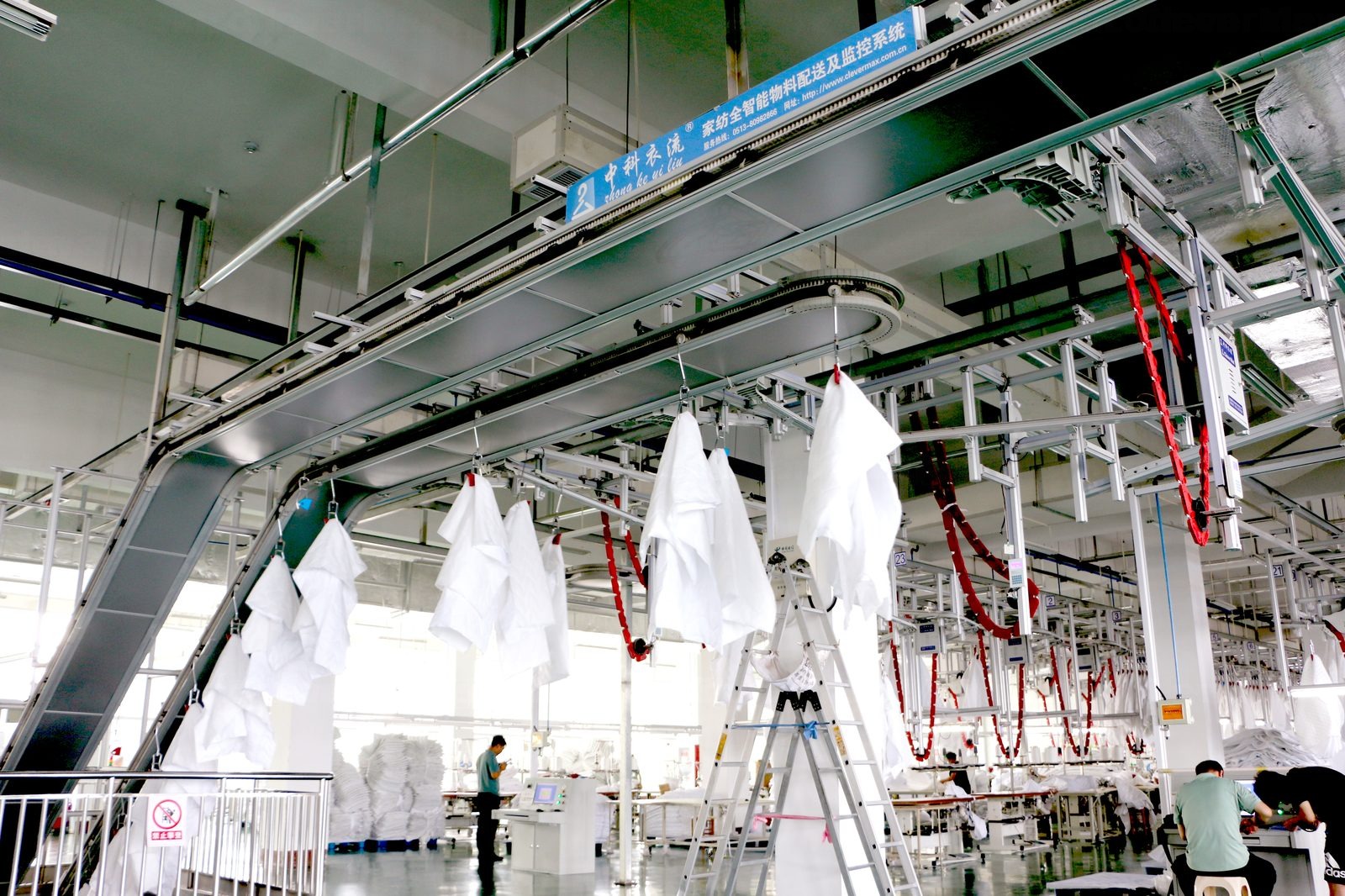
In 2019 CleverMax delivered the CleverNode cutting-data capture system and an intelligent sorting system, which between them meant that every step a garment took, from the moment it was cut on the table to the moment it went into a carton, left a record behind it. What CleverMax sold from that year on was accordingly no longer a production line but a plant that could account for itself.
Automating sewing alone is half a job
Factories that have put in a hanger line often describe the same odd feeling. Sewing has genuinely been transformed, in the sense that the system can say where any piece is and how long it has been standing, and yet the books at month end are as much of a muddle as they ever were.
The muddle lives in the part of the plant a hanger system never touched. It covers sewing, and sewing occupies only the middle stretch of a garment's life. Before the line the garment is a stack of cut pieces on a cutting table, and after it comes off, it still has to be sorted, matched by size, packed and shipped, both of which ends were still being run in 2019 on people, paperwork and stock counts that stopped the floor.
A digital middle between two paper ends is a data chain with a break in it, and once it is broken the sewing data, however good, can only be looked at rather than scheduled against, because a scheduler wanting to know how much work the plant is holding still has to walk over and ask the cutting-room and sorting supervisors. That is the underlying reason so many plants finish an automation project feeling that not much came of it.
The cutting end: a bundle on the wrong line, found a dozen operations later
Spreading, cutting, bundling and numbering leave the cutting room with a pile of tied bundles, and loading them onto the hanger line requires somebody to match each bundle to an order and a style.
The matching is done against paperwork, by eye. That it is slow matters less than that it can be wrong, because a bundle loaded onto the wrong line travels perfectly happily and is often only caught a dozen operations later at the size-matching table. By then what needs redoing is not just the bundle. Line takt has been spent on the wrong work, the orders queued behind it have been pushed back, and a delivery date has moved with them.
CleverNode moves that matching upstream to the table itself. Which lay was spread, which pieces came off it, and which order and size they belong to all go into the system at the cutting table and travel with the pieces onto the line, so the system already knows what a bundle is when it arrives and nobody needs to check it against a docket. A step that no longer exists no longer generates the error that belonged to it.
The sorting end: single-piece flow on the line, a pile at the end of it
Sewing finishes with the pieces of a single order scattered the length of the line. Conventionally they are heaped in one place and then picked out again, order by order, size by size, colour by colour, by hand.
That is slow as well as labour-heavy, and it undoes part of what the line was bought for. Single-piece flow, paid for at some expense, reverts at the last station into a mountain of work in progress, and everything waiting behind that mountain can only start at the rate people can pick through it. Hand picking also gets things wrong in three recognisable ways, wrong sizes, short shipments and orders crossed, none of which surfaces until the goods are with the customer.
The intelligent sorting system takes that stage over. What each piece is, which order it belongs to, its size and its colour have all been held in the record since the cutting table, so sorting follows the record rather than somebody's eyes, and those three failure modes come uncoupled from how the sorter happens to be feeling that day.
The plant's numbers finally reconcile
With both ends connected, the record runs unbroken from cutting table to dispatch.
Its usefulness is not any single efficiency figure but that the plant's numbers reconcile: fabric in against pieces out, where the loss occurred, which order is short, which operation the rework concentrates on. Answering any of those used to require halting for a stock count that ran for days and began going stale as soon as it was finished, which is why nobody did it more than a few times a year. The same questions are now answered from the system on request.
When Nantong Daily reported on CleverMax in 2022 it gave figures for what customers saw after installation: management headcount down around 70%, material-handling headcount down around 90%, production headcount down around 30%.
Material handling fell the furthest of the three, for the reason the two sections above describe. Most of the carrying in a garment plant happens not between sewing machines but between cutting, buffering, sorting and the warehouse. A hanger line on its own alters the stretch between the machines, whereas connecting cutting and sorting alters the stretches where the bulk of the carrying was, which is why that particular figure falls more steeply than the others.
The four wastes of a garment workshop are waiting, carrying, hunting and counting: waiting on the previous operation, carrying half-finished work in your arms, hunting the floor for a batch that has come back for rework, and adding up paper tickets to establish progress. None of the four produces anything. A hanger line deals with the waiting and the carrying, and bringing cutting and sorting in largely removes the other two, since a batch that needs finding can be located in the system and progress arrives as data instead of being computed from tickets.
From one line to one plant
Between the first generation in 2003 and 2019, CleverMax widened its product boundary three times.
First, material moved itself through sewing and operators stopped carrying work in their arms. Second, data produced itself and fed the YunDao cloud MES platform, so progress no longer had to be tallied from tickets. Third, in 2019, cutting and sorting joined the same dataset.
All three widenings extended the same chain, and by 2019 both of its ends were closed, which is when the whole-plant range took its present shape. A customer today can discuss a single line or the entire chain across cutting, sewing, hanger transport, intelligent storage, sorting and packing.
The break in the chain sits in a different place in every plant
Two plants can both have unconnected ends and still need to start in different places.
Where the break is at the cutting end, the symptom is wrong-order work and rework: a batch goes onto the wrong line, is caught a dozen operations later at size matching, and the whole batch goes back. Where the break is at the sorting end, the symptom is the overtime in the days before a shipment, with the line long finished while the pieces sit in the sorting area waiting to be picked and the delivery date held up at the last station.
Either symptom is something a floor manager lives with daily and can usually name without help, so deciding which end to connect first needs no study. It needs a recollection of which stretch gave way first during the last peak season. What connecting both ends is worth, on the other hand, only becomes visible on the day the plant can state its work in progress without stopping to count it.
Sources
Every factual claim above traces to one of the following. Where a source is offline — a certificate, a printed publication — we name it without a link.
- [1] 南通明兴科技开发有限公司 企业发展历程(公司资料) 2019 (offline source) accessed 2026-08-10 · Trade press
- [2] 南通日报《明兴科技:让传统产业插上"智慧翅膀"》A01 版(记者 陈静) 2022-06-12 accessed 2026-08-10