

Nantong inside a national advanced manufacturing cluster: the intelligent opportunity behind a 720 billion yuan target
Jiangsu issued a three-year action plan for the Suzhou-Wuxi-Nantong high-end textile cluster, targeting around 720 billion yuan of output by 2025 through 19 measures across four directions, one of which is intelligent upgrading. Nantong, where CleverMax is headquartered, is one of the cluster's three core cities.
On 21 December 2023 the Jiangsu Provincial Department of Industry and Information Technology issued the Three-Year Action Plan for Cultivating and Upgrading the Suzhou-Wuxi-Nantong High-End Textile National Advanced Manufacturing Cluster (2023-2025).
For textile manufacturers, three things in it are worth noting.
720 billion yuan: one cluster's output target
The plan states that by 2025 the Suzhou-Wuxi-Nantong high-end textile cluster will reach around 720 billion yuan in output from large enterprises.
A national advanced manufacturing cluster is the highest tier of industrial cluster recognised by MIIT and there are only so many of them nationwide, so the presence of this one on the list says something about where the region's textile industry stands in the country. The direction the plan sets for it is advancement toward world-class cluster status.
Behind an output target of that size sits pressure to upgrade. The 720 billion will not be reached by stacking on capacity, because neither land prices nor labour costs in the Yangtze delta support spreading out any further. The figure has to come from output per unit instead, through higher value-added products, better efficiency and lower unit cost, and the common answer to all three is intelligent production.
Nineteen measures, with intelligent upgrading one of four directions
The plan sets out 19 specific measures across four directions: high-end, intelligent, green and integrated development.
Intelligent upgrading standing as one of the four falls in line with national policy, since the Textile Industry Quality and Upgrading Implementation Plan (2023-2025), issued around the same time, targets 70% of large textile enterprises being substantially digital and networked by 2025.
The state sets the direction, Jiangsu sets the target, and what arrives at a company is a series of specific upgrading projects. Directions and targets can be written into a document. Production lines are converted one at a time.
Nantong: CleverMax's home ground
The plan's three core cities are Suzhou, Wuxi and Nantong, and CleverMax is headquartered in Nantong.
That is not a coincidence. Nantong is one of China's major home-textile production bases and the Dieshiqiao home-textile market is among the country's largest trading hubs for the category. CleverMax was founded there in 2003, and when the fourth-generation hanger system entered home textiles in 2008 it was this proximity that made the work possible, with customers a few kilometres away and process problems that could be looked at on the floor the same day.
Being able to get there the same day matters more to an equipment supplier than it sounds, because a process problem described three times over the phone stays vague while the same problem becomes obvious after a few minutes standing beside the line. What accumulated over twenty years was therefore not only equipment but an understanding of local conditions: the heavy loads of quilts and bedding, the scheduling problem of many styles in small batches, and the rhythm of ramping up for peak season, all learned in the workshops around Dieshiqiao.
The practical choice for companies inside the cluster
Policy supplies direction and resources, and upgrading happens one factory at a time.
For textile and home-textile manufacturers inside the cluster, what CleverMax offers is proximity, response speed and familiarity with local conditions. On-site support during installation, commissioning and optimisation after start-up, and the handling of problems that erupt in peak season all depend on somebody being physically present, and how fast that happens is a function of distance.
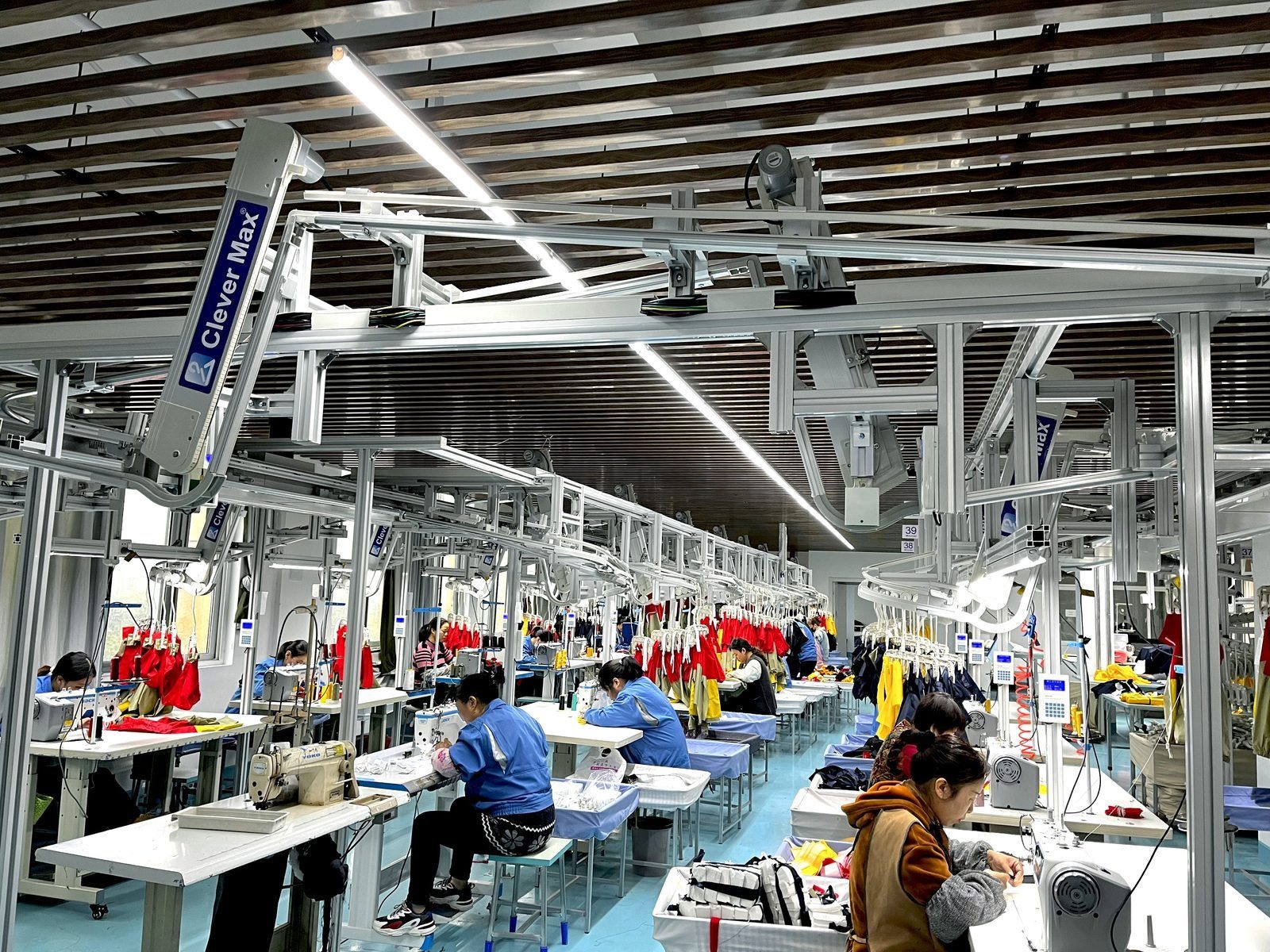
CleverMax delivers full-line solutions spanning cutting, sewing, hanger conveying, intelligent warehousing, sorting and packing. Core RFID automatic data capture makes every piece traceable end to end, and the YunDao MES platform feeds that data back into production scheduling, which is precisely the digital and networked capability the policy calls for.
A cluster's output target finally comes down to the space between stations
The 720 billion figure is the sum of what every production line in the region turns out. Whether it is reached depends in the end not on how many measures a document contains but on how much unpriced time is still sitting between the stations on those lines.
Home textiles make that unusually visible. Quilts and bedding are large and heavy, so carrying them by hand is slow to begin with, and piles waiting beside a station occupy floor space as well as time. When one style gives way to the next, whatever was piled there becomes the quantity that has to be sorted through again. On a Nantong floor, therefore, the stretch between operations is not only labour hours. It is square metres and changeover speed as well.
A cluster works to a three-year horizon while a production line settles its accounts at the end of every shift. The two timescales have nothing in common, and they point the same way regardless, because the only place output can rise from is the distance between one station and the next.
Sources
Every factual claim above traces to one of the following. Where a source is offline — a certificate, a printed publication — we name it without a link.
- [1] 工业和信息化部消费品工业司《江苏印发〈江苏省苏州市、无锡市、南通市高端纺织国家先进制造业集群培育提升三年行动方案(2023—2025)〉》 2024-01-04 accessed 2026-08-27
- [2] 工业和信息化部 国家发展改革委 商务部 市场监管总局《关于印发〈纺织工业提质升级实施方案(2023—2025年)〉的通知》(工信部联消费〔2023〕232号) 2023-11-28 accessed 2026-08-27