

MIIT replies to an NPC proposal: accelerate intelligent textile equipment, keep supporting smart factories
In its reply to Proposal No. 8998 of the second session of the 14th National People's Congress, MIIT gives a full section to accelerating the intelligent upgrading of textile equipment. The four programmes it lists have already been run, which means each has an administering body, a published list of participants and a door that can be knocked on. Across all four, one role recurs, and the term rules out suppliers who sell single machines.
In December 2024 the Ministry of Industry and Information Technology published its reply to Proposal No. 8998 of the second session of the 14th National People's Congress, document number MIIT Proposal [2024] 181.
The proposal was put by NPC deputy Liu Zibin, who is named in the salutation of the reply, and it concerned green, low-carbon, high-quality development in textiles. The reply is dated 4 December 2024 and was issued after consultation with the Ministry of Ecology and Environment. Of the four sections in the reply, one is given entirely to intelligent equipment, and the four lines of work it describes explain why a question about carbon ends up being answered with equipment.
What gives the section its weight is that the work has already happened
The second part of the reply, titled accelerate the intelligent upgrading of textile equipment, does not set out intentions. It lists four programmes already run, which matters to a company because work already under way has an administering body, a published list of participants and a door that can be knocked on.
The first is smart manufacturing into the industrial parks, under which MIIT has guided trade associations to work alongside textile smart-manufacturing system solution providers and national innovation centres, surveying the current state of smart manufacturing at enterprises in the main textile provinces and then advising each on how to upgrade. The centre of gravity here is the survey, which is to say establishing what a given plant actually looks like before anyone proposes a configuration for it.
Second come the smart manufacturing pilot demonstration programmes, run with the NDRC and two other ministries, and in the 2021 to 2023 round a group of textile enterprises were selected as demonstration smart factories. Selection is useful less as a credential than as publication, since a plant working under comparable conditions can go and see how somebody else solved it.
Third is the 2023 open competition for smart-manufacturing system solutions, which funded work on solutions for the textile sector with the stated aim of grouped, connected innovation across equipment and software. Grouped and connected is the phrase worth remembering, because it rules out thinking in single machines.
Fourth is the textile branch of the solution provider alliance, formed to bring in capable suppliers and then to introduce robotics companies to textile manufacturers. That last step concedes something: a company that can build a robot does not necessarily understand a sewing floor, and somebody has to stand between the two.
Survey, demonstrate, fund the hard problems, then make introductions. Taken in order the four describe a route rather than a list, since each one addresses whatever the previous one leaves unresolved: a survey tells a factory what it lacks, a demonstration shows what the remedy looks like in a comparable plant, the competition funds the capability nobody was yet selling, and the alliance puts the two sides of that transaction in the same room. Across all four, one role recurs, the textile smart-manufacturing system solution provider.
What that role is defined against
When a policy document uses the term, it is ruling out a different kind of supplier.
A vendor selling individual machines is finished at delivery, which leaves how the data connects, which software it talks to and whether the scheduling logic has to change as the buyer's problem. A solution provider has to hand over a line that runs, and that obliges it to hold equipment and software together, which is the grouped-and-connected requirement of the third programme restated as a commercial obligation.
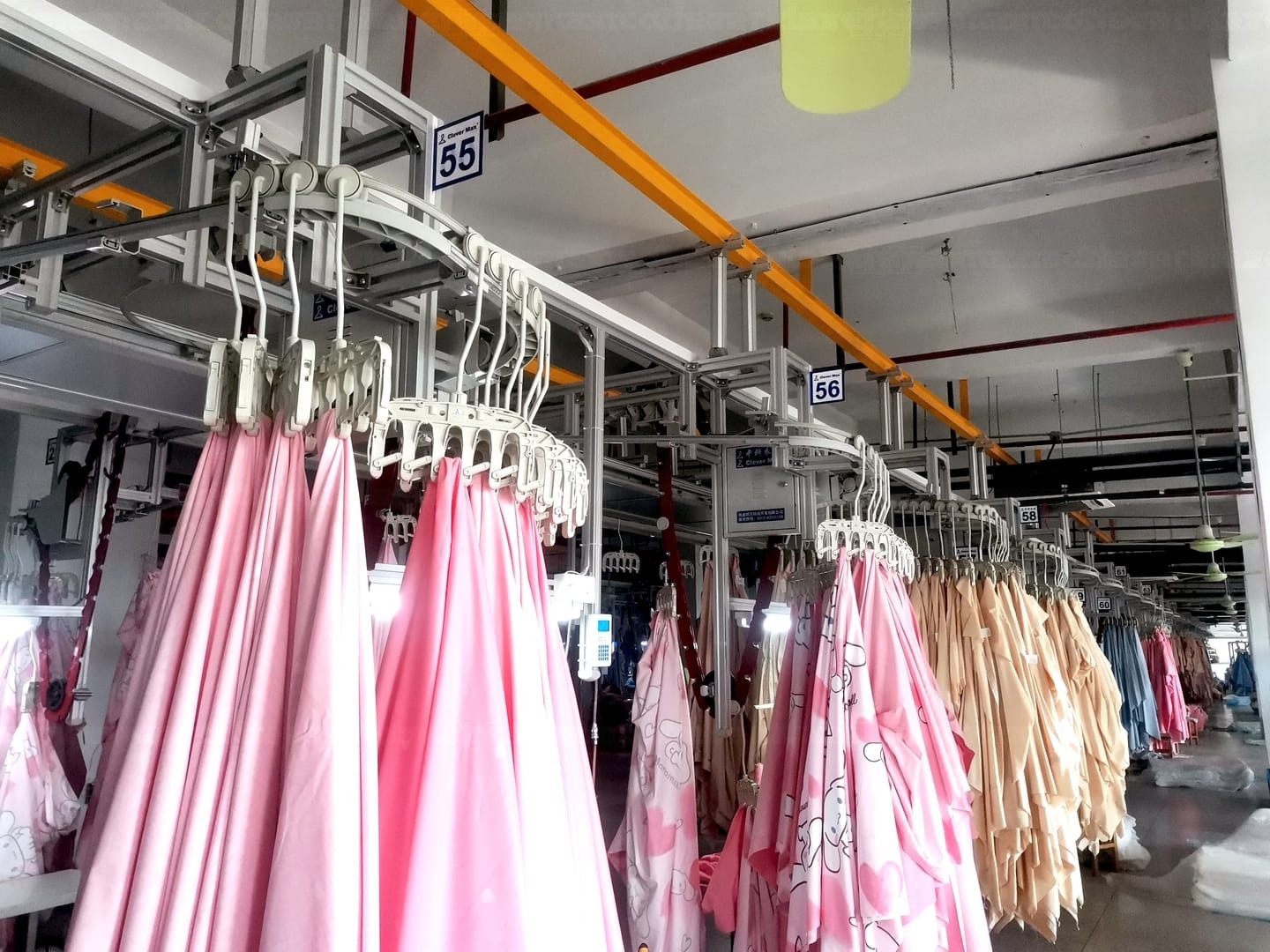
CleverMax works at that end. Its solutions span cutting, sewing, hanger conveying, intelligent warehousing, sorting and packing, while the core RFID automatic data capture, which came out of the industry-academia partnership formed with the CAS Institute of Software in 2005, records the location and dwell time of every piece with no manual entry. The YunDao cloud MES platform returns that data to production scheduling, which closes the loop: equipment generates data, data alters the schedule, and the schedule turns round and directs the equipment.
Whether that loop closes is the practical difference between a solution provider and an equipment supplier. Machines can be installed and running perfectly well while the loop stays open, in which case the data on the floor is still sitting inside each machine with nowhere to go, and the person doing the scheduling is working from the same paper ticket he was using before any of it arrived. That is the outcome a purchase order cannot protect against, because nothing on the order was specified wrongly.
The next-steps paragraph is more specific than usual
The closing section gives MIIT's direction, and its second point is driving intelligent upgrading:
Continue to support textile enterprises in building smart factories, accelerate the transfer and application of scientific results, strengthen work on robotics, intelligent inspection equipment and smart-manufacturing system solutions and the exploration of application scenarios, and drive intelligent upgrading across the textile industry.
Continue to support attaches to the four programmes above, meaning the pilot and competition channels stay open. The exploration of application scenarios is the half of the sentence left to companies, because a scenario can only come off a working floor. Nobody assembles the rhythm of a rush order dropped into a small-batch, many-style day inside a laboratory.
Read together, the two phrases amount to a prompt for a plant planning a retrofit. The application channels exist, and what has to be entered into them is a real set of operating conditions. Finding out how the local industry bureau has framed its criteria for the current round, and doing it before the scope and phasing of a project are fixed, costs less than reworking a frozen design afterwards.
Three documents in a row
A single document can be a passing breeze. Three inside little more than a year cannot.
In November 2023 the four-ministry Textile Industry Quality and Upgrading Implementation Plan (2023-2025), MIIT Joint Consumer [2023] 232, set the target that 70% of large textile enterprises be substantially digital and networked by 2025, and made vigorously developing smart manufacturing one of seven priority tasks. That document supplied the number.
In April 2024 MIIT and the Ministry of Commerce jointly made the renewal of ageing equipment and the raising of enterprise digitalisation the first work task of their campaign. That document named the object.
In December of the same year this reply confirmed continued support for building smart factories, which is the document that describes how the support arrives.
A target, a named object, a means of support. Each document supplies one of the three, and while any of them is missing a company still has a reason to wait another year, whether because the requirement was vague, because it was unclear which equipment it applied to, or because no channel existed through which help might arrive. With all three in place the waiting has lost its external justification, and the only reason left to delay is the difficulty of the retrofit itself, which is a real difficulty and a different kind of one.
The survey is a step neither side can skip
That the first programme begins by surveying rather than by issuing a recommended configuration reflects something both policy and suppliers run into. There is no standard answer in intelligent upgrading.
An apparel plant and a home-textile plant work under different conditions, since a shirt and a curtain differ in weight, in length and in how they hang on a carrier. Small-batch, many-style production and continuous bulk runs follow different scheduling logic, because the former changes style several times a day, which makes buffer size the governing constraint, while the latter needs a steady cycle time above all. A new building and a retrofit are different problems again, one allowing the shell to be drawn around the line, the other requiring the rail to be fitted between a column grid and a ceiling height that are already fixed.
What a survey establishes, then, is those conditions rather than the size of the company. The order in which CleverMax walks a floor is the same: category mix, batch characteristics, floor conditions, and which of the existing equipment is still worth keeping in place. Only once those four are known does a proposal have a starting point. Without them what comes out is a generic configuration.
In the end a factory has four question marks to resolve: whether to upgrade, which stretch of the line to upgrade, what it costs, and how soon it shows in the output figures. No document answers any of the four, and no document was ever going to, since all four depend on conditions that exist only inside one particular building. What those four programmes establish is narrower but not trivial, which is that the arithmetic no longer has to be done alone, and that somebody whose job is to have seen a hundred of these floors can be asked to look at this one.
Sources
Every factual claim above traces to one of the following. Where a source is offline — a certificate, a printed publication — we name it without a link.
- [1] 工业和信息化部《对十四届全国人大二次会议第8998号建议的答复》(工信建议〔2024〕181号) 2024-12-04 accessed 2026-08-27
- [2] 工业和信息化部 国家发展改革委 商务部 市场监管总局《关于印发〈纺织工业提质升级实施方案(2023—2025年)〉的通知》(工信部联消费〔2023〕232号) 2023-11-28 accessed 2026-08-27