

Hanger systems are turning from optional into necessary
A listed competitor has filed its audited 2025 report: hanger-system revenue of 215 million yuan, up 22.05%, at a gross margin of 35.69%, an improvement of 6.23 points. Buying share with low prices lifts revenue and pulls margin down behind it. These two went up together. Two further sets of figures cover overseas margin and Southeast Asian demand.
On 25 April 2026, Zhejiang Sunrise Intelligent Technology filed its 2025 annual report with the Shanghai Stock Exchange. Sunrise builds hanger systems and is publicly listed, which means the report has been through an audit and every line in it carries legal liability for the people who signed it. That makes it a more useful document about this market than anything written to be persuasive.
Three numbers from that filing:
- Hanger-system revenue of 215 million yuan, up 22.05% year on year - Gross margin of 35.69%, an improvement of 6.23 percentage points - Overseas revenue up 56.06%, which the report attributes to orders from Southeast Asia
A rival's accounts are worth reading at CleverMax because the buyers are the same buyers, and what those buyers open a conversation with has been changing over the same two years. It used to be what does this cost. It is now whether it suits the product mix and how long it takes to pay back. A question about price is a comparison between suppliers, whereas a question about payback is a comparison against the plant's own current state, and asking the second means the question of whether to install one is no longer open. What is left is when.
Revenue and margin went up together
Buying share with low prices lifts revenue and pulls margin down behind it, which is why the two figures are worth reading together rather than one at a time. If buyers in this category were shopping on price, that 22% of revenue growth would be sitting on top of a margin line heading the other way.
Margin went up 6.23 points instead, which says buyers were not comparing who was cheapest but working out what the thing saves them.
And what it saves is a sum a garment plant can do for itself. Only a fraction of the time on a line is sewing, while the rest goes into four things: waiting for the previous operation, carrying half-finished work between stations, crossing the floor to find a batch that came back for rework, and adding up paper tickets after the shift to see where an order stands. None of the four produces anything, and labour costs more every year, so with the numerator rising and the denominator unchanged the sum comes out a little more favourably every year it is run.
The same product earns twice as much abroad
Another pair of figures from the report: gross margin of 44.50% on overseas business against 26.92% at home.
A gap that wide on an identical product is not about the product. It is about what happens after installation. A supplier's engineers cannot live in someone else's country, so the system has to run with nobody watching it, and when something breaks the supplier has to work out remotely which part of the line is at fault and then talk a local technician through it. Few suppliers can do that, which is what overseas buyers are paying for.
A domestic project has its supplier down the road, so you call someone out. That convenience hides the difference between a stable system and an unstable one until peak season, when a day down is a day lost. The 26.92% is therefore not the same purchase at a lower price. It is the same machinery plus an assumption that help will always be an hour away.
CleverMax's product was built under the overseas condition rather than adapted to it later. The first export order went to Myanmar in 2007, at a time when remote support was not a phrase anyone in the industry used, so the crew installed the line and flew home, and whatever happened next had to be resolved from Nantong across a time zone, where a wrong diagnosis cost another day. Being pushed that way made running unattended a default of the design rather than something added for export projects. Installations have since reached more than 20 countries, with offices in nine of them.
Capacity moves to Southeast Asia, and the orders left behind change shape
The third figure is that 56.06% growth in overseas revenue, which the report puts down to Southeast Asian demand.
What Southeast Asia takes is the large-batch, long-lead-time work, because that is the work where cheap labour counts for most. As capacity migrates, the orders that stay concentrate at the opposite end, short lead times, small batches and many styles, and that is the end where bundle flow struggles. A bundle of several dozen pieces has to clear one operation before the next starts, and every style change means re-balancing the line. Three style changes in a day means three re-balances.
What single-piece flow changes
One passage in the report describes what this industry sells:
In a smart manufacturing workshop in the sewing industry, upgrading the traditional bundle-flow production process to single-piece flow enables production that is data-driven, component-based and intelligent, that is, whole-process production data is digitised through RFID capture.
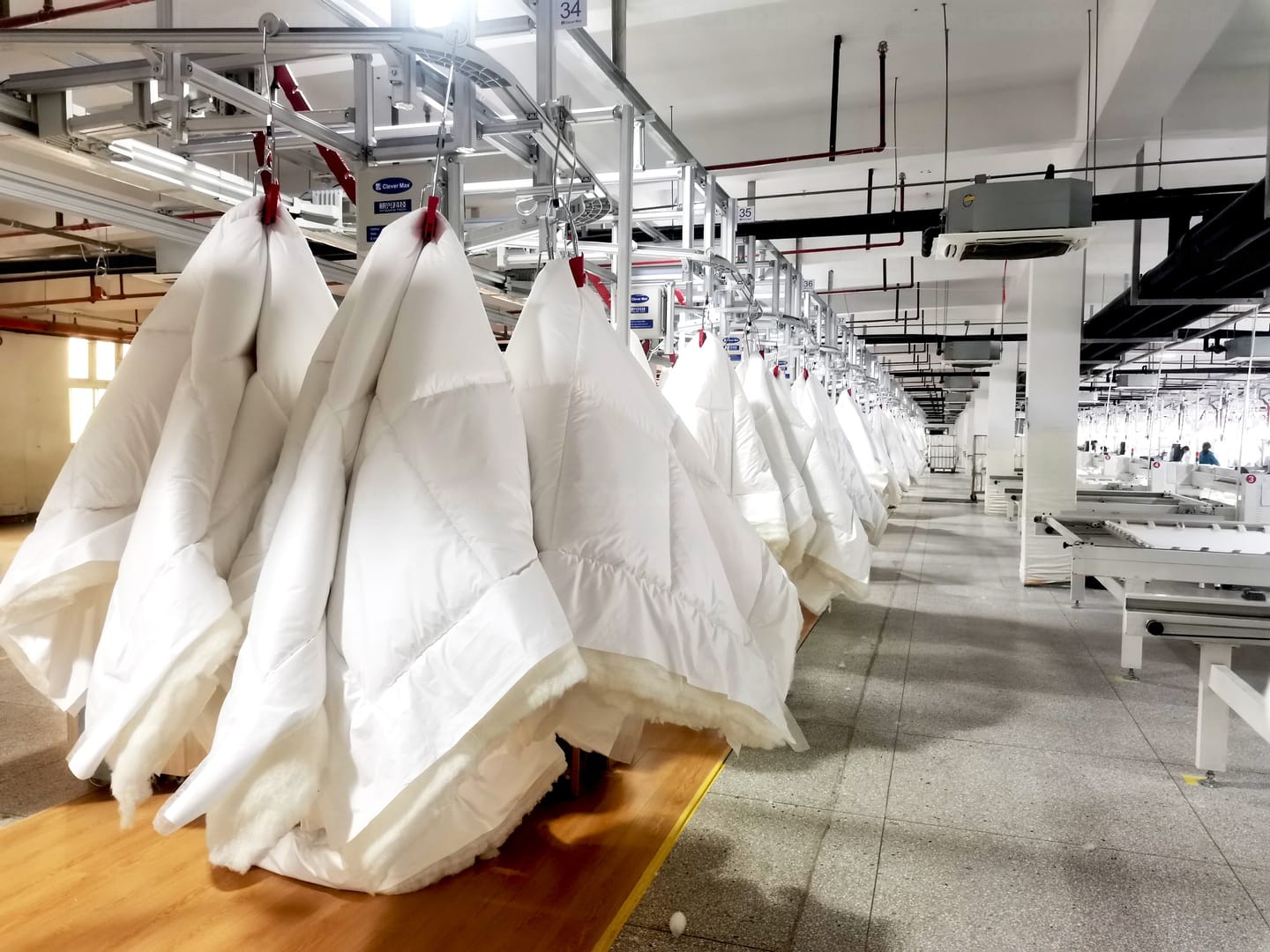
Single-piece flow means each garment travels on its own, with a record of where it is and how long it waited, rather than moving only when a whole bundle is done. The floor changing style three times a day in the paragraph above stops re-balancing anything, because each garment now carries its own route.
The difficulty is in the word record. Dozens of operations and a thousand pieces in progress is past what anyone tracks by hand, so single-piece flow depends on the data being captured without a person involved. That is the job RFID and the hanger carrier do together: a tag on the carrier, a reader at each station entrance, an automatic read as the carrier goes past.
CleverMax has worked this way for close to twenty years, starting from the research partnership established with the CAS Institute of Software in 2005. The captured data feeds the YunDao cloud MES platform, so scheduling runs on the floor's actual state instead of an estimate.
Why the report is worth reading yourself
Neutral material is the scarce thing when you are buying equipment. Vendor brochures flatter themselves and industry reports stay vague.
An audited annual report is filed with an exchange and carries legal liability, and nobody writing one has a reason to talk a rival up. Describing the domestic market, this one sorts the participants into three groups. The third reads:
The third category is domestic Chinese companies, represented by the issuer, with other principal companies including Nantong Mingxing Technology Development Co., Ltd. (CleverMax).
CleverMax did not write that sentence. The same grouping appeared in a 2020 exchange filing, and six years have not changed it.
The line is not the reason to read the report, though. The figures are: a category raising price and volume at once, an overseas market paying close to double for reliability, and a capacity shift changing the shape of what stays behind.
Two cases where the answer is not yet
If your order book is dominated by very small runs, often under 300 pieces per style, the scheduling gain from a hanger line gets eaten by the changeover losses that come with switching styles that often.
If the building constrains you, with low ceilings or irregular column spacing forcing the rail into detours, every extra metre is cost and the payback period stretches.
Working out which case you are in is arithmetic you can do yourself, and it is worth doing before anyone quotes you anything: count the hours your floor spends each day waiting, carrying, searching and counting, multiply by your labour cost, and set the result against what a hanger line costs. Having that number in hand changes the conversation with any supplier, because it moves the discussion off configurations and onto your own payback period. If you would like CleverMax to work it through in more detail than an estimate allows, send us your product mix, your annual output and the conditions in your building.
Sources
Every factual claim above traces to one of the following. Where a source is offline — a certificate, a printed publication — we name it without a link.
- [1] 上海证券交易所 浙江瑞晟智能科技股份有限公司 2025 年年度报告(股票代码 688215) 2026-04-25 accessed 2026-08-10
- [2] 上海证券交易所 浙江瑞晟智能科技股份有限公司首次公开发行股票并在科创板上市申请文件审核问询函之回复 2020-05-27 accessed 2026-08-10