
In 2005 CleverMax brought the Chinese Academy of Sciences onto the garment floor
In 2005 CleverMax signed a long-term partnership with the CAS Institute of Software and Institute of Automation. It sounded like an odd pairing at the time, until you notice that the hard part of a hanger system was never the rail or the carriers but making a production line aware of what it is doing, which is a real-time systems problem and not a mechanical one. That agreement set the technical direction CleverMax has followed for the next twenty years.
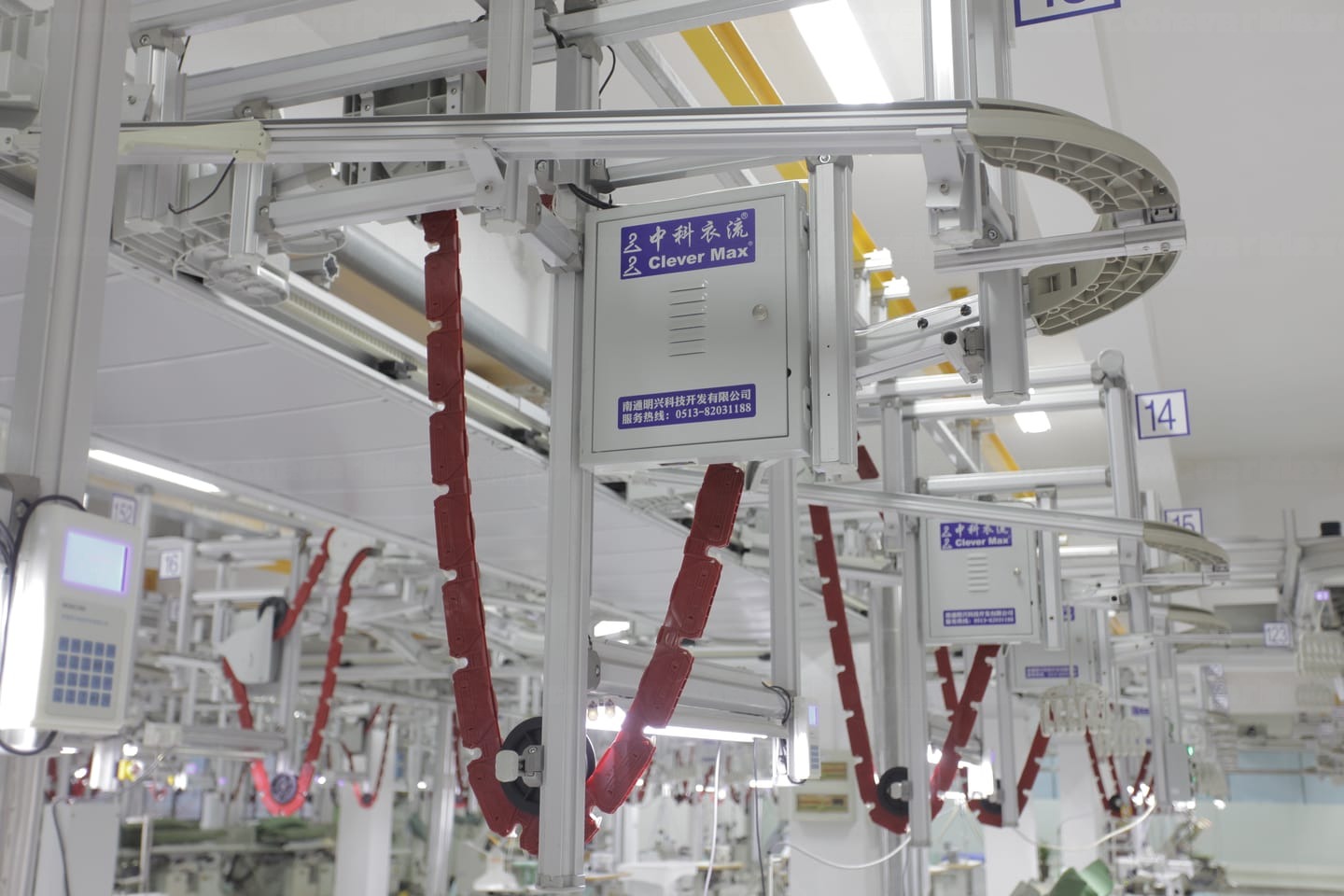
In 2005 CleverMax signed a long-term strategic partnership with the Institute of Software and the Institute of Automation at the Chinese Academy of Sciences.
A hanger-equipment maker in Nantong walking into a software institute struck people as the wrong address. Surely a machinery company belongs with a mechanical institute. Someone put that to them directly at the time.
Two years of the first generation, and the difficulty surfaced
Once the first generation was installed in customer workshops, the mechanics turned out to be the part that settled first. Rail, carriers, points and lifts are mature problems that a few rounds of drawings will get right, and most competitors reach something workable within a few years. The trouble sat at the other end, in the part of the system nobody can point at on a drawing.
Which order is on a given carrier, which operation it has reached, how long it dwelt at the last station, where it goes next, and which way to divert it if that station is backed up. Mechanics answer none of that, because none of it is a question about steel. Something has to work it out behind the scenes, quickly enough that the carrier has somewhere to go by the time it arrives at the junction.
A layer below, it is a real-time systems problem, because the workshop will not wait for the computation to finish. Between reading a tag and committing to a routing decision there is very little time, and several hundred carriers hang on the line at once, each of them generating events continuously. Academia has established methods for that class of problem, whereas an equipment manufacturer working from experience alone has none. Two years in, CleverMax knew exactly which piece it was missing.
One side knows how to solve it, the other knows what the floor allows
The Institute of Software had years behind it in human-computer interaction and real-time intelligent systems, while the Institute of Automation worked on control and identification. What CleverMax brought was garment-floor and line-engineering experience, meaning it knew what actually happens on site.
Neither half is sufficient. An institute can formalise a problem and solve it, but not state the boundary conditions a workshop imposes on the answer, such as whether an operator will use the button she has been given, when a rework piece cuts into the queue, or how the line behaves when the power dips. That is where a purely academic design fails within a week. CleverMax knew those boundaries, yet experience pushed on its own stops at a certain level of complexity, and several hundred carriers running concurrently is well past the point where anyone sequences them by feel.
Nor was the agreement something to frame and forget. Among the five inventors named on "Monitoring Method and System for Intelligent Material Distribution" are researchers from the Institute of Software alongside CleverMax's founder, Yu Ming. Later invention patents were filed jointly by CleverMax and the institute, including "A Reversing Transfer Conveying Device and Conveying System", "Customised Mixed-Flow Production System" and "Automatic Pattern-Making Method and System for Personalised Garment Customisation".
Read those titles in order and the technical direction is visible
How material gets tracked, then how it gets diverted and transferred, then how many product types flow together, and finally how a made-to-order garment generates its own pattern. Over two decades the questions climbed a layer at a time, each one standing on the one below.
What that direction means for a customer is not obvious on the day of purchase and takes some years to become visible. The thing factories fear most when they commit capital to automation is that the business will change and the equipment will become a liability: conveying goes in this year, small-batch mixed-flow orders arrive two years later, and customised orders after that. Had those capabilities come from unrelated technical lines, every shift in the business would have meant tearing something out. Because they grew as layers on one line, a change happens at the top while the tracking and routing underneath stay where they are.
RFID came out of the same decision. The industry at large was still on barcodes, and a barcode has to be scanned by hand, a missed scan breaks the chain, and where two lines merge the system cannot tell one piece from another. Replacing barcodes with RFID settled automatic identification, real-time tracking and merge management together, so the position and dwell time of every piece is captured without anyone keying it in. That choice traces straight back to the 2005 agreement.
From joint research to a joint company
In 2013 the Institute of Software and CleverMax jointly funded Jiangsu YunDao Information Technology to turn the work into a cloud platform. The institute put in people and method, the equipment maker put in the floor and the data, and what had been collaborative research became shared risk, which is an unusual depth for an industry-academia relationship to reach.
When China Home Textile Brand Network reported on the CleverMax home-textile system in 2015, that platform was the one they described. YunDao feeds the hanger line's real-time data back into production scheduling, turning work-in-progress counts, completion by operation and per-piece cycle time, once scattered across paper tickets and people's memory, into an asset that can be queried, analysed and decided on.
When something goes wrong on the floor, ask what it fundamentally is
What the 2005 agreement fixed was not a product but an order of operations: establish what a floor problem fundamentally is, then find the people who can formalise it and work on it with them.
The hardest thing in a workshop is rarely a broken machine, since a broken machine announces itself and someone repairs it. It is the problem nobody can describe cleanly, nobody can quantify, and everybody settles by asking the oldest supervisor for a guess, which works until the day he is not there. CleverMax had one of those twenty years ago, and it happened to knock on the Academy's door about it.
Sources
Every factual claim above traces to one of the following. Where a source is offline — a certificate, a printed publication — we name it without a link.
- [1] 国家知识产权局 发明专利《智能物料配送的监控方法及系统》(中科院软件所与南通明兴合作成果,发明人含俞明) 2009-06-03 accessed 2026-08-09
- [2] 国家知识产权局 发明专利《一种换向移载输送装置和输送系统》(南通明兴与中科院软件所共同申请) 2014-06-11 accessed 2026-08-09
- [3] 品牌家纺网《明兴科技:传统家纺"搭上"云平台》 2015-09-01 accessed 2026-08-09 · Trade press
- [4] 南通明兴科技开发有限公司 企业发展历程(公司资料) 2005 (offline source) accessed 2026-08-09 · Trade press