

Two people carrying one duvet a dozen metres: the trip a hanger line removes
In 2015 China Home Textile Brand Network reported on the CleverMax home-textile material-distribution and monitoring system. A duvet can weigh more than ten times what a shirt weighs, and every load-bearing number in an apparel hanger system is derived from the weight of apparel, so the whole carrying structure had to be rebuilt. The weight is also why the payback in home textiles arrives faster than in apparel.
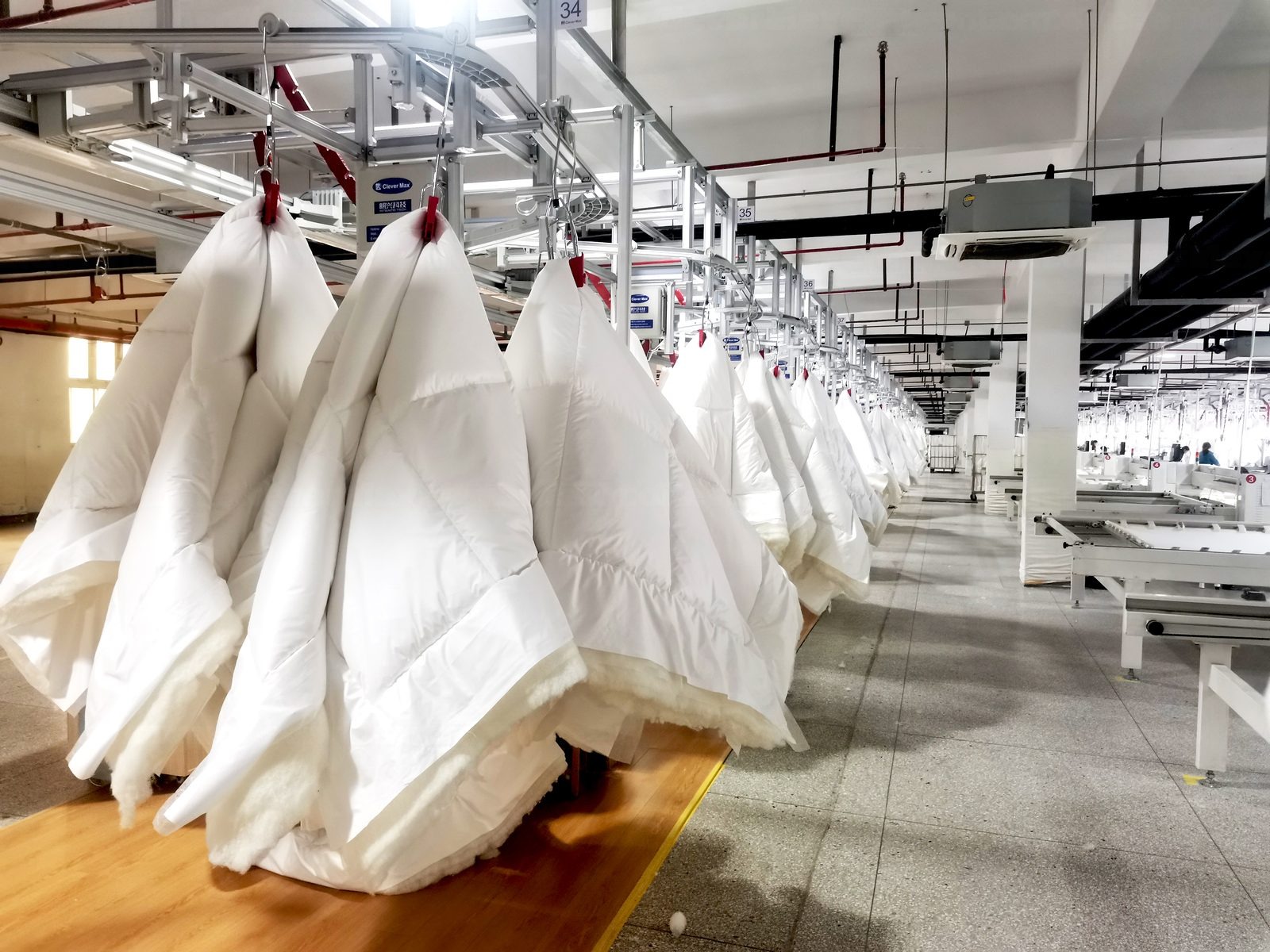
Once the apparel hanger line was running, the first thing home-textile customers asked was whether theirs could be hung too.
Two questions sit inside that one. Will the rail hold the goods, and is hanging them worth the money. The first is engineering and the second is arithmetic, and while the plants asking were thinking about the first, the arithmetic turned out to come back better for them than it does for apparel.
A shirt and a winter duvet are not in the same weight class
A shirt weighs two or three hundred grams. A winter duvet can run to four or five kilos, more than ten times as much. A shirt hangs flat, while a curtain opened out is three or four metres long.
Carrier load, rail strength, turn radius, station spacing, how many pieces a station can hold: every one of those numbers in an apparel hanger system was derived from the weight and bulk of shirts and jackets. Hang a four-kilo duvet on a carrier rated for three hundred grams and at best the rail deforms and the line runs badly, at worst it will not hold the goods at all.
So CleverMax did not take the route of reinforcing an apparel line. Everything load-bearing was rebuilt from scratch: heavier rail, a strengthened carrier structure, a wider turn radius, and station spacing and capacity recalculated. Those heavy-load calculations became the basis of the later home-textile and automotive-interior work.
Chinese suppliers who genuinely understand both apparel and home textiles have always been few, and the reason is in that recalculation, which cannot be reached by adjusting a parameter on an existing design.
The real cost in a home-textile workshop sits outside the sewing
In September 2015 China Home Textile Brand Network reported on the home-textile system CleverMax was then shipping, sold under the name Zhongke Yiliu. Yu Ming described it this way:
It moves all the material mechanically, which frees up a great deal of processing time from non-sewing operations.
Non-sewing operations are where the cost in a home-textile workshop actually is.
Sewing a duvet cover takes what it takes, and no operator is quick enough to reclaim much there. Moving a duvet between stations, on the other hand, takes two people to lift it, a dozen metres of walking, and a hunt for somewhere to set it down, which comes to a few minutes a trip and several hundred trips a day. Because it takes two of them, each trip costs two operators' time, and not one additional stitch goes into the cover.
That carrying and waiting accounts for a startling share of a conventional home-textile day and produces nothing at all. The customer is paying for the workmanship in the duvet, not for the distance an operator covers crossing the floor.
Waiting, carrying, hunting and counting, the four wastes garment plants talk about, all land harder here. The heavier and bulkier the material, the slower the carrying, the harder the hunting, the worse the waste. Which is why the return in home textiles is the more immediate of the two. What comes back is two operators' time per trip rather than one.
The method underneath is unchanged, still a tag on the carrier
The load-bearing structure was replaced entirely. The data layer was not touched: an RFID tag on the carrier, a reader at each station entrance, position and dwell time recorded as the carrier passes.
The method comes from invention patent CN100493401C, filed by CleverMax's partner the CAS Institute of Software, where it is set out plainly.
An RFID tag is fitted to the hanger; when the hanger passes the RFID reader at the entrance of a workstation, the reader picks up the information on the hanger's tag.
The 2015 report describes the same arrangement as "a special radio-frequency tag fitted inside every carrier."
Why the tag belongs on the carrier and not on the goods comes down to the fact that goods leave the line. They come off for inspection, they go away for rework, they get packed when they are finished. A tag riding on the goods breaks the record at the moment the goods leave the rail. A carrier does not leave. It keeps circulating, and it picks up recording again with whatever is hung on it next. Keep the tag with the carrier and the chain holds, which is as true of a duvet as it was of a shirt.
From whether it will carry the goods to whether it will untangle the floor
The same report covers the system's link to a cloud manufacturing platform run by Jiangsu YunDao Information Technology, a company founded in 2013 by the CAS Institute of Software together with CleverMax.
Once shop-floor data is on a cloud platform, lines spread across several sites can be scheduled off one sheet, and the hooks are left in place for the made-to-order work that followed. For a home-textile group running several categories across several plants, that layer is worth more than the speed of any single line. The hardest thing about running multiple sites is that the owner does not know how much work is left at each of them and has to phone the plant managers one by one, and what comes back over the phone is the manager's own estimate. With the data on a platform, work in progress at every site is on one screen and the estimating step is gone.
Looking back, 2015 divides what came before from what came after.
Before it, the question was whether the line could carry a customer's goods. After it, the question was whether putting the goods on a rail would untangle the floor. The product is still a hanger system. It simply has one more question to answer.
The arithmetic for a heavy-goods workshop cannot be done from the doorway
The part of a home-textile design that cannot be guessed at is the load. A summer quilt and a winter duvet both count as duvets and differ by a factor of three or four. A sheer and a heavy blackout drape both count as curtains and differ by as much again. That weight decides rail selection, carrier structure and turn radius, and through them the cost of the whole line. Whether the building is tall enough to hang from, how many pieces run in a batch, and where cutting and packing currently sit will each move the design again.
So the first thing CleverMax puts to a home-textile customer is not a configuration list. It is a request to weigh the heaviest product in the range and measure the lowest beam in the building. Once those two numbers exist, the design has a shape.
Sources
Every factual claim above traces to one of the following. Where a source is offline — a certificate, a printed publication — we name it without a link.
- [1] 品牌家纺网《明兴科技:传统家纺"搭上"云平台》 2015-09-01 accessed 2026-08-06 · Trade press
- [2] 国家知识产权局 发明专利 CN100493401C《智能物料配送的监控方法及系统》 2009-06-03 accessed 2026-08-06