

"70% of large manufacturers substantially digital and networked": a 2025 target that starts being answered in 2022
A workshop that still learns yesterday output from paper tickets collated the next morning does not, by the official 2025 standard, count as digital. The Smart Manufacturing Development Plan for the 14th Five-Year Period, issued jointly by eight ministries, sets the hard targets: by 2025, 70% of large manufacturers substantially digital and networked, over 500 smart demonstration factories built, and over 150 system solution providers cultivated.
A workshop that still learns yesterday's output from paper tickets collated the following morning does not, measured against the official standard set for 2025, count as digital, whatever equipment it has bought in the meantime. That standard is not a trade-association recommendation that a factory can weigh up and set aside. It sits in a development plan signed jointly by eight ministries.
The Smart Manufacturing Development Plan for the 14th Five-Year Period, document number MIIT Joint Planning [2021] 207, was issued on 28 December 2021 over the names of MIIT, the NDRC and the ministries of Education, Science and Technology, Finance and Human Resources and Social Security, together with the State Administration for Market Regulation and SASAC, which between them control funding, people, standards and assessment.
Three numbers
The plan sets three headline targets for 2025.
First, on transformation: 70% of large manufacturing enterprises substantially digital and networked, and more than 500 smart demonstration factories built that lead their industries.
Second, on supply capability: market satisfaction rates above 70% for smart manufacturing equipment and above 50% for industrial software, and more than 150 capable smart-manufacturing system solution providers cultivated.
Third, on foundations: more than 200 national and industry standards drafted or revised, and more than 120 industrial internet platforms of industry or regional significance built.
The first is the assignment given to manufacturers and the second the assignment given to equipment and solution providers, and the two are deliberately paired, because seven manufacturers in ten cannot complete a transformation unless there are enough suppliers capable of joining equipment to software for them to hire one.
What "substantially digital and networked" means
The proportion is the easy part of that target. The difficulty is the word substantially, and where exactly the bar sits.
The direction the plan gives is that transformation should be built around process and equipment, grounded in data, carried by the production cell, workshop, factory and supply chain, and from that several requirements are clear enough to test yourself against.
Data has to be generated automatically. Compiled by hand, aggregated the next day or estimated from a sample, it is not digitalisation.
Equipment has to connect. As far as digitalisation is concerned, a new machine that is not connected differs very little from an old machine that is not connected.
Captured data has to be used. Sitting unread in a database it is not networked collaboration, and it has to feed back into scheduling, into quality and into delivery.
Those three requirements form a chain of generation, transmission and use, in which a break at any link invalidates everything downstream of it, and that is why factories measuring themselves against the standard usually find the distance longer than they assumed. Buying a few connected machines is not the same as closing the chain.
Textiles named specifically
In the section on standards, the plan states that smart-manufacturing standard systems are to be built for textiles, petrochemicals, building materials and automotive among others.
Once textiles were on that list, the policy did not stay at the level of a general plan for long. In November 2023 a four-ministry programme applied the 70% target to textiles specifically, and in April 2024 MIIT and the Ministry of Commerce made the renewal and upgrading of ageing equipment the first work task of their campaign for the year, which means the direction running from the 2021 plan through a sector programme and down to concrete annual tasks holds consistently across all three tiers of document. A factory reading only the first of them would underestimate how specific the follow-through became.
The "system solution provider" role
The plan's second target calls for cultivating more than 150 smart-manufacturing system solution providers, accelerating that cultivation, promoting standardised development and delivering low-cost solutions.
Why the role needs cultivating at all becomes obvious on any factory floor, where sewing machines come from a sewing machine maker, cutting tables from a cutting table maker and software from a software house, so that each supplier delivers the item it sells while nobody owns the interfaces between them, which is where a transformation project usually stalls. The job of this role is to connect equipment, software and data into a line that runs, and it is a different job from selling any of the three.
That is what CleverMax has done since 2003, and set against the chain above, each of the three links has something answering to it.
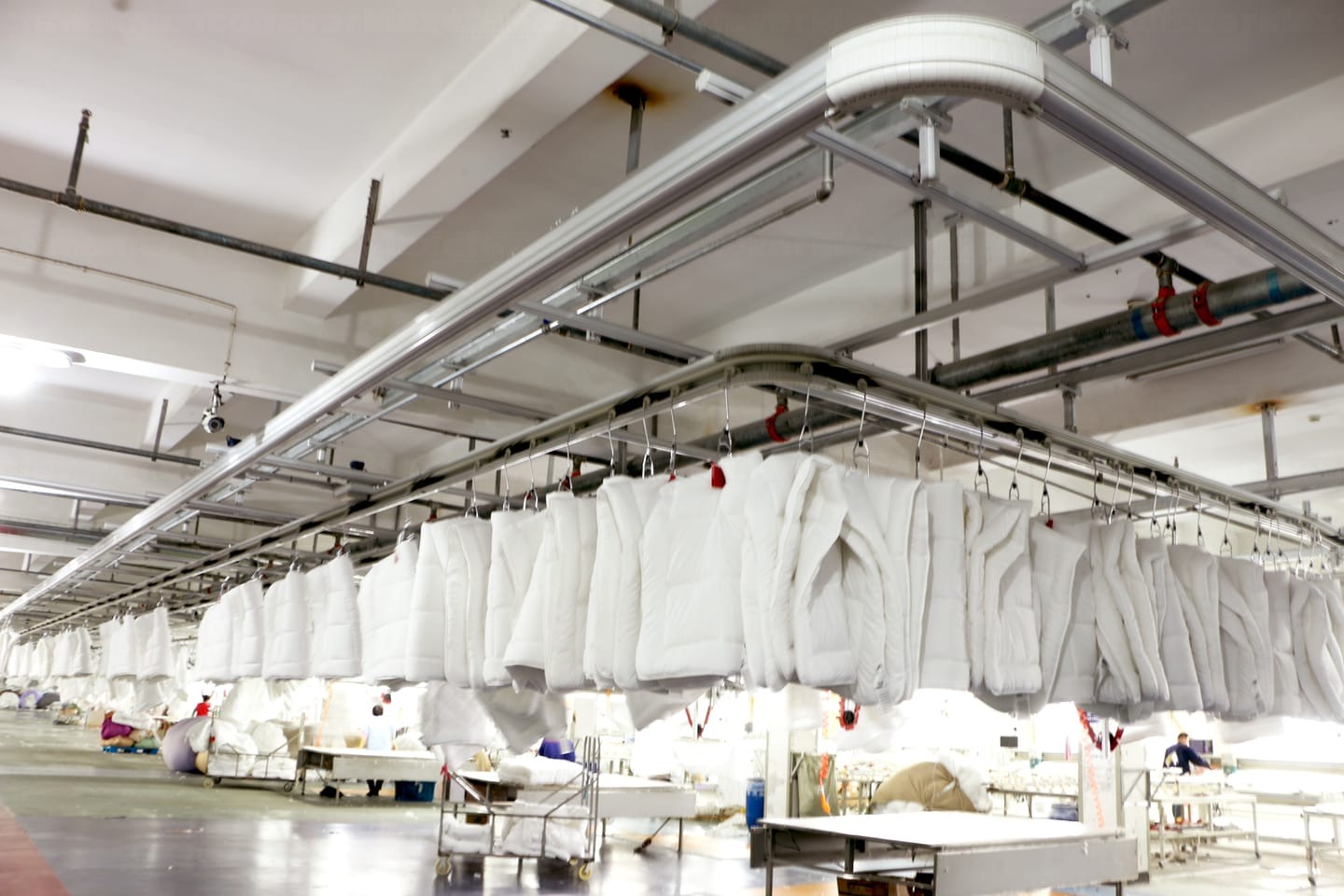
The CleverMax hanger system handles material movement: pieces hang on carriers and are routed automatically to the next station along the process path, with nobody carrying anything and nothing piling up in between.
The core RFID identification came out of the industry-academia partnership formed with the CAS Institute of Software in 2005, and works from a tag on the carrier, a reader at each station entry and an automatic read as the carrier passes, with the host deciding in real time whether the piece enters. The location and dwell time of every piece is tracked automatically end to end, with no manual entry at all. That answers to the first requirement, that data be generated automatically.
The industry long relied on barcodes, which have to be scanned by a person, so that a missed scan breaks the chain and merged lines cannot be told apart. That human scan was always the link most likely to fail, and removing it is what lets RFID settle automatic identification, real-time tracking and merge management in a single move.
The YunDao cloud MES platform feeds that data back into scheduling, which answers to the third requirement. Equipment plus software, from material movement through to decisions made on data, is the chain the plan describes.
2025 is not far off
The plan was issued at the end of 2021 with targets set for 2025, leaving four years.
Four years does not sound short, but very little of it is available as working time. An equipment upgrade needs design, procurement, installation, commissioning, staff adaptation and a ramp back to full output, usually several months of it, and because production cannot stop in peak season the work has to sit in the quiet months, so missing one quiet window costs another half year, while a phased project stretches longer still. Once decision-making, scheduling and ramp-up are subtracted, the window for actually doing the work is narrower than it looks.
The most useful thing in the plan is not the target it sets but the self-assessment it implies. Take generation, transmission and use back to your own floor and check each one: whether yesterday's output figure was typed in by a person or captured by a machine, whether what was captured reached the scheduler, and whether the floor hears about a revised schedule the same day. Whichever of the three is broken is the one to work on next, and CleverMax is glad to go through all three with you once you know which it is.
Sources
Every factual claim above traces to one of the following. Where a source is offline — a certificate, a printed publication — we name it without a link.
- [1] 工业和信息化部等八部门《关于印发〈"十四五"智能制造发展规划〉的通知》(工信部联规〔2021〕207号) 2021-12-28 accessed 2026-08-27