
The screen at the workstation: the CleverMax industrial pad joins the hanger system and data finally runs both ways
In 2024 the CleverMax industrial pad was connected to the hanger system at four kinds of station: preparation, processing, in-line inspection and completion. It reads like a hardware swap, and what it fixes is a direction problem. The system had been reading the stations for years while no station could read the system, so a schedule still reached the floor by somebody walking over and explaining it.
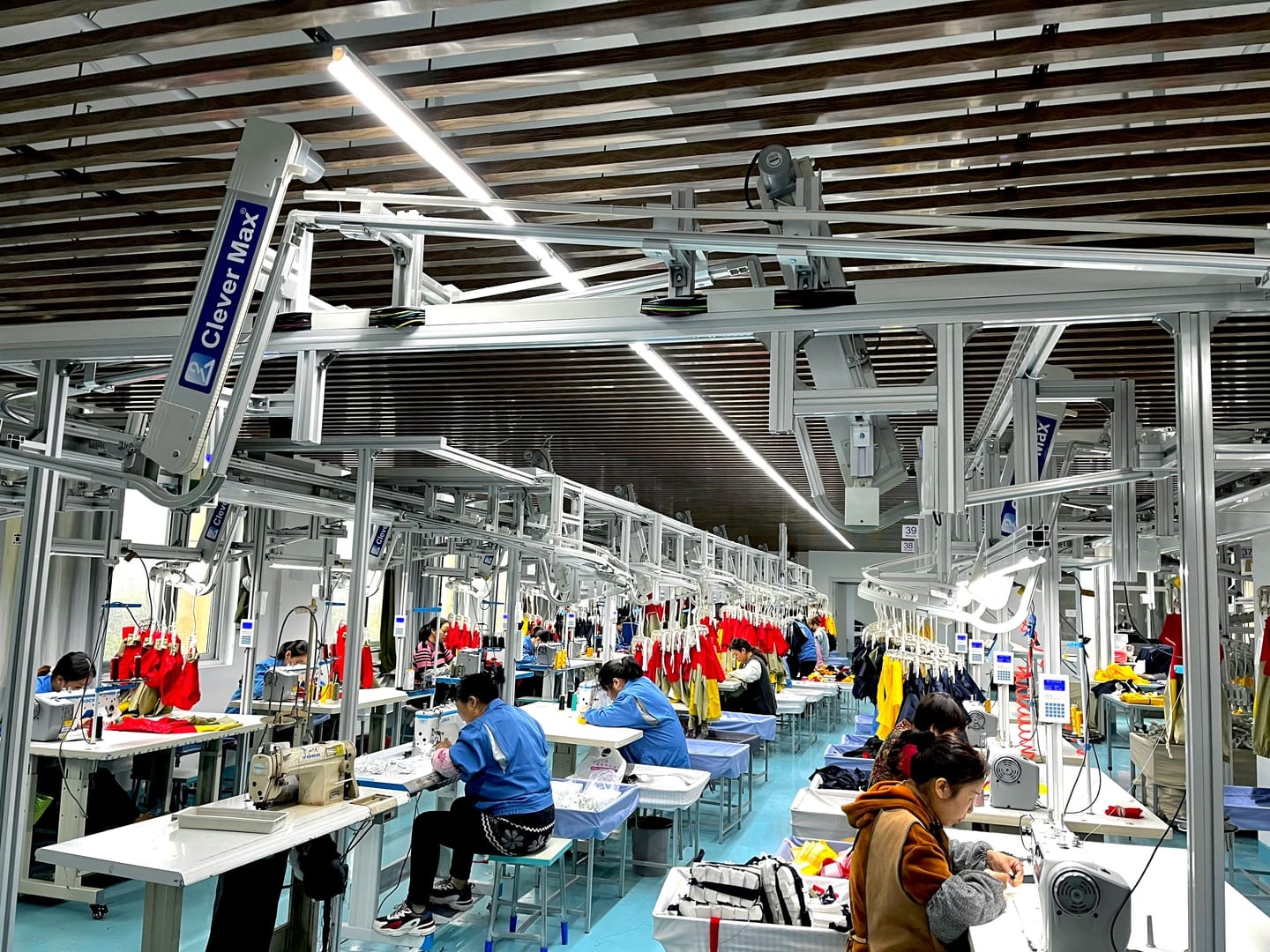
In 2024 the CleverMax industrial pad was connected to the hanger system, so that floor staff at all four kinds of station, preparation, processing, in-line inspection and completion, can take a task, read what the operation requires and put data back.
More than a decade of capture, and nothing visible at the station
Since the approach set out in the 2006 RFID patent, the hanger system had been capturing data on its own, because carriers hold tags and station entrances hold readers, which is enough for the system to know where a piece of work is and how long it has waited.
That capture had a direction problem. It ran one way, with the system reading the stations while no station could read the system.
One-way capture leaves three gaps, and each of them quietly costs capacity.
The operator does not know what is in her hands. Which order the piece belongs to, which style, which size, how many operations are still to come: all of it exists in the system and none of it is visible where she sits. Paper tickets filled in for a while, but a ticket holds only so many words and was printed at the start of the shift, so it stopped matching live status hours ago.
Inspection findings cannot be entered where they are found. An in-line inspector who spots a problem writes a slip or walks over and mentions it, and while that is travelling, the batch has moved on and the same fault is repeating itself across the next few hundred pieces. Catch it at final inspection instead and the rework is on a different scale altogether.
Work instructions depend on somebody explaining them. When the style changes, how this operation is done at this station is either taught in person or posted on a sheet, and the sheet has to be replaced at every changeover, which on a busy day is easy to skip. One station missed is a whole batch made wrong.
Four station types, four situations
The screen closes those three gaps.
Preparation takes the task and confirms the material, so which lot this piece should be cut from is on record rather than in dispute. Processing displays the current operation and reports completion, so the screen changes when the style does and nobody waits for the supervisor to come over. Inspection records the result where the fault was found, without waiting to be collated. Completion confirms the piece off the line, closing the record for that garment.
With the four connected, the data runs both ways, tasks and instructions travelling down while progress and quality travel back up. Only with both directions open does a schedule held in the MES actually arrive at a workstation.
Until then a schedule was a plan that reached the floor through people, which introduces delay, misreading and plain error. However finely the plan is calculated, covering the last hundred metres by shouting undoes the fine calculation.
The more often styles change, the more the screen is worth
This matters most where batches are small and styles are many.
In high-volume production a station performs one operation all day, explaining it once is enough, and a posted sheet lasts a month. In that workshop the value of a screen genuinely is modest, because the supervisor's voice covers it.
Run dozens of orders on one line at once, though, and a station may switch a dozen times in a day with different requirements each time. Nobody holds that in their head, no posted sheet keeps pace with it, and a screen is the only thing that matches the rate.
Order books have been moving towards small batches, many styles and short lead times, so the number of switches per day keeps climbing. A station terminal turning from a nice addition into something a line cannot run without is recent, and what changed to make it so was the order book rather than the technology.
Keeping what the experienced operator knows inside the system
When the Nantong Federation of Industry and Commerce reported on CleverMax in 2020, it put the company's aim as making garment and home-textile plants less difficult to manage.
The difficulty has a location. The information lives in people's heads, and it leaves when they do. An experienced operator knows how the operation is done, which step of this style is awkward and what tends to go wrong there. A new hire does not, and when the experienced operator resigns the knowledge goes with her, so the plant pays the tuition over again.
That used to be absorbed by bringing people on slowly, and it no longer can be. What garment plants are short of is not orders but skilled labour. Fewer young people want to work on a floor, experienced operators are thinning out, and new hires take a long time to come up to speed, which puts the highest training cost exactly where the hands are scarcest.
A screen fixes that knowledge in place. Operation content, process parameters and quality checkpoints, once written into the system, no longer hang on one person. A new hire working from the screen comes up to speed sooner. In an industry short of skilled labour that is worth more over time than the efficiency gain.
The value is not the screen, it is the data behind it
Industrial tablets are not new. Manufacturing has used them for years, plenty are on the market, and their specifications differ very little.
What this step is worth lies in the connection. It draws on data the hanger system is already capturing, so every line on the screen has a live basis instead of being a second system somebody maintains by hand.
That distinction settles how the project ends. Plenty of factories have installed a shop-floor terminal and abandoned it, and the sequence is always the same: the numbers have to be keyed in, nobody keys them in once things get busy, data that is not accurate stops being trusted, what is not trusted stops being read, and the tablets end up gathering dust. A terminal survives only where the data behind it captures itself.
Behind the CleverMax industrial pad sit the RFID tags on the carriers, the readers at the stations and the YunDao cloud MES platform, so what is displayed never passes through a pair of hands on its way there. That is why it stays in use.
Start by watching how information reaches a station today
There is a free way to judge whether a workshop needs station terminals. Stand beside one station for half an hour and watch how that operator learns what to do with the piece in front of her. She reads a ticket, she asks the supervisor, or she looks up at a sheet on the wall. If any of the three is doing the work, there is a stretch of person-to-person relay in the middle, and its length is however often the supervisor walks past.
For a plant already running a hanger line that stretch is the shortest, because the capture layer exists and adding terminals is far lighter than converting a line. For a plant still working off paper tickets the order reverses: get the data captured first, and decide what belongs on a screen after that.
Sources
Every factual claim above traces to one of the following. Where a source is offline — a certificate, a printed publication — we name it without a link.
- [1] 南通明兴科技开发有限公司 企业发展历程(公司资料) 2024 (offline source) accessed 2026-08-10 · Trade press
- [2] 南通市工商联/南通市总商会《明兴科技:以科技创新,颠覆服装家纺传统生产方式》 2020-11-06 accessed 2026-08-10