

A competitor named CleverMax in its Shanghai Stock Exchange filing: this market has only a handful of players
The hardest part of buying a hanger system is not comparing specifications but finding a reference point you can trust. On 27 May 2020, Zhejiang Sunrise named CleverMax alongside Sweden ETON and Zhejiang Yina as the sector principal competitors, in a filing answering the Shanghai Stock Exchange. Its weight comes from who wrote it and who read it: a competitor, answering a regulator, on the record.
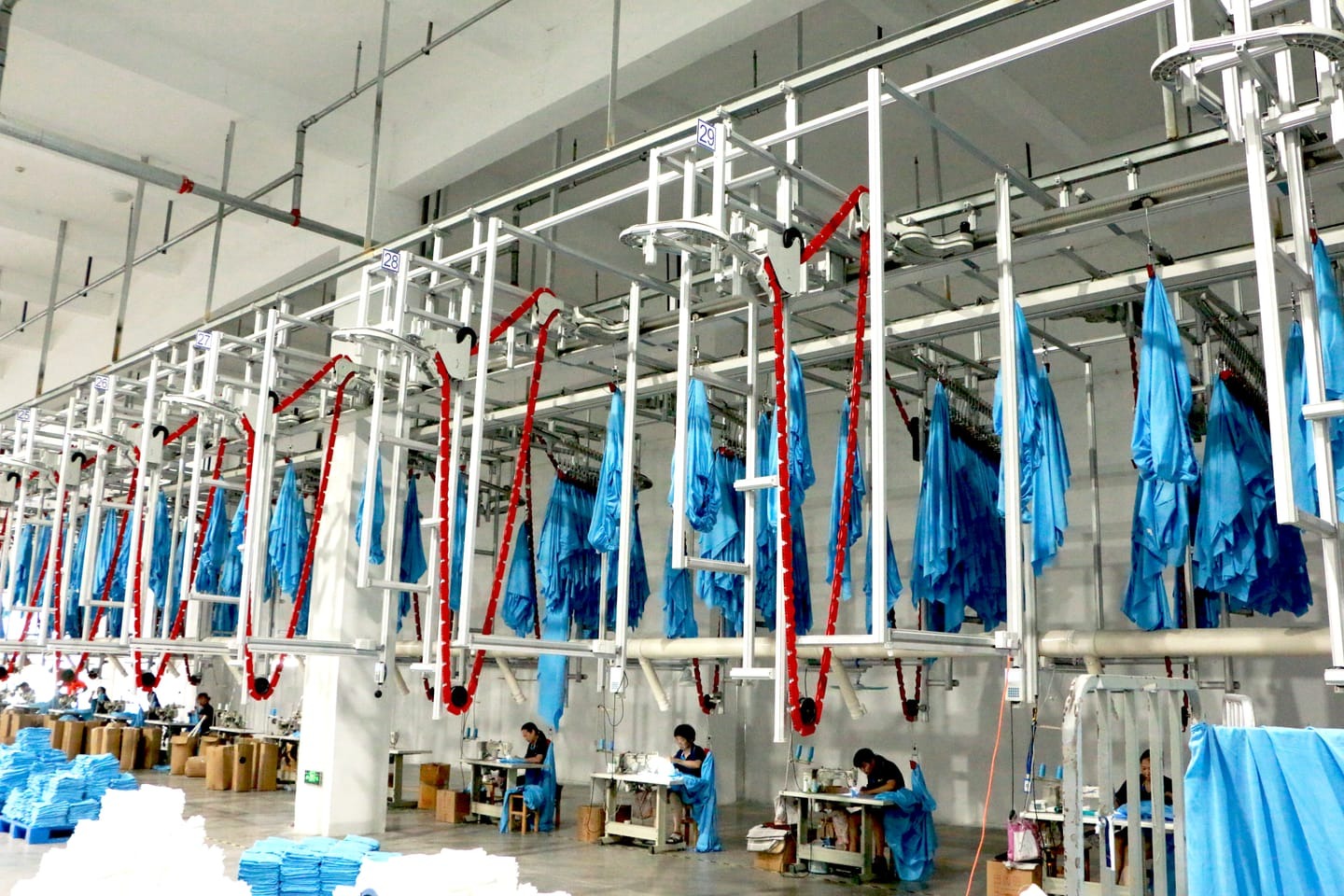
The hardest part of buying a hanger system is not comparing specifications, which any engineer on your staff can do in an afternoon. It is finding a reference point you can trust once the specifications all read alike. No brochure ever ranks its author third, every machine on a trade show stand is running in the best condition it will ever be in, and industry rankings are frequently paid for by the companies they rank.
Which is why one document from May 2020 deserves to be singled out, on the grounds of who produced it rather than what it says. CleverMax did not write it, a competitor did, and it was filed with the Shanghai Stock Exchange rather than written for anybody's customers.
A document in which you cannot exaggerate
On 27 May 2020, Zhejiang Sunrise Intelligent Technology Co., Ltd. filed its reply to the Shanghai Stock Exchange's review enquiry on its IPO application. The company later listed on the STAR Market as 688215.
Anyone who has been near a capital market knows what such a reply is: the exchange questions the applicant point by point, the sponsor and the auditors put their names to the answers, the content becomes public disclosure, and getting it wrong carries legal liability. Those procedures add up to something simple. In that setting, a company has no incentive whatsoever to talk up a competitor.
Yet in that document, describing the competitive landscape for apparel hanger system production, Sunrise sorts the participants into three groups and states:
The third category is domestic Chinese companies, represented by the issuer, with others including Nantong Mingxing Technology Development Co., Ltd. (CleverMax, founded 2003).
Elsewhere in the same filing:
At present the principal domestic competitors in the market are Zhejiang Yina Intelligent Technology Co., Ltd. and Nantong Mingxing Technology Development Co., Ltd. (CleverMax).
Named twice, and on both occasions in a passage whose subject is who the principal competitors are.
The market structure this sketches
Taken apart, the two passages show the layering of the industry fairly clearly. Overseas brands, ETON of Sweden foremost among them, entered China early and have long held the premium position in buyers' minds, while the domestic firms formally named in a regulatory filing by a company heading into an IPO number only a handful.
The list is short not because the business is quiet but because it asks for several unrelated things to be done well at once. Mechanical structure, control systems, automatic identification and production-scheduling software are four competences, and a line runs badly if any one of them is weak, which means that having built all four you still need years of running in real workshops before the process details are worked out. That the field is small is itself evidence of how high the barrier is.
CleverMax was founded in 2003 in Nantong, a city that ranks among China's largest textile manufacturing bases, and it is the company whose founding year the filing bothers to note. Its founder had opened a garment factory in 1993 and spent ten years making clothes before that, which means the workshop where those process details were worked out belonged to the company itself. This is not an equipment company that wandered into apparel but an equipment company that grew out of a garment plant.
The unflattering passage is the most convincing one
The exchange pressed further with a specific question: why had companies such as CleverMax not been included among comparable industry peers?
Sunrise answered that none of them is publicly listed and that they do not disclose their own business or financial data, so no quantitative analysis is possible.
On the face of it that reads as though CleverMax did not qualify. The meaning actually sits with the party asking. For the exchange to want to know why these companies were left out, it had already concluded they compete in the same market, or the question would never have arisen. And Sunrise's answer denies only one thing, which is the availability of financial data. It does not say too small, or technically behind, or in a different business.
Turned round, a filing full of praise for CleverMax would not be credible at all. A competitor setting out the market for a regulator has no reason to speak well of a rival, so being listed among the principal domestic participants in a document of that kind carries more weight than any self-description.
What the filing is actually useful for, if you are buying
Which returns to the reference point. What the filing offers is a market coordinate that does not depend on a vendor's own account. You do not have to take CleverMax's word about CleverMax when you can read what a competitor said about CleverMax in a setting where disclosure has to be accurate. The document is public and the original is on the exchange's website.
Third-party material is scarce when you are evaluating this category, and a competitor's disclosure to a regulator, written under the constraint that it has to be accurate, sits closer to the real shape of the market than anything a vendor prints for you.
Another thread from the same year
The timing of the filing is worth noting too. Through the first half of 2020, apparel manufacturing was absorbing pandemic-driven swings in order volume and equipment budgets were being cut across the board.
Some months later, a trade-press interview in China Sewing Machinery reported CleverMax's business as running against the market that year, and noted that the company had been placed on Nantong's first list of pandemic-supply manufacturers. That thread leads back to founder Yu Ming's other company, Nantong Honghua Fashion, which had been a government-designated protective-clothing producer during SARS in 2003.
Pandemic supplies have no direct bearing on hanger systems, but they establish the same point as the founding history does. The company has had garment production lines under its own roof throughout, which is why a government looking for capacity in a hurry could find it at all, and why it could start cutting the same week rather than after a procurement cycle. Understanding how garments get made and selling equipment that makes them remain separate competences, and the first one is the harder to acquire late.
Arrive with the research done
The real use of this filing is as a list of questions. Sunrise divides the domestic market into three categories, so ask what separates them in practice: which stage of the project the imported brands are expensive at, how a joint-venture proposal and a domestic proposal differ once you get to after-sales support, and what it implies about product categories that CleverMax is the company whose founding year gets recorded.
Questions of that shape are difficult to answer from a standard configuration, because answering any of them means coming back to your own product mix, your batch profile and the building the line has to fit inside. Those are the enquiries CleverMax would rather receive than a request for a price, and reading the filing first is what puts you in a position to ask them.
Sources
Every factual claim above traces to one of the following. Where a source is offline — a certificate, a printed publication — we name it without a link.
- [1] 上海证券交易所 浙江瑞晟智能科技股份有限公司首次公开发行股票并在科创板上市申请文件审核问询函之回复 2020-05-27 accessed 2026-08-06
- [2] 缝制设备网 / 《中外缝制设备》《南通——明兴:逆市上扬有秘诀》 2020-09-07 accessed 2026-08-06 · Trade press