

Two ministries, one notice: renew ageing equipment and take smart manufacturing into the parks
The General Offices of MIIT and the Ministry of Commerce have made the renewal of ageing equipment and the raising of enterprise digitalisation the first of five work tasks in the 2024 textile and apparel campaign. Because the task sits under a digital-textiles heading, what gets assessed is not how many machines were replaced but whether the data got connected. In that frame an unconnected new machine counts as the old one.
On 12 April 2024 the General Offices of the Ministry of Industry and Information Technology and the Ministry of Commerce jointly issued a notice on the 2024 textile and apparel supply-improvement campaign, document number MIIT General Office Joint Consumer Letter [2024] 131.
The notice lists five work tasks, and any factory still running old equipment is better off reading the first of them in the original.
Task one puts equipment renewal inside a digitalisation frame
Promote the renewal and upgrading of ageing equipment, raise the level of enterprise digitalisation, carry out smart manufacturing into industrial parks for the textile sector, and assist enterprises with intelligent upgrading. Promote the development and application of new materials, technologies and products, expand end-product applications, and consolidate the leading position of the textile and apparel industry.
The task sits under a heading about advancing digital textiles and cultivating new quality productive forces, and the heading a task sits under determines how the spending under it eventually gets assessed.
Had equipment renewal been listed on its own, the assessment would count machines replaced. Placed inside digitalisation, the assessment asks whether the data got connected once the machines were in. Within that frame a new machine with no network connection and an old machine with no network connection are the same machine. What the notice wants is not new equipment but a line that captures data, connects to a system and can carry a schedule.
Which equipment counts as due for replacement
The sentence that stalls most owners is the obvious one. The machine still runs, so why replace it.
The answer is not in the machine. Whether old equipment still turns and whether it produces data are separate questions, and measured with the second of them, three checks are enough.
Production data is compiled by hand. Work-in-progress requires a stock count that stops the line, operation progress comes off paper tickets, and a delivery estimate rests on the supervisor's judgement. None of that is necessarily wrong. It is a day old and sampled, which will serve to answer a customer but not to schedule tomorrow.
Line adjustment depends on experience. A blocked station is found when the supervisor walks past it, and a change in the style mix means the whole schedule is recalculated by hand. The arrangement works while the supervisor is on the floor and stops working on the day he takes leave.
Material moves in someone's arms. Half-finished pieces are carried between operations and then wait in a pile beside the next station, an interval for which nobody is paid by the piece and nobody is timed, so it appears on no report anywhere.
Where two of the three apply, the line is effectively blank on digitalisation. The equipment is not broken. It simply does not talk, which is precisely what the assessment described above looks at, so a plant that replaces the machines without addressing any of the three ends up with the data chain broken in the same place and, within the frame the notice sets, with nothing to show for the money.
Making the line produce its own data
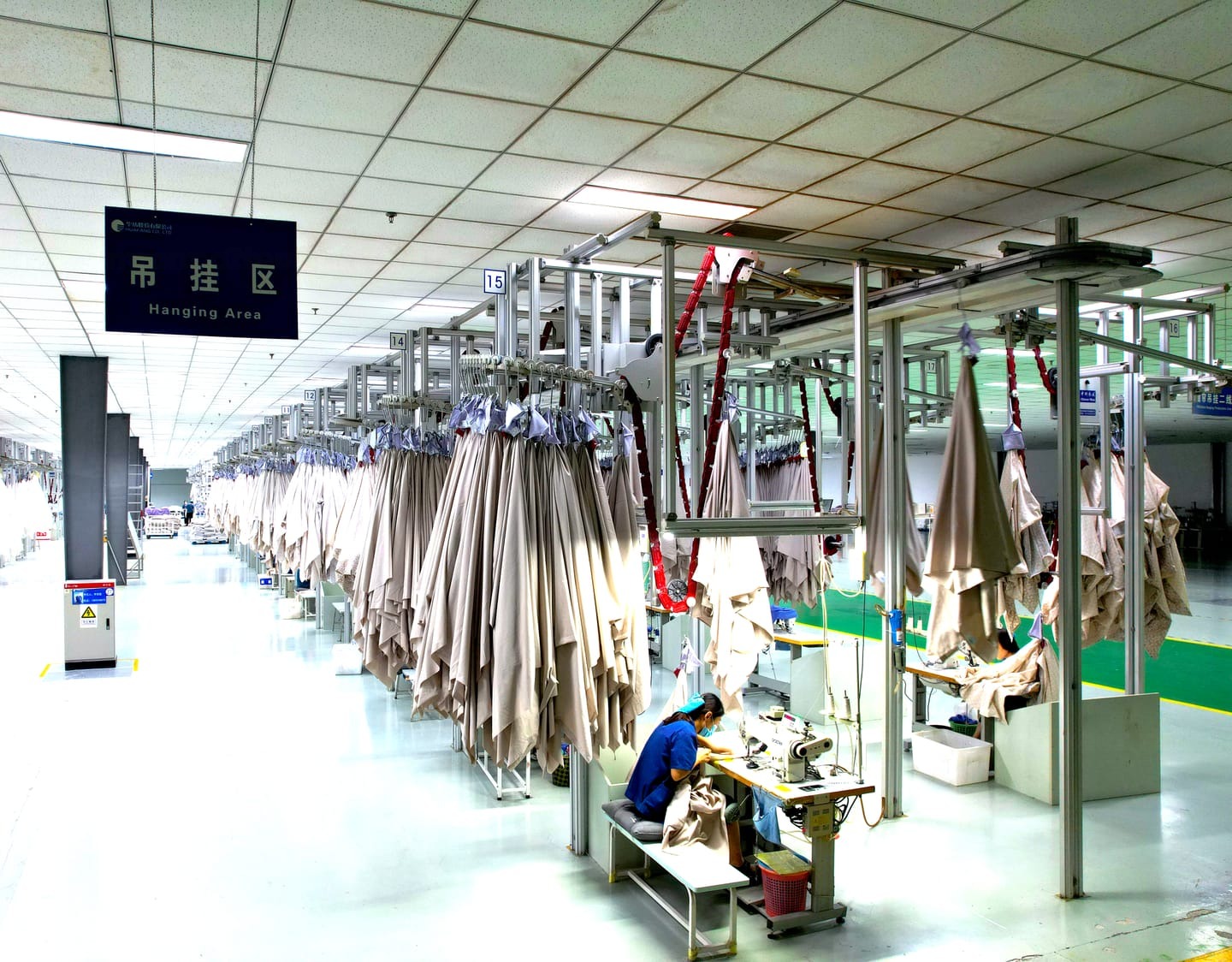
This is what CleverMax has spent more than twenty years on, and the approach is to put data capture inside the movement of material rather than add a step for someone to perform.
The CleverMax hanger system hands the carrying to a machine, so a carrier travels to the next station by itself. Its core RFID identification came out of the industry-academia partnership formed with the CAS Institute of Software in 2005: a tag on the carrier, a reader at each station entry, automatic reading as the carrier passes, and the host deciding in real time whether the piece enters. The position and dwell time of every piece is tracked automatically end to end, with no manual entry at all.
That last phrase is the line between this and a barcode.
A barcode needs a person with a scanner, and one missed scan ends the record for that piece from then on. Where two lines merge onto a single rail, scanning cannot reliably say which piece came from which. RFID settles automatic identification, real-time tracking and merge management together, at the cost of laying tags and readers across every station up front. The more stations, the larger that one-off outlay, while what it buys back is the manual entry that would otherwise be paid for every day thereafter. The two run on different timescales, which is why the sum has to be done against the station count at proposal stage rather than when the quotation arrives.
Data also needs somewhere to go. The YunDao cloud MES platform returns what is captured to production scheduling, so work-in-progress counts, completion by operation and per-piece cycle time become numbers that can be queried, analysed and acted on. Raising the level of enterprise digitalisation, as the notice puts it, is on one particular line simply those numbers existing where none existed before.
Smart manufacturing into the parks is not a slogan
What that phrase involves was spelled out eight months later in a different document.
MIIT's December 2024 reply to an NPC proposal, MIIT Proposal [2024] 181, states that associations are to be guided to work with textile smart-manufacturing system solution providers and national innovation centres in surveying the state of smart manufacturing among enterprises in key textile provinces and advising them on intelligent transformation.
A survey followed by advice means the matching is organised rather than left to a factory comparing quotes on its own. A company inside a park that asks its local industry bureau or trade association can find out what is scheduled in this round, and which plants nearby have already been surveyed.
The pace of a retrofit runs a beat behind the policy window
Equipment renewal keeps its own pace, and that pace is not set by the timetable in a document.
Design, procurement, installation, commissioning, staff adaptation and ramp-up come to several months laid end to end. Production cannot stop in peak season, so the window in which work can actually begin usually falls in the quiet months, and phasing the work extends it further. More than a quarter, in other words, separates the decision from the result.
That single beat is why the same notice means two different things to two factories. One that starts before the quiet season has time to show a result inside the policy window. One that waits until the document is close to expiry has moved nothing but a decision.
The hardest part of a retrofit to settle is rarely the equipment specification. It is the transition. Which old machines stay and which go, how the line is switched over section by section without halting production, and whether operators follow the new routine or the old one during the weeks when both exist. A proposal that answers those is the difference between a planned changeover and a shutdown gambled on the quiet season.
Sources
Every factual claim above traces to one of the following. Where a source is offline — a certificate, a printed publication — we name it without a link.
- [1] 工业和信息化部办公厅 商务部办公厅《关于开展2024纺织服装优供给促升级活动的通知》(工信厅联消费函〔2024〕131号) 2024-04-12 accessed 2026-08-27
- [2] 工业和信息化部《对十四届全国人大二次会议第8998号建议的答复》(工信建议〔2024〕181号) 2024-12-04 accessed 2026-08-27