

2010, the year garment factories found that hiring more people no longer worked
In 2010 average annual pay at urban private employers in China rose 14.1%, with the rate of increase 7.5 points higher than the year before. That October the State Council issued its Opinions on Strengthening Vocational Training to Promote Employment, placing the answer in skills and industrial upgrading. For garment factories, this was the year that adding headcount stopped adding up.
For decades a garment factory had one way to grow: hire more people, add more machines. In 2010 the arithmetic behind that method stopped working.
Start with two numbers
China's Ministry of Human Resources and Social Security reported the following in its 2010 statistical bulletin:
In 2010 the average annual wage of employees at urban non-private units nationwide was RMB 37,147, an increase of RMB 4,411 on the RMB 32,736 recorded in 2009, up 13.5% year on year, with the rate of increase 1.5 percentage points higher. In 2010 the average annual wage of employees at urban private units nationwide was RMB 20,759, an increase of RMB 2,560 on the RMB 18,199 recorded in 2009, up 14.1% year on year, with the rate of increase 7.5 percentage points higher.
Almost every garment factory sits in the second category, where pay rose 14.1% in a single year. The more consequential half of that figure is the second one: the rate of increase was itself 7.5 points higher than the year before, which means the labour cost line was not rising along a fixed gradient but steepening under it. Any owner who had costed a three-year capacity plan at 5% wage growth found the plan invalid twelve months into it, and not because he had been careless with the number. The number had changed shape.
The same bulletin reports 242.23 million migrant workers nationwide, of whom 153.35 million were working away from their home area.
That is not the profile of a country short of labour, and yet garment factories in those years could not fill their floors, least of all the skilled sewing positions. The headcount was there. The willingness to spend it on a sewing floor was not, and supply in total is a different quantity from supply by trade. A young man arriving in a city can start in electronics, in delivery or in catering within the week. A sewing floor asks him for three months at a machine before the work runs fluently, and pays an apprentice rate for those three months, so he goes where the money starts sooner.
The State Council wrote its answer into a document that year
On 20 October 2010 the State Council issued its Opinions on Strengthening Vocational Training to Promote Employment, document number State Council [2010] 36.
Opinions issued at State Council level set the tone for every province and ministry, so rather than addressing any individual company they identify the contradiction the country is facing and indicate where the way out lies. The document opens by conceding the weakness:
At the same time, vocational training work still does not meet the needs of social and economic development, industrial restructuring and the improvement of workers' skills. The vocational training system needs to be further improved, efforts need to be intensified, and its relevance and effectiveness need to be strengthened.
It then states the significance of vocational training in three clauses, of which the third points straight at manufacturing:
It is an inevitable requirement for accelerating the transformation of the economic development model, promoting industrial restructuring, and raising enterprises' capacity for independent innovation and core competitiveness.
Later that year the ministry issued a separate circular dealing specifically with hiring difficulties, the Circular on Effective Measures to Alleviate Current Structural Shortages in Employment in Some Regions, document number MOHRSS [2010] 110. When a problem has to be handled by a ministerial circular of its own, it has stopped being a seasonal difficulty in a handful of provinces.
What a structural shortage sounds like on a sewing floor
Policy calls it a structural shortage. The version an owner gives you carries more detail than that.
General labour is available, skilled operators are not. Young people will not come onto a sewing floor. An operator takes months to bring up to speed, and when the peak season ends she is liable to leave, carrying a skill this factory paid to teach her to an employer who paid nothing for it. Wages go up every year and hold nobody.
What the State Council proposed was to raise skills and upgrade the industrial structure together, and inside a garment plant those two instructions arrive at the same conclusion.
If people are becoming expensive and hard to keep, they cannot go on doing work that requires no skill at all.
How much of a skilled operator's day is not spent sewing
Anyone who has spent time on a sewing floor knows that the hours an operator actually spends at her machine are only a fraction of the shift. The rest goes into four things:
- Waiting for the previous operation to finish - Carrying half-finished pieces between stations by hand - Searching for a batch when rework or a rush order arrives - Counting work-in-progress off paper tickets
None of the four requires any sewing skill, and all four are done by the skilled operator anyway, which puts them on her clock and at her rate. The months the factory spent bringing her up to speed bought a skill that stands idle for a sizeable part of every shift.
Cheap labour absorbs that quietly. Pay rising 14.1% in a year, with the trained operators leaving regardless, turns it into a line item that has to be laid out and counted, since it is now the fastest-growing cost in the building and still the least visible one.
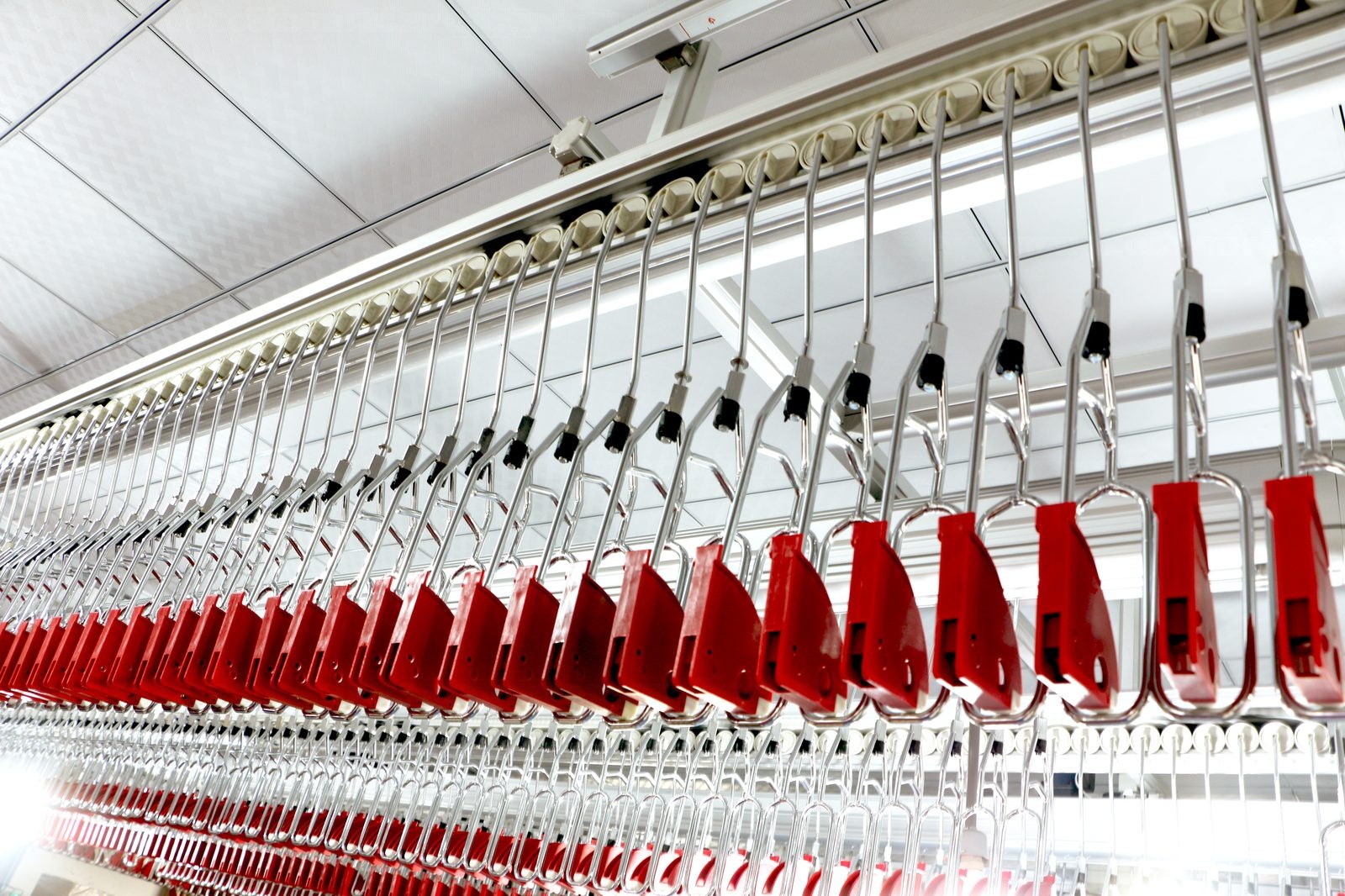
A hanger system takes all four off her. Waiting and carrying pass to the rail, where the carriers queue themselves up to the next station and the operator never leaves her seat. Searching and counting pass to the controls, which hold the station and the dwell time of every piece as it goes, so the tickets stop being counted at the end of a shift. What that buys is not a smaller headcount or a shorter line. It is the portion of one skilled operator's day that those four things had been consuming, handed back to her machine.
That is the direction the document was pointing in. Raising skills was never a matter of turning every operator into a generalist. It was a matter of spending a scarce skill only on the work that actually calls for it.
The industry had already had the signal a year earlier
In April 2009 the State Council issued the Textile Industry Restructuring and Revitalisation Plan, document number State Council [2009] 10, drawn up during the post-crisis restructuring and still running through 2010.
Side by side, the two documents make one argument from two ends, the 2009 plan from the industry side and the 2010 Opinions from the labour side. Equipment is the only bridge available between them for a simple reason of arithmetic: the hours a garment takes have to be supplied either by people or by machines, and there is no third source. Once the people become expensive and scarce, the balance shifts to the other column whether or not anyone plans for it.
In hindsight 2010 was the dividing line. Labour costs never returned to 2009 levels and the shortage of skilled operators never eased, so the factories that started automating after that year and the ones that kept growing by adding people were no longer solving the same problem, and they ended up on separate roads.
More than a decade on, the sum is easier to do
What made the decision hard in 2010 was that the number was new. A 14.1% rise had appeared for the first time, and nobody could say whether it was a one-off or the shape of the coming decade, so committing capital against it was a bet. The bet is gone. Every year of the wage curve since has gone the same way.
Most of the factories that hesitated converted eventually. What the hesitation cost them was a decade of paying a bill that never printed. The hours going into waiting, carrying, searching and counting were there the whole time, but they have never held a line of their own on any statement, which is how an owner can read his accounts every year and never once see them.
Pulling the figure out takes an afternoon. Count the hours a day that go into those four things, multiply by what labour costs now, and set the product beside the price of a hanger line. In 2010 those two numbers were close enough to argue about. With labour several times dearer, there is nothing left to argue.
Sources
Every factual claim above traces to one of the following. Where a source is offline — a certificate, a printed publication — we name it without a link.
- [1] 国务院《关于加强职业培训促进就业的意见》国发〔2010〕36号(成文 2010-10-20) 2010-10-20 accessed 2026-08-27
- [2] 人力资源和社会保障部《2010年度人力资源和社会保障事业发展统计公报》(农民工与年平均工资数据来源于国家统计局) 2011-07-20 accessed 2026-08-27
- [3] 国务院《纺织工业调整和振兴规划》国发〔2009〕10号 2009-04-24 accessed 2026-08-27