

The architecture of the first hanger system was set by people who ran a garment factory
When a carrier stops a few centimetres beyond where an operator's hand falls, she takes the garments down and keeps them within reach, the hanger system runs empty overhead, and output is what it was before the line arrived. What consumes capacity is never the sewing, but the carrying, waiting, hunting and counting in between. The routing logic in CleverMax's first-generation hanger system was established one parameter at a time on the founders' own production line, after ten years of running a garment factory.
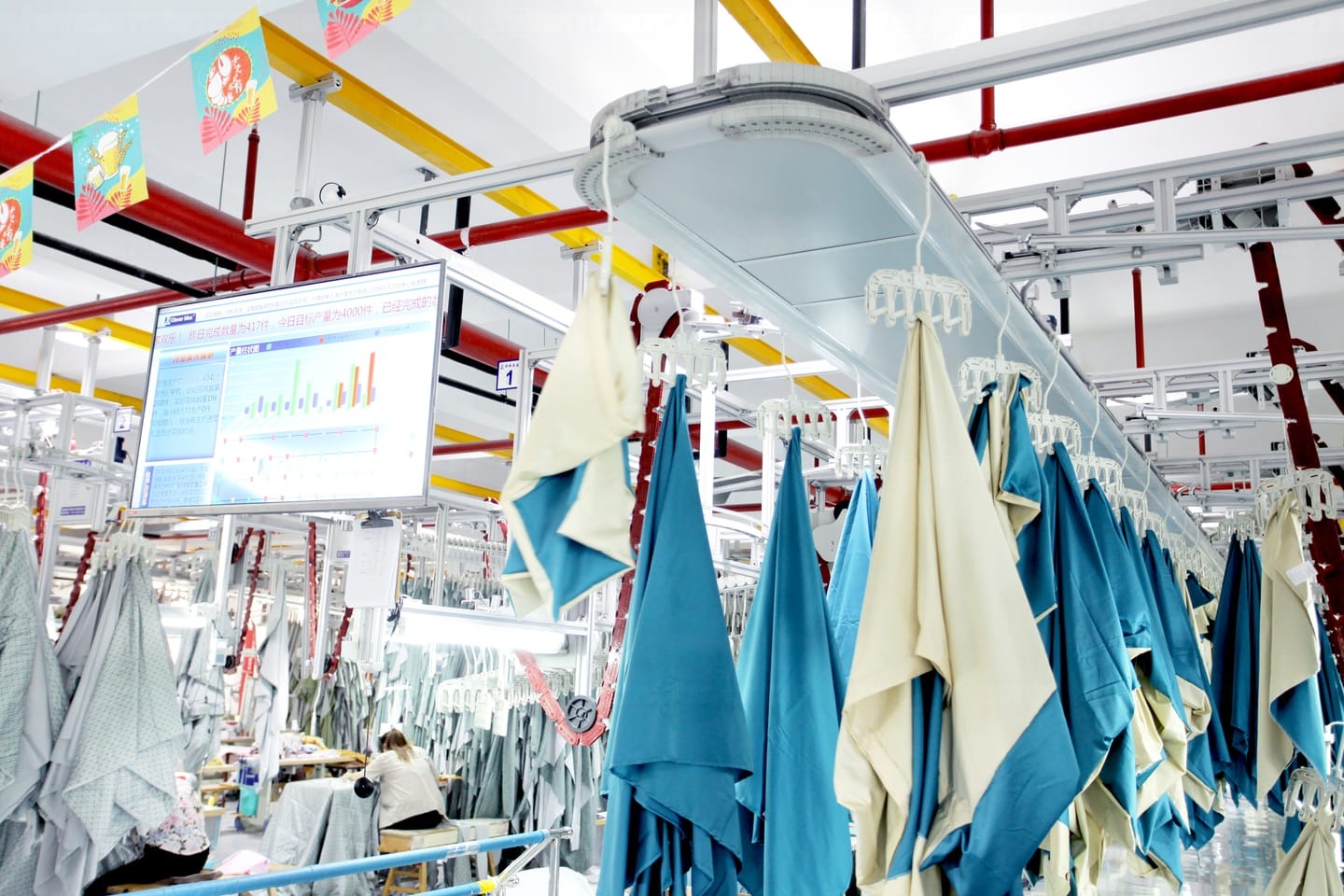
Two months after the hanger system was commissioned, the owner walked the floor and found the operators had stopped using it.
They were lifting the garments off the carriers in armfuls, stacking them beside their machines, and hanging the pieces back one at a time as they finished them. Overhead, the hanger system ran empty. When he asked why, an operator explained that the carrier came to rest a few centimetres beyond where her hand naturally fell, so every pick cost her a small lean forward, several hundred of them in a shift. It was less trouble to take the whole lot down and keep it within reach.
So the account stood like this: the money spent, the line installed, the operators trained, and output no different from the month before it arrived. The only thing that had changed was that the workshop now had a rail running above it.
A few centimetres, and whether the line pays for itself
Where a carrier should stop relative to the operator is the kind of number that looks inconsequential on a drawing, because what it is really measuring is the range in which a person's reach stays comfortable, and no one can calculate that in advance. It has to be found at the machine, watching an operator work through the pick-and-place a few times, following the travel of her arm, and moving the stop forward or back by degrees until she can reach it without thinking.
What a number arrived at that way is worth does not show until the end of a shift. Set it correctly and each pick saves a second or two, which across twenty-odd stations and several thousand pieces a day is not a second or two at all, but capacity. Set it a few centimetres off and the awkwardness repeats several hundred times a day, until sooner or later the operators find their own way round it, which means taking the garments off the line altogether. Once they do, the rail might as well not be there.
CleverMax's first-generation hanger system is full of numbers arrived at that way, and the people who arrived at them were not draughtsmen. They had spent the previous ten years running a garment factory, and they had paid for those few centimetres themselves.
Ten years of making clothes before any equipment
The usual route into this business runs the other way: engineers or software people survey an industry, conclude it is inefficient, build something and sell it in. CleverMax began at the other end. In 1993 this same group opened a garment production factory, and for ten years that is what they did, they made clothes.
A garment passes through dozens of operations between cut piece and finished product, and in that factory it travelled between them in somebody's arms. An operator would finish a bundle, stand, carry it to the next station, find somewhere to set it down, walk back, sit, and take up the machine again, half a minute a trip and several dozen trips in a day. The work stood in piles at every station, and anyone walking in could see at a glance whose pile had grown deepest.
Nobody was paid for the walking. The operators were all on piece rate. Walking earns nothing. But the alternative was to let the work bank up in your own hands, which slowed you down further, and that came out of the same pocket. So everyone walked, and walked quickly.
The scheduler's position was worse. Which station was backed up, and how much remained before an order could ship, existed only on paper tickets and in a supervisor's memory, an arrangement that held perfectly well while the order book stayed calm. Once several styles ran together and a drawer of tickets sat unentered, the quantity of work actually out on the floor became a figure nobody in the building could produce. With a customer on the telephone asking for a date, the best available answer was an approximate one, and an approximate answer is expensive in both directions: quote early and you pay the penalty, quote late and you lose the order.
Unwalkable distance on one side, undeliverable dates on the other, and the owner sat between them. Wages went out on time, output did not move, and no one could identify the stretch of line where the money was disappearing. Hiring more people only made the carrying more chaotic. The software on the market required the numbers to be typed in by hand, and what got typed in proved less reliable than the supervisor's memory.
Both problems returned every year, and nothing on the market addressed either. With nothing to buy, the only place left to work the problem out was their own floor, a year at a time.
Ten years brought the account into focus: what consumes capacity is never the sewing, it is the carrying, waiting, hunting and counting that happens between one seam and the next. Research has since put a figure on it. Handling time accounts for roughly 80 per cent of the total production time of a garment, and a comparable share of factory cost. Nobody had calculated that for them at the time. They arrived at it a day at a time, over ten years.
In 2003 they took the problem out of the garment business and founded CleverMax to solve two parts of it: let the garment travel to the next station by itself, and let progress be recorded without anyone writing it down. The first-generation hanger system was completed that year.
The four layers fixed in the first generation, unmoved since
The original idea reads plainly enough today. Hang the garment on a carrier, let the hanger system take it to the next station, and leave the operator where she sits.
Only the visible part is plain. What was actually fixed underneath it was a structure in four layers: loading of cut pieces, station-to-station flow, production data capture, and carrier routing. Twenty-odd years later not one of the four has moved, and what has changed is only how finely each is executed.
Material flow on a production line reduces, in the end, to those four things. Divide them wrongly and every feature added afterwards becomes a patch on a poor foundation, which is why a number of competitors ran for several years before going back to restructure. CleverMax was spared that step for an unremarkable reason: the people posing the question were also the people who would have to live with the answer.
When a sound architecture still will not run
This is the layer engineers most often underestimate. The four layers determine who is responsible for what. Whether the line runs is a different question, and it comes down to which piece arrives at which station at which moment. That has to match the actual rhythm of a particular floor, and match it closely. What sets that rhythm is the unequal pace of the operations themselves.
No two operations on a line take the same time. Overlocking is quick, setting a sleeve is slow, buttons are quick again, and the slowest operation, the bottleneck, sets the output of the whole line regardless of how fast everything upstream of it can work. A hanger system that feeds pieces at a fixed interval produces the condition every floor supervisor complains about: one station cannot clear its work while the station after it sits starved. Routing therefore cannot run off a clock. It has to run off the state of the station downstream, how many pieces it is holding, how quickly it is getting through them, and roughly when it will come free, all of which the system has to work out before it can decide where to send the next piece.
Three design decisions follow from this, and all three had to be settled in the first generation.
First, how much buffer to allow. Each station can hold only so many carriers, and once it is physically full, nothing more can enter, so pieces either wait on the rail or route past. A line therefore needs spare stations held in reserve to take the pieces that have nowhere else to go. How many stations are held back, and how many carriers each one holds, together make up the buffer on that line. Too little slack and a fast operation finishes with nowhere to put its work and stops to wait on a slow one. Too much and work in progress accumulates on the rail, occupying floor space and tying up cash, and if the style changes, every piece held there becomes rework. How much depends on the gap in cycle time between consecutive operations, and only someone who has scheduled a line has a feel for that gap.
Second, how rework returns to the line. On paper this is a minor branch. On a floor it happens every day. An inspection station pulls a piece, a carrier takes it to the repair operator, and it returns to inspection to be checked again, a loop that has to be routed in its own right. The difficulty is that a rework piece arrives out of turn, and the moment it does, the downstream load the system had planned around is no longer accurate. Where it re-enters the rail, what priority it takes in the queue, and how the system continues to account for it while it is off the line all had to be settled early. Left unsettled, rework falls out of the record, the work-in-progress count for the line stops reconciling, and every scheduling decision resting on that data loses its footing.
Third, the few centimetres between the machine and the person. The height of the pick-and-place, which side of the body the carrier stops on, where the pedal sits, which button an operator presses to release the carrier when she has finished a piece. What is reasonable on a drawing is not always what an operator is willing to do. There is no formula for any of it, only trying one value after another. CleverMax got through that faster than most, because the operators the first generation had to convince worked in the founders' own factory, and anything that sat badly in the hand was called out on the spot.
Once those three were settled, the routing logic came free of any individual's knowledge of the floor. And because each of them had been established on a working line rather than assumed at a desk, the same logic transfers to another plant or another product category by changing parameters rather than architecture. What makes it standardisable is not that the floor has been treated as an ideal system, but the opposite: that every place where a floor refuses to behave like one has been written down.
Twenty years on, the first thing still has not changed
Ten years in a garment factory passed before the road even began, which is slow by any measure. But by the time it did begin, what needed solving was entirely clear, and it had become clear by standing on a floor and watching. That is why it is still where the work starts.
When a CleverMax engineer walks into a customer's workshop today, the first thing they do is still not to take measurements. It is to stand and watch for a while: how the operators move, where the half-finished work accumulates, where rework comes back from, what the person doing the scheduling is holding. Where work piles up and where it waits are both visible to anyone willing to stand still long enough to see them. Only after that does anyone discuss a proposal.
Sources
Every factual claim above traces to one of the following. Where a source is offline — a certificate, a printed publication — we name it without a link.
- [1] 上海证券交易所 浙江瑞晟智能 IPO 审核问询函之回复(记载南通明兴成立于 2003 年) 2020-05-27 accessed 2026-08-09
- [2] 缝制设备网 / 《中外缝制设备》《南通——明兴:逆市上扬有秘诀》 2020-09-07 accessed 2026-08-09 · Trade press
- [3] 南通明兴科技开发有限公司 企业发展历程(公司资料) 2003 (offline source) accessed 2026-08-09 · Trade press