

6.85 million industrial sewing machines in 2024, up 22.32%: an equipment renewal wave already under way
China produced 6.85 million industrial sewing machines in 2024, up 22.32% year on year, while sector leader Jack reported revenue of 6.094 billion yuan, up 15.11%, against net profit of 812 million yuan, up 50.86%. Output up a fifth and profit up a half do not line up, and the gap says factories are buying more and buying better. What most of them then hit is the same wall.
Domestic output of industrial sewing machines reached 6.85 million units in 2024, up 22.32% year on year.
Over the same period Jack Technology, the largest firm in the sector, reported revenue of 6.094 billion RMB, up 15.11%, and net profit attributable to shareholders of 812 million RMB, up 50.86%.
Output up a fifth, profit at the top of the industry up a half. Those two figures do not line up, and the gap between them is what this piece is about.
What profit growing three times faster than revenue tells you
Revenue rose 15% and net profit rose 51%, which puts profit growth at more than three times the rate of sales.
When a manufacturer's results come out in that shape there is usually one explanation, which is that the things being sold now carry a higher price and a wider margin. Revenue built by shipping volume at the cheap end of the range comes with a compressed gross margin and cannot produce a threefold gap of that kind.
So factories have stopped buying the cheapest tier. Machines with more automation, with a control system, able to connect to a network and report data, are displacing basic models as the mainstream purchase.
Output rising a fifth says more buyers came to the market. The profit structure says they bought better machines. Both happening at once is what an equipment renewal cycle looks like.
What is driving the cycle
Several pressures are working at the same time.
Cost. Apparel export unit prices fell by more than a tenth in the first quarter of 2025 while volumes continued to rise, and when the price per piece is pushed down, cost has to follow it down, with efficiency the only component that has any give in it.
People. Skilled sewing operators are harder to recruit and more expensive to keep. For roles that add no value to the garment, carrying, stocktaking and searching for work, the labour cost has stopped adding up.
Policy. In April 2024 MIIT and the Ministry of Commerce jointly made the renewal and upgrading of ageing equipment and the raising of digital capability the first work task of the year, under document number MIIT General Office Joint Consumer Goods Letter [2024] 131.
Competitors. This one matters most, because the first three can be deferred and this one cannot. When the factory across town re-equips, brings down the labour hours in a garment and shortens its lead time, it gains room to quote. The factory that held off then feels the pressure not from a policy document but from a customer arriving with somebody else's quotation, which is a deadline set by the order book rather than by a ministry.
What happens after the machines are replaced
Most factories start their renewal with the sewing machines, and efficiency does improve when they do.
Then they tend to hit a wall.
The sewing time has been compressed, and yet the total time a garment spends on the line has barely moved. The saving was never in the operator's hands. It was in the space between one station and the next. A new machine makes an operation three seconds quicker, the operation after it is still someone walking a bundle of half-finished work across the floor, and the three seconds disappear back into the waiting.
On a garment floor the time genuinely spent sewing is only a portion of the time a piece spends on the line. The remainder goes on waiting for the operation upstream, carrying work to the operation downstream, hunting for a batch that has to be reworked, and collecting tickets at the end of a shift to establish what was actually made. None of those four adds value, and replacing a sewing machine addresses not one of them.
Which is why upgrading individual machines has a ceiling. Going past it means changing the line rather than the machines on it.
From replacing machines to reorganising the line
The line is the layer CleverMax works at.
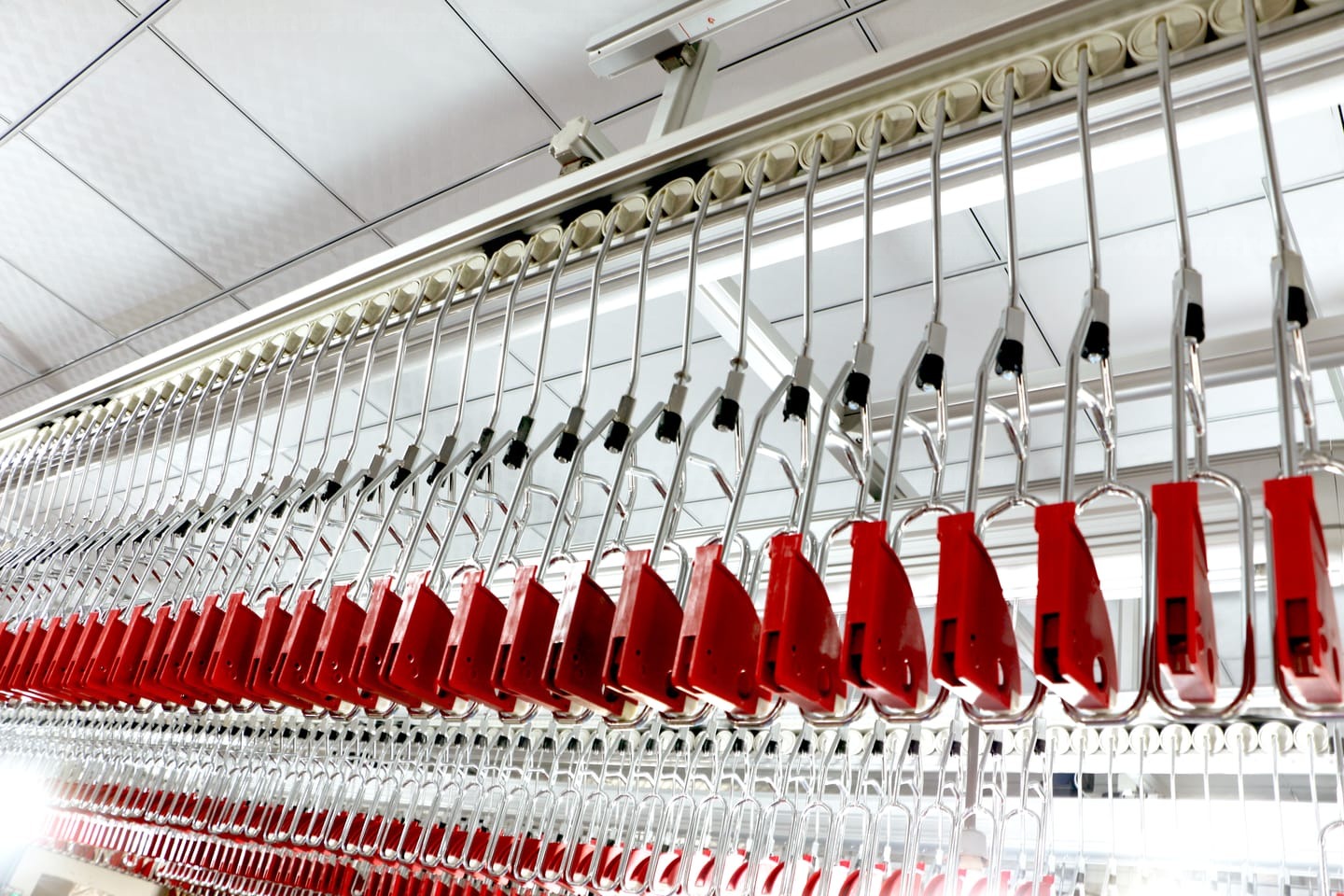
The CleverMax hanger system hands material movement to the system, so that work in progress hangs on a carrier and is routed to the next station along the process path, with nothing carried by hand and nothing accumulating in between, which compresses the wait between stations to whatever the routing allows. This is the point at which the three seconds from the paragraph above stay in the output figure instead of leaking back out.
Identification is handled by RFID, the technology behind which came out of the research partnership established with the Institute of Software at the Chinese Academy of Sciences in 2005. A tag on the carrier and a reader at the entrance to each station mean a carrier is read as it passes, and the host system decides in real time whether it should enter. The position and dwell time of every piece of work in progress is tracked throughout, with nothing keyed in by hand.
The industry ran on barcodes for years, and a barcode has to be scanned by a person, so a missed scan breaks the chain and two styles running merged become impossible to separate. RFID settles automatic identification, live tracking and merged-style management together.
The YunDao cloud manufacturing MES platform feeds what the line reports back into scheduling. Which station is backing up, which style has fallen behind, how tomorrow should be laid out, all become figures that can be looked up rather than judgements drawn from experience. This is what the policy documents mean when they talk about equipment and software being joined into a working line.
Timing
The renewal cycle is already running. Output up a fifth and profit at the top of the industry up a half indicate that a good number of factories have already moved.
Of the three figures in this piece, though, the ones to remember are not the first two. The 6.85 million units and the 50.86% describe how far other people have got, and neither has any direct bearing on a particular factory's accounts. What matters is the wall that comes after the sewing machines are replaced: the new machines are in, the individual operations are genuinely faster, and the question is whether shipped output rose with them.
If it did not, those seconds are stuck between the stations, and another round of machines will leave them stuck in the same place. Establishing that does not require anyone to come and measure it. Two months of shipping records will show it. Once it has been established, a conversation about the line stops being a conversation about buying equipment and becomes one about recovering the seconds already paid for.
Sources
Every factual claim above traces to one of the following. Where a source is offline — a certificate, a printed publication — we name it without a link.
- [1] 证券日报《缝制机械行业景气度回升 龙头企业业绩增长》 2025-05-15 (offline source) accessed 2026-08-27 · Trade press
- [2] 工业和信息化部办公厅 商务部办公厅《关于开展2024纺织服装优供给促升级活动的通知》(工信厅联消费函〔2024〕131号) 2024-04-12 accessed 2026-08-27