

A national target with teeth: 70% of large textile firms digital and networked by 2025
Four ministries have set a target: by 2025, 70% of large textile enterprises are to be substantially digital and networked. The threshold for "large" is annual main business revenue above 20 million yuan, low enough that an apparel plant of two or three hundred people is on the list. This is not a bonus for the leaders. It is a pass mark that seven in every ten firms are expected to clear.
On 28 November 2023 four ministries, MIIT, the National Development and Reform Commission, the Ministry of Commerce and the State Administration for Market Regulation, jointly issued the Textile Industry Quality and Upgrading Implementation Plan (2023-2025), document number MIIT Joint Consumer [2023] 232.
It is a short document, and it contains one number that anyone running a sizeable textile plant ought to know.
Seventy per cent is a pass mark, not a prize
By 2025, the plan states, 70% of large textile enterprises are to be substantially digital and networked.
"Large" here means an industrial firm with annual main business revenue above 20 million yuan, which is a low enough bar that an apparel or home-textile plant of two or three hundred people is almost certainly on the list. The sentence therefore does not say that the leading firms in the sector should get to seven in ten. It says that seven of any ten firms on that list should, which leaves the remaining three not merely behind the pace but outside the target the ministries have set themselves.
What separates a pass mark from a prize only becomes visible outside the factory gate.
In a tender, the buyer's questions are no longer about how many lines and machines there are, but about whether work-in-progress can be shown and whether a delivery date has anything behind it. Where a supply relationship requires two systems to talk to each other, the fallback when they cannot is a spreadsheet emailed once a day. And when a competitor quotes a lead time that looks impossible, it is usually data rather than overtime that has compressed it. Taken together, these do not stop an undigitised plant from winning work. They narrow it to the work of customers who do not ask.
Smart manufacturing gets a priority task of its own
Of the seven priority tasks the plan sets against its targets, the third is vigorously develop smart manufacturing and raise the industry's quality and efficiency, and it names three things: industrial software and production equipment for smart manufacturing, wider spread and application of digital and intelligent technology, and innovation platforms and service platforms to support both.
They are listed separately because on a factory floor they go missing separately.
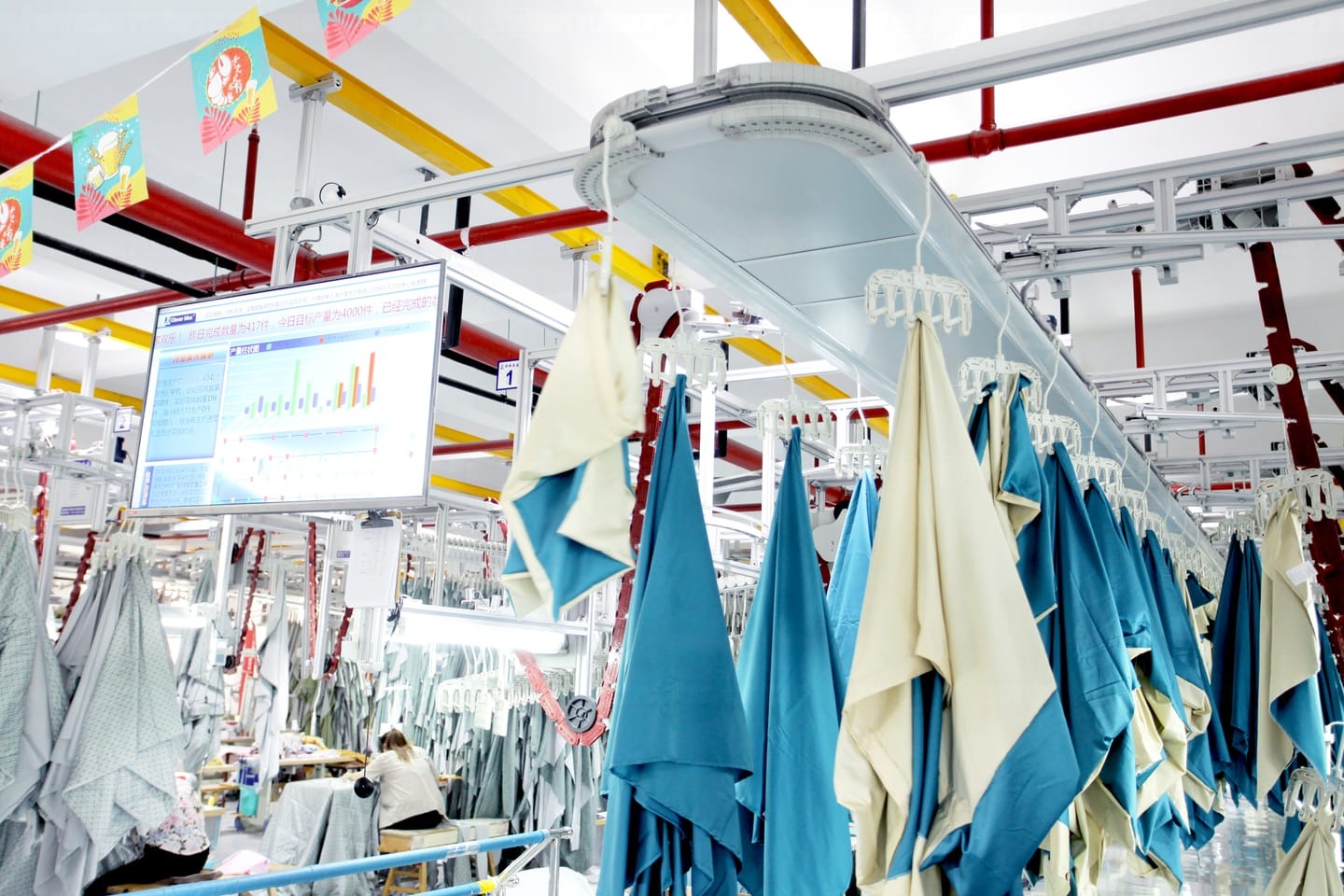
Where the equipment is missing, half-finished work still travels between stations in somebody's arms, and the distance a garment covers in a shift adds up to more time than the sewing does. Where the software is missing, the machines have been bought but each one's data stays inside it, legible to nobody. The third case, the one covered by that phrase about spread and application, is the plant where equipment and software are both installed and neither is used: the operator does not press the release button, the supervisor still counts off paper tickets, and the figure in the system stops reconciling with the garments hanging on the line.
None of the three is closed by a purchase order. Equipment has to be specified, software has to be connected, and a workforce has to be taught a different set of movements before any of it holds. Joining those three stretches is what CleverMax has been doing for more than twenty years, with the CleverMax hanger system carrying material and capturing data, the YunDao cloud MES platform returning that data to scheduling, and in between a set of parameters that engineers arrive at one at a time while standing on the floor.
Where the money comes from is written into the safeguards
Most companies read a policy document for the funding before they read it for the tasks. The second safeguard measure says this:
Increase funding support. Coordinate existing channels and increase support from fiscal, financial, securities and social capital sources for textile technological innovation, green development, smart manufacturing and public services.
The load-bearing phrase is coordinate existing channels. No new fund is being created. What is being asked is that the channels already in place, technical-renovation programmes, equipment-renewal subsidies, smart-factory recognition awards, be pointed the same way. Application windows, qualifying criteria and co-funding ratios for all of those sit with provincial and municipal authorities and vary considerably between them, which is why whether a retrofit project stands up often depends less on the quality of the proposal than on how the local industry bureau has written its criteria for the year. Asking before the project is defined costs a great deal less than assembling supporting material after the design is frozen.
Three documents, and the direction has not moved
One document can be a passing breeze. Three in succession cannot.
In April 2024 the General Offices of MIIT and the Ministry of Commerce issued a notice on the 2024 textile and apparel supply-improvement campaign, MIIT General Office Joint Consumer Letter [2024] 131, whose first work task is to promote the renewal and upgrading of ageing equipment, raise enterprise digitalisation, carry smart manufacturing into the industrial parks and assist enterprises with intelligent upgrading.
That December, replying to Proposal No. 8998 of the second session of the 14th National People's Congress under MIIT Proposal [2024] 181, the ministry gave a full section to accelerating the intelligent upgrading of textile equipment and undertook to continue supporting textile enterprises in building smart factories.
A target, then a named category of equipment, then a stated means of support: across little more than a year, each later document pushes the earlier one toward something a factory can act on. For the people inside one, that removes the part of the decision that was a bet on policy.
Digital and networked, restated as a question the floor can answer
Read cold, being digital and networked sounds like a list of equipment to buy. As a self-assessment it reduces to a single question. At this moment, how many pieces are in progress, which station is each sitting at, and how long has it been there, without asking anyone.
A line that can answer is networked in the sense the document means, even if none of its machines are new. A line that cannot has nothing to do with the 70%, even if every machine was bought this year.
Against a 2025 deadline there is not a great deal of room. Taking a line from specification through to output back at its original level spans several months, and the part of that stretch in which work can physically begin has to fall in the quiet season, because production cannot stop in peak. The deadline therefore arrives earlier than it reads. A plant that intends to answer the question above by 2025 has to begin a full production cycle before then.
Sources
Every factual claim above traces to one of the following. Where a source is offline — a certificate, a printed publication — we name it without a link.
- [1] 工业和信息化部 国家发展改革委 商务部 市场监管总局《关于印发〈纺织工业提质升级实施方案(2023—2025年)〉的通知》(工信部联消费〔2023〕232号) 2023-11-28 accessed 2026-08-27
- [2] 工业和信息化部《〈纺织工业提质升级实施方案(2023—2025年)〉解读》 2023-12-11 accessed 2026-08-27