

Four CISMA shows on, what visitors ask at the CleverMax stand has changed
CleverMax appears in the official CISMA exhibitor directory for 2017, 2019, 2023 and 2025. The stand moved from Hall E1 to Hall E2, and what stands on it is still a hanger system. The real signal is in the first thing visitors say. It used to be "what does a line like this cost". Now it is "my floor is chaos, will putting it on a rail sort that out".
CISMA, the China International Sewing Machinery & Accessories Show, runs every two years, and the industry treats it as a report card. Who is still on the floor and who has quietly disappeared is answered by one pass through the official exhibitor directory.
CleverMax's entries read 2017 at stand E1-D61, 2019 at E1-A62, 2023 at E2-A42 and 2025 at E2-A62. The 2021 edition was cancelled because of the pandemic. Across eight years and four shows, either side of the pandemic, CleverMax has not missed one.
In an industry that reshuffles this often, showing up four times running with the same thing on the stand is already a filter.
The stand number changes. What is on it does not
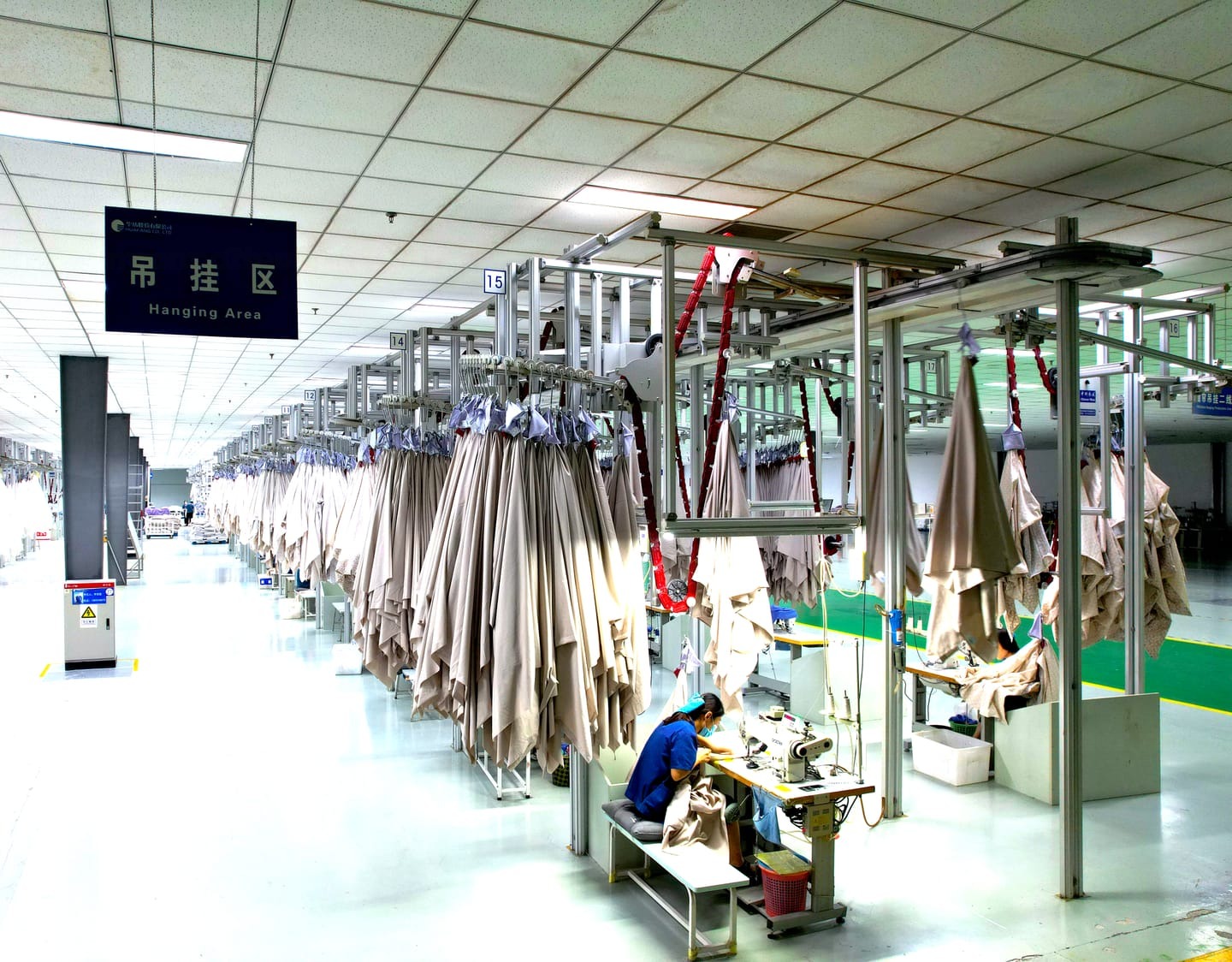
Across those four shows the centre of the CleverMax stand has always been one thing: a hanger system. No chasing whatever was fashionable, no switching lanes.
What genuinely changed is the first thing customers say when they walk up. That sentence is a more sensitive instrument than any market report, because it points straight at whatever hurts most this year.
In 2017 the common opening was "what does a line like this cost". The customer had a machine in mind and was pricing ours against somebody else's, comparing cost per metre of rail and cost per station.
By 2023, as the trade site Shifair reported at the time, the stand was showing established ways to fit a hanger system to made-to-measure tailoring, mixed-flow production across several lines, and heavy home textiles. The question had moved with it. Not what the line costs, but "my floor is chaos right now, will putting it on a rail sort that out?"
No supplier created that shift. The order book did
Nobody in equipment sales educated customers into this. It was forced on them by the shape of their orders.
Over the past decade apparel plants have been taking smaller batches, more styles and shorter lead times. Where one style used to occupy a line for two months, the same line now sees several styles in a week. A line that only runs one style cleanly cannot absorb that work.
And the reason it cannot is not a shortage of capacity. It is that nobody can sequence it fast enough. A supervisor cannot hold the position of dozens of orders in their head, and the numbers on paper tickets are always half a day behind the floor. By the time you notice an order has stalled, the delivery date is already gone.
So what customers care about moved off the equipment and onto whether the system knows where every piece is.
The CleverMax answer: data that generates itself
The product is still a hanger system. It simply has to answer that question now.
The answer is plain enough. An RFID tag on every carrier, a reader at every station entrance. Where a garment is and how long it has waited is recorded the instant the carrier passes the reader. Nobody scans anything. Nobody fills in a ticket.
That is fundamentally different from a barcode approach. A barcode has to be scanned by hand, so one missed scan on a busy day breaks the chain for that piece, and where two lines merge a barcode cannot tell one piece from another. RFID settles automatic identification, real-time tracking and merge management in a single stroke.
This capture layer comes out of the industry-academia partnership CleverMax established with the CAS Institute of Software in 2005, and it is the root of the whole technical approach. With that data, production can be re-sequenced against actual status instead of a supervisor's estimate. The things on the stand labelled "platform" or "system" are outlets for that data, not separate products with their own price tag.
Heavy goods: the heavier the load, the better the arithmetic
Heavy loads are the other thread drawing more attention to the stand each year.
A duvet, a mattress cover or a set of curtains is not in the same weight or bulk class as a shirt, and a standard carrier simply will not hold one. That demand came from home-textile plants first. They saw what apparel factories were getting and asked whether the same rail could carry their goods.
To carry them, rail, carrier structure and turn radius were all recalculated. To be clear about what belongs to whom: the duvets and curtains are the customer's product. Ours is the system strong enough to move them reliably.
There is a counter-intuitive but very practical point here. The heavier the goods, the more visible the return. Heavier product means manual handling accounts for a larger share of total hours, and more of the soiling, crushing and rework that handling causes. Remove that cost and you save more than a light-fabric plant would.
Trade shows have one further use for an equipment company
You get to watch dozens of competitors demonstrate live, in one place, on one day. Who is solving what, which stands customers refuse to leave, which concepts sound good but will never reach a real factory floor. A day on the floor tells you more than any market report.
That is the other reason CleverMax has not skipped a show. We come to be seen, and we come to look.
Before the next one, work out what your own opening question is
The next CISMA falls in 2027, which leaves two years in which order books will fragment somewhat further than they already have.
What a visitor takes home from any stand at that show will be largely determined by the sentence they open with. Ask what a line costs and the answer can only be a configuration sheet, which is a document that cannot be reconciled against a particular factory once the visitor is back on their own floor. Ask whether a hanger system can untangle the mess a specific workshop is in, and the person on the stand has to ask about product mix, batch profile, floor conditions and existing machinery before they can say anything useful, because without those four things the arithmetic does not exist. Which means the better question is not one that occurs to anyone in a hall. It comes from having gone through the numbers at home first.
Those numbers are ordinary ones. How many times a month a line changes style. How many pieces are lost in the first hour after each change. How much of a supervisor's day goes into answering where a particular batch has got to. Every factory already has all three sitting in its records, and what is missing is only the habit of reading them together. A factory that has read them will not need to think of a question in 2027, because it will have been carrying one for two years.
Sources
Every factual claim above traces to one of the following. Where a source is offline — a certificate, a printed publication — we name it without a link.
- [1] CISMA2025 官方参展商名录(展位 E2-A62) 2025 accessed 2026-08-06
- [2] CISMA2023 官方参展商名录(展位 E2-A42) 2023 accessed 2026-08-06
- [3] CISMA2019 官方参展商名录(展位 E1-A62) 2019 accessed 2026-08-06
- [4] CISMA2017 官方参展商名录(展位 E1-D61) 2017 accessed 2026-08-06
- [5] 世展网《CISMA2023 明兴科技参展报道》 2023-09-05 accessed 2026-08-06 · Trade press