

The first line shipped abroad went to Myanmar, and it forced the real lesson
In 2007 CleverMax delivered its first overseas hanger system project, in Myanmar. It forced a question that never comes up domestically: with none of the supplier's people on site, does the line still run? Answering it is what later carried CleverMax into more than twenty countries.
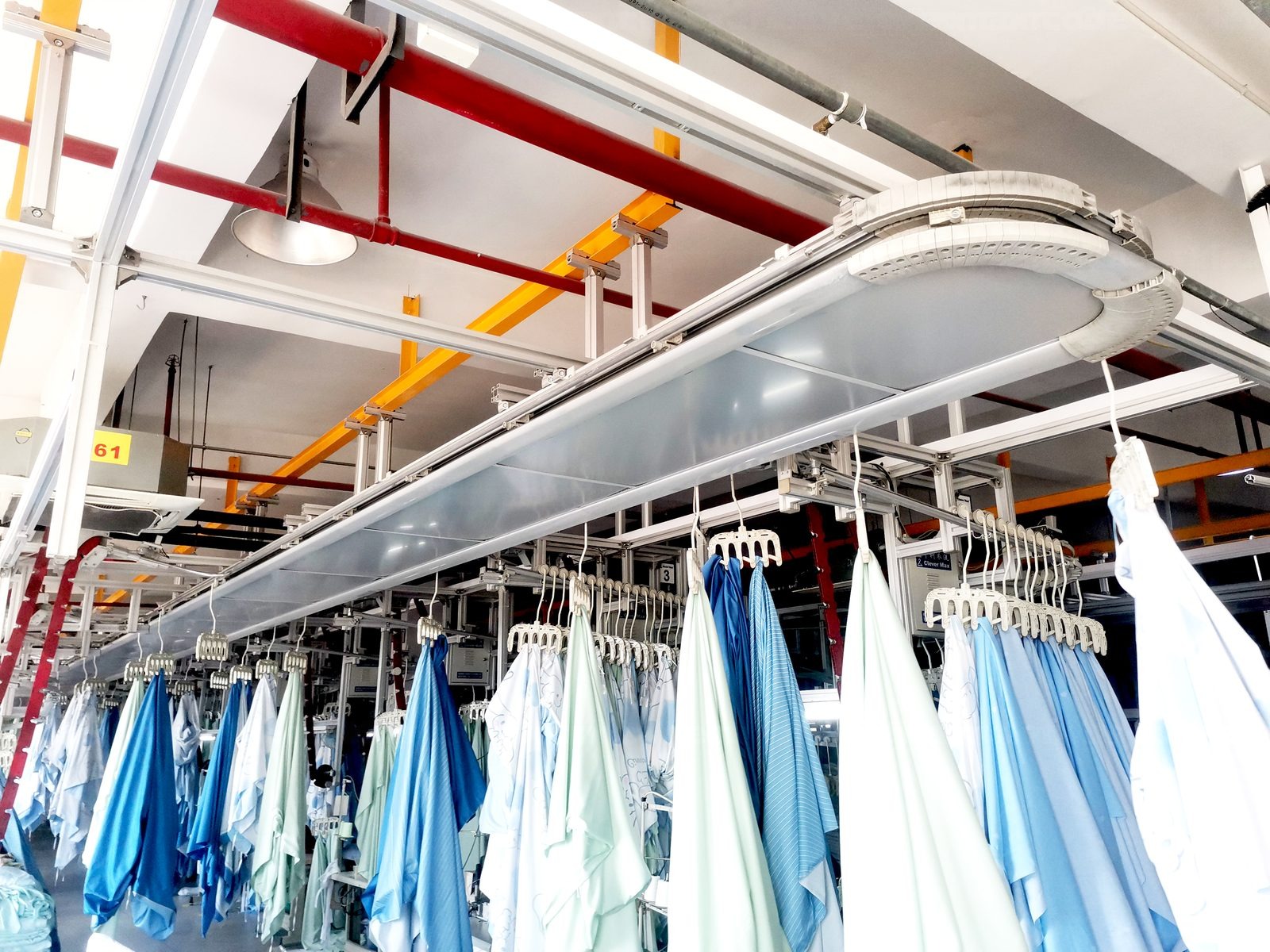
In 2007 CleverMax delivered its first overseas hanger system project, in Myanmar.
It was not the product of a strategy. Those were the years when Chinese apparel capacity was moving into South-East Asia, and among the customers opening plants in Myanmar, Vietnam and Cambodia, one asked whether CleverMax could put a line in over there. The answer was yes.
A question you can dodge at home and must answer abroad
Doing it revealed that an overseas project is not the same species as a domestic one.
When a domestic customer has a problem they telephone, and an engineer is on site the next day. Not in Myanmar, where a visa has to be arranged, the travel takes days and nobody shares a language, so a single site visit costs ten times or more what it costs at home. Once the cost of showing up runs that high, the informal safety net of sending someone when it goes wrong is gone.
Which leaves a question that cannot be avoided: with none of the supplier's people on site, can this line keep running by itself?
In China that question can be dodged, because someone can always drive out. In Myanmar it has to be answered, and being forced to answer it honestly changes a good many design habits.
Three things forced on the product in 2007 that became core capabilities
First, installation had to be completable by non-specialists. Some steps on a domestic project rely on an experienced hand, the kind of thing that resists being written on a drawing but takes ten seconds to demonstrate on site, and that demonstration does not travel. Those steps had to become procedures someone can follow, and anything that could be marked on the part itself was marked on the part. The unexpected return came at home, where installations got faster because the veteran no longer had to be present at every site.
Second, faults had to announce themselves. Problems that used to need an engineer's eyes to diagnose become a week of stopped production when the engineer is a flight away, so the system had to report which segment and what condition, clearly enough for a local maintenance technician to act on it. No factory owner needs reminding what a stopped day costs in missed delivery dates.
Third, the spares strategy is a different discipline entirely. Domestically you ship next-day. Abroad you stock for the worst case and decide in advance what must sit at the customer's site and what can wait for freight, because get that judgement wrong and a part worth a few pounds holds a whole line down for a fortnight.
In 2007 all three were improvised responses to one difficulty. They turned out to be the actual barrier to entry in international work. Selling equipment abroad is not hard. Having it run for years somewhere you cannot see is hard.
The capacity moved. Did the management problems move with it?
Customers opening plants in Myanmar, Vietnam and Cambodia went for cheaper labour. Cheap-labour locations tend to have fewer skilled operators, higher turnover and thinner management experience, which means the domestic habit of leaning on veteran hands, a supervisor's memory and a drawer of paper tickets travels badly, since all three take years of continuous service to build up and those floors turn over their people twice a year.
The four wastes of a garment workshop weigh more heavily in a plant like that. Waiting while the previous operation finishes, carrying work in your arms, hunting down a batch when it comes back for rework, and totting up tickets to see where an order stands. The greener the workforce, the more time those four consume, and no labour rate is low enough to absorb it.
A hanger system is therefore worth more in that setting, not less. It hands material flow to the rail and progress capture to the system, so an operator does one operation, decides nothing about where a piece goes next and writes nothing down. For someone two weeks into the job, the amount that has to be learned falls by more than half. On the management side, it is the first time anyone can watch the plant in real time rather than waiting for a month-end reconciliation.
From one order to more than twenty countries and nine offices
From that first Myanmar order through to 2020, CleverMax systems reached successful installations in more than 20 countries, with offices established in nine of them.
The offices are part of the answer to the 2007 question. A system that reports its own faults tells you which segment is in what condition, and somebody still has to decide which part to change and change it. Some distances cannot be closed by remote support, so someone has to be in that time zone, able to reach the site the same day and able to talk a maintenance crew through the work in their own language.
For a customer building in South-East Asia, South Asia or Africa, that matters more than a specification sheet. What is being bought is not a rail. It is the uptime of that line over the next five to eight years.
Going to Myanmar first turned out to be luck
In hindsight, going to Myanmar rather than Europe or the United States was lucky, because plant conditions, power stability and the experience level of maintenance staff were all more demanding there than at a typical domestic customer of the period.
A system that stays up under those conditions will not struggle much anywhere else. A product tuned in ideal conditions is exposed the moment reality touches it, while a product raised in hard conditions only steadies as conditions improve.
It is also why an export design is never a domestic configuration shipped abroad. Whether the local voltage dips, whether the building is tall enough, how many people on the maintenance crew can read an alarm: those go into the drawing, and only then has the line really landed.
Sources
Every factual claim above traces to one of the following. Where a source is offline — a certificate, a printed publication — we name it without a link.
- [1] 缝制设备网 / 《中外缝制设备》《南通——明兴:逆市上扬有秘诀》 2020-09-07 accessed 2026-08-09 · Trade press
- [2] 南通明兴科技开发有限公司 企业发展历程(公司资料) 2007 (offline source) accessed 2026-08-09 · Trade press