

The fifth generation: dozens of orders on one line, no tangle, no stoppage, no reliance on a supervisor's memory
CleverMax released its fifth-generation flexible hanger line in 2017 and exhibited at CISMA the same year. The first four generations had settled whether a piece moves by itself, whether the data exists and whether heavier goods stay on the rail. The fifth faced tangle instead, with a style down to a few hundred pieces or a few dozen, dozens of orders live on one line at once, and every style running a different route. The constraint was no longer capacity but scheduling.
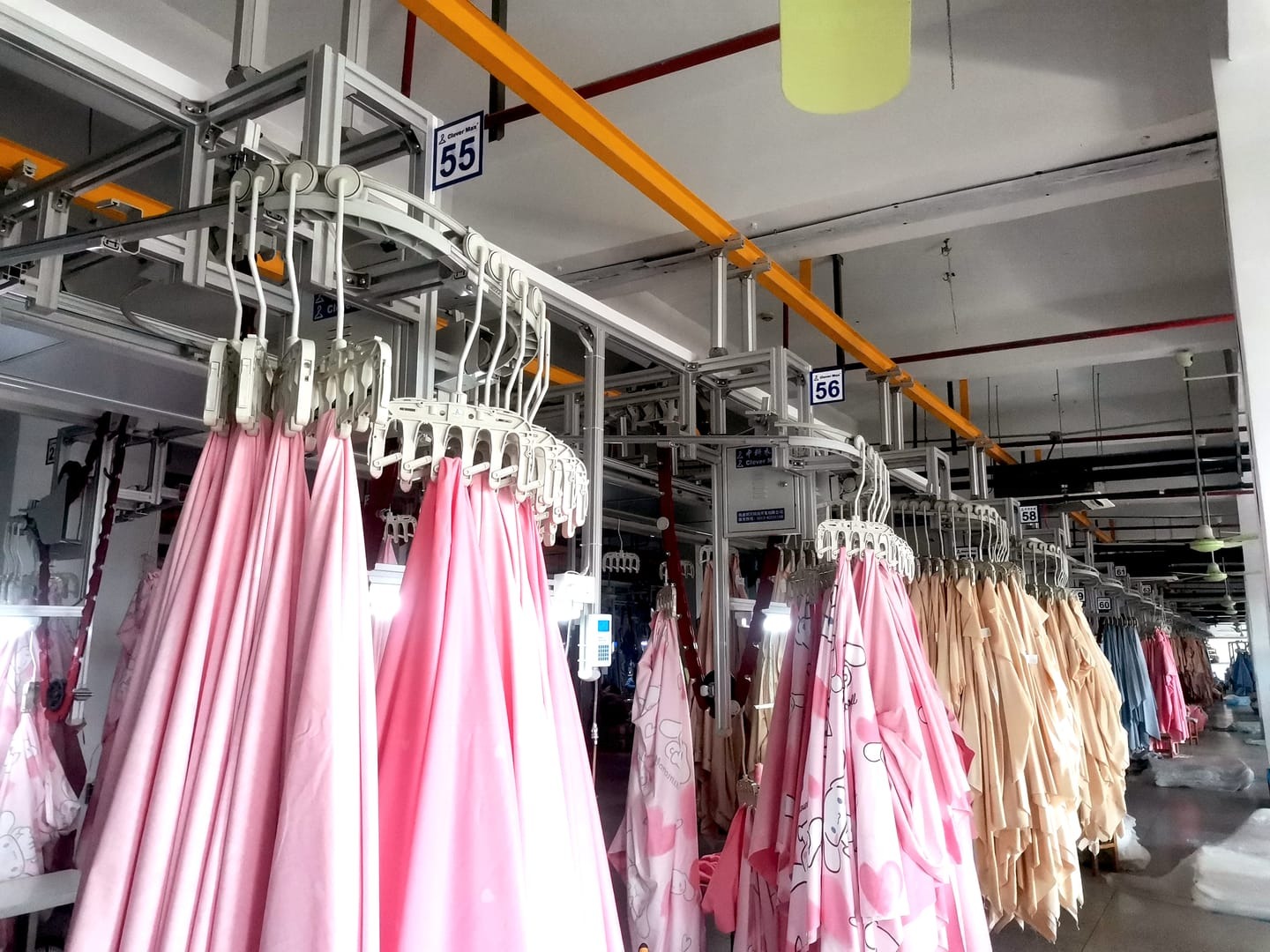
In 2017 CleverMax released the fifth-generation flexible hanger production line, and exhibited at CISMA that year from stand E1-D61.
Counting from the first generation in 2003, that was the fourteenth year of this product line and its fifth generation. The first four ran along a single thread: whether a piece can travel on its own, whether the data can appear on its own, and whether heavier goods will stay on the rail. Once those three were settled, the problem left over had nothing to do with either mechanics or identification.
The order book changed shape while the line stayed sequenced for one style
Over roughly a decade, the orders arriving at garment plants had quietly changed shape.
Batches shrank, styles multiplied, lead times contracted. A style used to mean thousands of pieces, which let a plant sequence its stations around that style and run straight through for a month without much intervention. A style may now be a few hundred pieces, or a few dozen, with a dozen or several dozen different orders live on one line at the same time.
Send that order book into a conventional line and capacity is not what binds. The machines are the same machines and the operators the same operators, so the pieces a day still come out. What binds is deciding who should receive which piece and when.
Every style runs a different route. One passes through 28 operations, another only 19. One needs special handling at operation 12 and another skips it outright. Running dozens of styles on one line therefore means running dozens of routes at once across a shared set of stations.
No supervisor's memory holds that. Keeping dozens of routes in mind, along with how far each has progressed and how many pieces each station is holding, would be hard enough if the figures were stable, and they change every hour. When the memory gives out, the outcome is usually one of two. Either the work is split into style batches and changed over several times a day, which loses the efficiency in the changeovers, or the mix is forced through until the floor fills with half-finished pieces nobody can assign, at which point rework means going through them by hand to find which order each one belongs to.
Three capabilities, following the three places the line binds
First, every piece follows its own route. The route map does not live in the central controller. It lives on the carrier, which arrives knowing the order it belongs to, the stations it needs and the stations it skips, leaving each station to read it and decide whether to admit it. A line therefore never has to be re-sequenced around one style, and dozens of styles genuinely run together.
Second, dynamic line balancing. Separate routes do not stop loads from colliding. In mixed-style running, station loads shift continuously with the order mix, and a station with spare capacity this hour can be physically full the next. When work piles up at one station, following pieces that need the same operation are diverted automatically to other stations that can perform it. A person cannot do this, not for want of arithmetic but because the situation moves faster than anyone can walk over to look at it, and by the time a supervisor sees a pile it has been forming for a quarter of an hour.
Third, bottleneck scheduling. Diverting pieces only moves them out of the way, while output remains set by the slowest operation. The system reads the current bottleneck out of the live distribution of work in progress and directs following pieces and spare stations toward it. Identify the bottleneck correctly and you have the switch for the whole line's capacity.
All three rest on the 2006 patent
All three sound like algorithms, and an algorithm needs numbers to work on. Where those numbers come from was settled in 2006.
Invention patent CN100493401C, "A monitoring method and system for intelligent material distribution", was filed by CleverMax's partner the CAS Institute of Software, with CleverMax founder Yu Ming among its named inventors. The approach it established is an RFID tag on the carrier, a reader at each station entry, the host deciding entry in real time, and a PLC controlling the gate precisely.
Without accurate positions and dwell times for work in progress, there is no way to tell which operation is the bottleneck, and without the bottleneck, balancing has no idea where to divert to, so diverting can move pieces into somewhere more congested than where they started. That is why software-only offerings so often fail to land on a real floor. The algorithm is sound, the numbers going into it were keyed in after the fact, and figures entered after the fact trail the floor by half a day.
Above that layer, the YunDao cloud MES platform feeds the same numbers back into production scheduling, so what a supervisor sees at the end of the rail and what a scheduler sees in the office are one live picture, with no reconciliation to get through before a decision.
The order book has since settled the question
By 2023, small batches, many styles and short lead times had spread from made-to-measure work into ordinary garment plants and become the normal condition almost everywhere. Brands squeeze lead times, e-commerce repeat orders arrive fast, consumers want ever finer variation, and all of that pressure lands on the shop floor.
The question visitors brought to the CleverMax stand at CISMA changed with it. Not what a line costs, but whether the mess currently on their floor can be untangled by putting it on a rail.
It can, because the line was built to move one piece at a time
The unit a fifth-generation line schedules is a single garment rather than a batch. One piece hangs on one carrier, and the route it takes and the station it enters are decided by the system from that piece's own process path. Running dozens of styles down one line is therefore the ordinary case, and single-piece customisation runs on exactly the same logic: styles in the same category, with process paths close to one another, can be mixed straight onto one line, with no need to split lines or to finish one style before starting the next.
Mixed flow is a phrase that covers rather different practices. Plenty of lines on the market still schedule by the batch: a style runs for a stretch, changing style means clearing the line, and there is a ceiling on how many styles can be in progress at once. Identification rests on barcodes, a barcode has to be scanned by a person, and a missed scan drops that piece out of the system, which with dozens of styles moving together is enough to lose track of which is which. A batch-scheduled line can handle small runs, but every changeover costs a clear-down and a resequence, and the more fragmented the order book, the more visible that cost becomes.
Bringing the scheduling unit down to one piece is what the RFID tag on the carrier buys. Nothing is scanned by hand, so nothing drops out of the chain. That trade was settled in the 2006 patent: an extra layer of hardware to build, in exchange for knowing where every piece is and how long it has been there while dozens of styles run together.
Most style lists arriving from a garment plant sit inside that range. Shirts, suits, outerwear, home textiles: within a category the skeleton of the process is stable and what varies is detail and quantity, which is the mix a fifth-generation line takes as it comes. What warrants a longer conversation is a combination that crosses categories, where the process paths diverge widely, and the layout and the number of spare stations to hold back have to be worked out against the actual style mix and the space available.
This is not a comparison anyone needs to sit and do in their own office. Send CleverMax the list of styles currently in production and a floor plan, incomplete though either may be, and an engineer will work them through against the process paths and come back on whether those styles belong on one line, how that line should be built, and how many spare stations to hold back. Most plants are told it can be sequenced. Where it cannot be straight away, the same calculation is what shows where the gap sits and what would close it.
Sources
Every factual claim above traces to one of the following. Where a source is offline — a certificate, a printed publication — we name it without a link.
- [1] 南通明兴科技开发有限公司 企业发展历程(公司资料) 2017 (offline source) accessed 2026-08-10 · Trade press
- [2] 中国国际缝制设备展览会(CISMA)官方参展商名录 2017(展位 E1-D61) 2017 (offline source) accessed 2026-08-10 · Trade press