

Garment plants stopped putting up buildings that year and spent the money on the lines inside
Fixed-asset investment in Chinese apparel fell 1.5% in 2018, while value added in textile machinery rose 9.5% the same year. One shrinking, one growing, and the apparent contradiction says one thing: the money was not going into new buildings. It was going into equipment inside the plants that already existed. A national demonstration list published that autumn confirmed it.
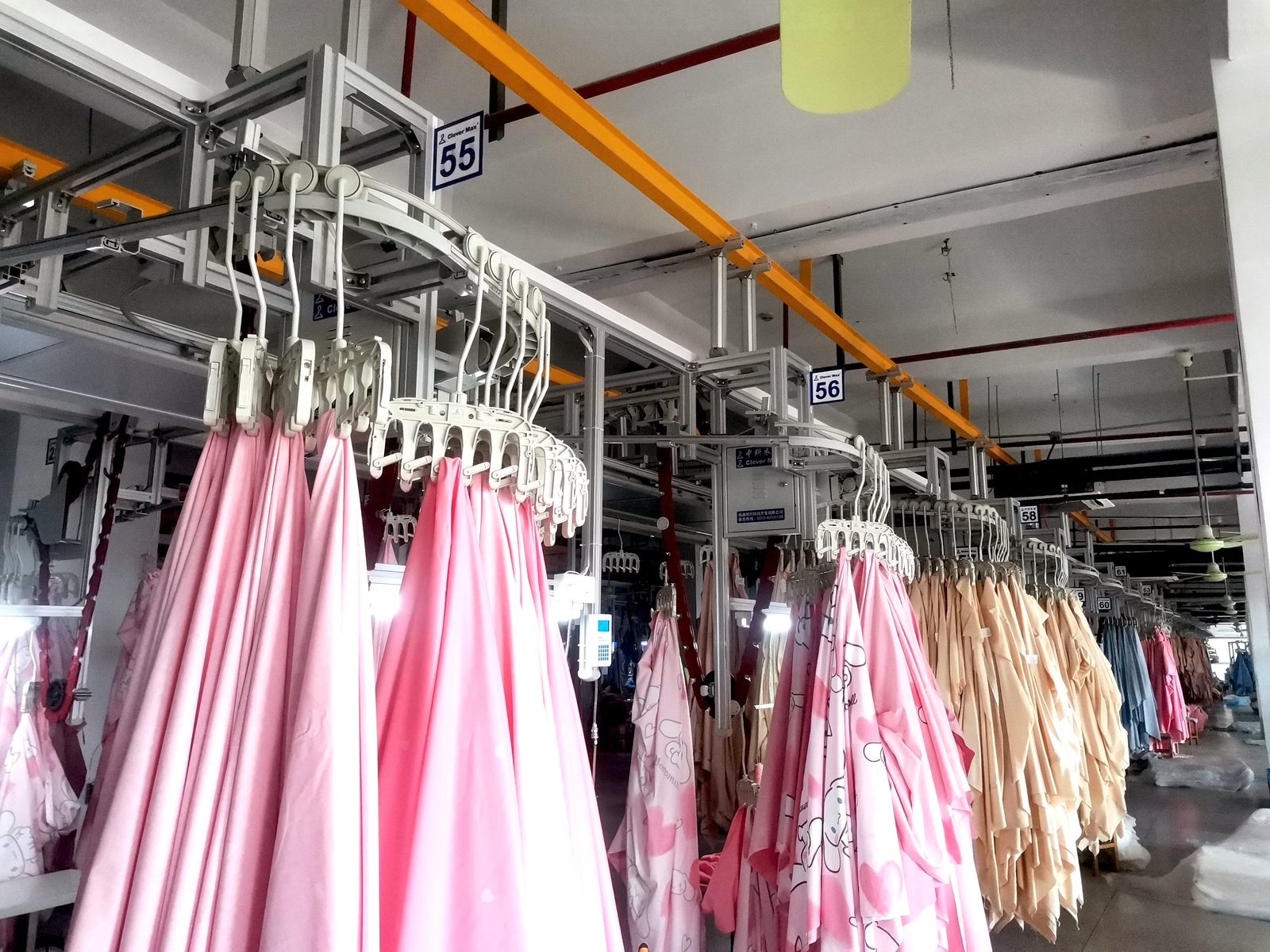
When a garment factory decides to spend money, it usually has two directions to choose between. It can put up a new building and add floor space, or it can re-equip and re-lay the floor it already occupies. The first shows up handsomely in the fixed-asset investment figures. The second is invisible from outside.
In 2018 the industry chose the second.
Most of the retrofit work CleverMax took on that year was not fitting out new plants but re-laying old ones, several of them in buildings more than a decade old whose column spacing and ceiling heights had been set for something else entirely. The rail had to be routed around the columns, and every detour around a column reorders the stations that follow it, which is why a drawing for a job like that cannot be produced until somebody has measured the building.
A new building needs land, permits and two or three years. The waste on an existing floor is leaking today.
Two numbers moving in opposite directions describe one thing
The industry department of China's National Development and Reform Commission reported the following on 2018:
In 2018, completed fixed-asset investment across the textile industry rose 5.0% year on year... fixed-asset investment in the apparel industry fell 1.5% year on year, though the rate of decline narrowed over the period.
Fixed-asset investment in apparel was negative, which ordinarily suggests an industry contracting. The same document, however, also says:
Value added in the textile machinery industry rose 9.5% year on year.
Textile machinery grew 9.5%, more than twice the 4.4% recorded by apparel itself.
Fixed-asset investment is dominated by construction and land, and equipment retrofits make up a much smaller share of the same total, so a falling headline figure sitting alongside a booming equipment sector admits only one reading: garment factories were not putting up buildings, they were re-equipping the floors they already had.
A good many of them did exactly that in 2018. Since the money never became a building, nobody outside the fence saw it happen, and the statistics that count square metres could not see it either.
The national list picked workshops, not machines
That September, China's Ministry of Industry and Information Technology published its smart-manufacturing pilot demonstration list for the year, document number MIIT Zhuang Han [2018] 343. Ninety-nine projects spanned everything from polysilicon to automotive, and three of them were textile and apparel:
50 Continuous dyeing and printing digital workshop pilot demonstration Huafang Co., Ltd. Shandong 52 Intelligent textile factory pilot demonstration Shandong Ruyi Technology Group Shandong 64 Knitted apparel intelligent manufacturing pilot demonstration Wuhan Aidi Group Hubei
Digital workshop, intelligent factory, intelligent manufacturing. Not one of the three names describes a machine, because each of them describes a line and a floor.
A better sewing machine improves one station by a few per cent, and that improvement is real but capped by the cycle time of the single operation it sits in. Rebuilding a workshop changes the relationships between operations instead, which matters because a garment plant collects its waste in exactly those relationships, in four forms:
- An operator idle because the previous operation is unfinished - Half-finished pieces carried between stations by hand - A batch hunted down across the floor when rework comes back - Progress counted off paper tickets, and known a day late
None of the four produces anything.
Strip those three projects down and each is a rebuild of how work moves between operations. That is the layer a hanger system works on too, approaching it from the material-flow end.
The same judgement had been reached internationally two years earlier
In July 2016 the International Labour Organization published ACT/EMP Working Paper No. 14, "ASEAN in Transformation: Textiles, Clothing and Footwear". Its subject is Southeast Asia, but its judgement about the sector travels:
Of all the sectors analysed in this research, the TCF sector seems to be the most vulnerable to the extensive technological displacement of workers.
Of every sector studied, textiles, clothing and footwear is the one most exposed to displacement by technology.
Page 31 offers a Chinese example, an automation company's down-filling system that cut headcount on that operation from five people to two at roughly USD 33,000 per machine, paying back in about a year and a half.
A filling machine is not a hanger system. It replaces labour inside one operation, whereas a hanger system replaces the handling and the tracking between operations, which is the wider and more expensive territory of the two. The arithmetic is the same in both cases. Establish which hours produce nothing, then ask what equipment costs to buy those hours back and how many years it takes to return the price.
What a line actually saves
What a hanger system buys is not square metres. It is the few dozen short journeys between stations, and it settles all four wastes in one move. The rail walks those journeys instead of a person, carriers queue themselves into each station, and work stops piling up beside a machine waiting for someone to pick it up. Progress is no longer reconstructed from tickets either, since the controls hold where every piece is standing and how long it has stood there. What is left in an operator's hands is the sewing, which is the part that genuinely needs her skill.
Minyoung Suh of the Wilson College of Textiles at NC State University cited a figure in the ITMA 2019 special issue that puts the scale of this plainly:
When a piece of clothing is manufactured, the handling time is about 80% of the overall production time, and approximately 80% of the factory cost is related to the handling cost.
Roughly 80% of the time that goes into making a garment is not spent making it, and roughly 80% of factory cost sits outside the sewing. The figure sounds extreme on the page. It stops sounding extreme after a day standing on a floor.
Which is what a digital workshop and an intelligent factory come down to inside a garment plant. The terms are not software terms. They name the recoverable share of that 80%.
The choice made in 2018 is still being made
Negative investment in apparel next to strong growth in textile machinery carried one message at the time: retrofitting the floor you have pays better than building another one, and the industry had voted on that with its own money rather than in a survey.
What the vote bought showed up only years later. A plant that moved in 2018 spent that year working out on its own floor how to route around its columns, what order to run its stations in, and where the rework loop should come back onto the rail. None of those numbers reaches a drawing or a report, and all of them govern how long the line stands still at every style change afterwards. A factory starting now serves the same apprenticeship, on smaller batches and with less room to get any of it wrong.
So the contrast in the 2018 figures is not a statistical curiosity. It is the record of an industry that had already settled where its money belongs, which is not in additional square metres but in the space between the few dozen stations it occupies already. A building stands unchanged for a decade. The relationships between the stations are re-cut every time the style changes, and those relationships, not the floor area, are the real shape of a factory's capacity.
Sources
Every factual claim above traces to one of the following. Where a source is offline — a certificate, a printed publication — we name it without a link.
- [1] 工业和信息化部《关于公布2018年智能制造试点示范项目名单的通告》工信部装函〔2018〕343号(含附件《2018年智能制造试点示范项目名单》) 2018-09-27 accessed 2026-08-27
- [2] 国家发展和改革委员会产业司《2018年纺织行业运行情况》 2019-02-13 accessed 2026-08-27
- [3]