

International research: handling takes 80% of apparel production time, and 79% of that handling is still done by hand
Nobody on a garment floor can say how much of a shift an operator actually spends at the machine. A study from the Wilson College of Textiles at NC State University, written around ITMA 2019, puts the figure at about 80% of overall production time going into handling, with roughly 80% of factory cost tied to it, while in the plants surveyed 79% of assembly handling was still done by hand, not one plant was fully automatic, and only 21% of companies had even semi-automatic systems. An average across plants is not a reading of any particular floor, which is why this piece is about how to take that reading yourself.
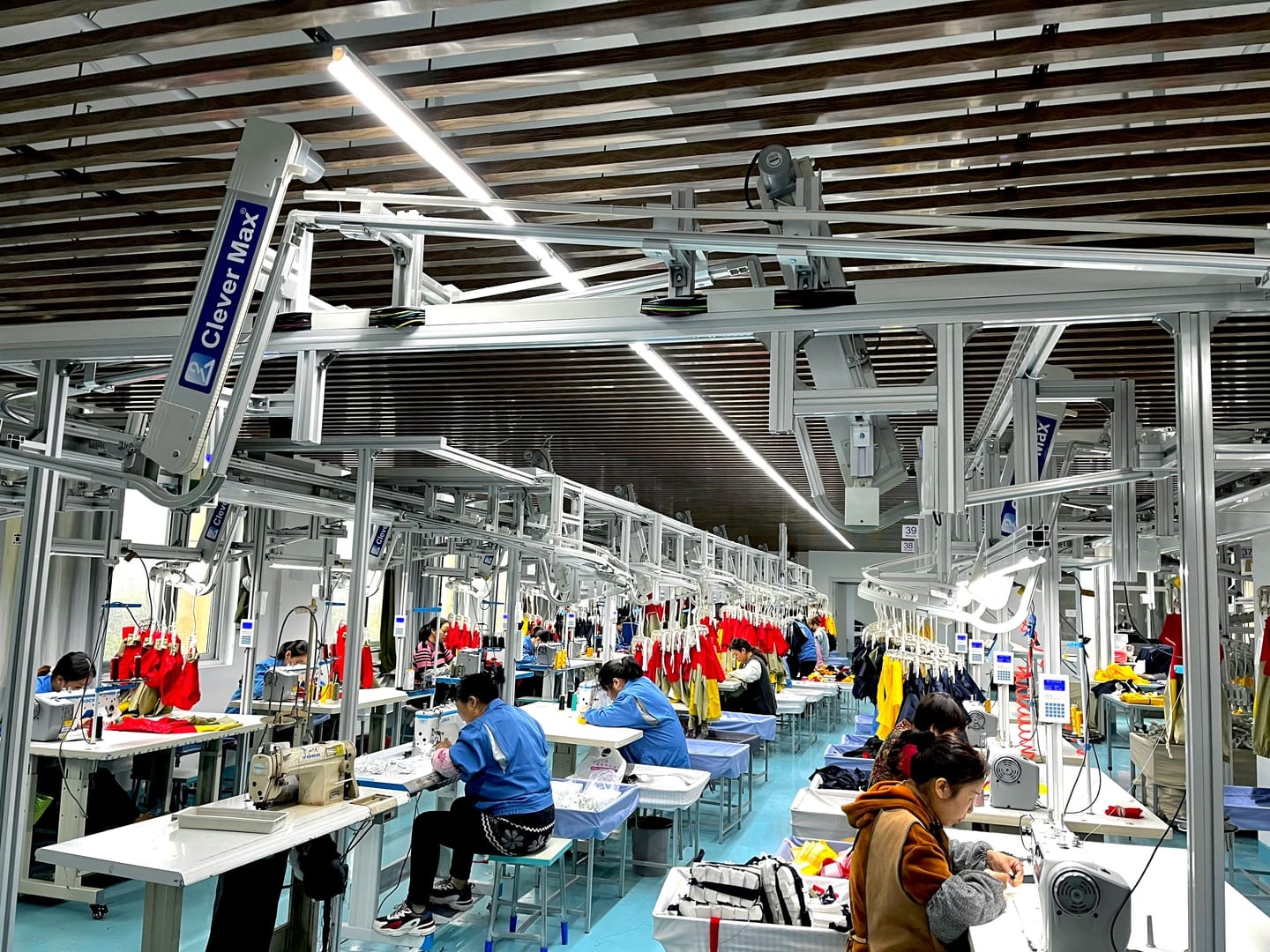
Ask an owner what share of a shift his operators actually spend at the machine and he cannot tell you. Neither can the operators. Nobody is idle, and that is precisely the difficulty. On a floor where every pair of hands is moving, no single spot looks like waste, so no one takes the account apart to see where the hours went.
Eighty percent of the time spent making a garment is not spent making the garment
Minyoung Suh, of the Wilson College of Textiles at NC State University, walked ITMA 2019 to survey what cutting and sewing automation had actually reached, and published the result in the exhibition's special issue of JTATM. ITMA runs every four years and is the largest textile machinery show in the world, so it is a fair census of what the industry can buy. Among the findings she cites are those of Gries and Lutz (2018):
When a piece of clothing is manufactured, the handling time is about 80% of the overall production time, and approximately 80% of the factory cost is related to the handling cost.
Handling takes roughly 80% of total production time, and roughly 80% of factory cost is tied to handling.
Handling, in the paper's terms, is lifting, moving, mounting, re-positioning and re-orientating. On a floor it is cut pieces going from one stack to another, half-finished work carried from one operation to the next, a rework batch dug out and walked back. All of it is paid for by the hour and none of it advances the garment. That is why the eighty percent has no address: rather than sitting in one department where a manager could be held to account for it, it is spread thinly through the gap between every consecutive pair of operations. Each gap is too small to be worth an intervention, and together they are the largest number in the building.
The second set of numbers is the harder one
A cost on that scale should have drawn engineering attention decades ago. Szimmat (2007), also cited in the paper, found that it had not:
material handling during product assembly took place mostly (79%) manually in textile product plants. None of the plants handled material automatically, while only 21% companies employed semi-automatic systems.
In textile product plants, assembly handling was mostly manual, at 79%. Not one plant handled material fully automatically, and only 21% of companies used semi-automatic systems.
Put the two findings side by side and the industry comes into focus: eighty percent of the time and eighty percent of the cost rest on the one activity automation has barely touched.
Why handling in particular resists automation
The paper is candid about the reason. Flexible material is an order of magnitude harder to handle than anything that resists bending, because cloth will deform past tolerance under nothing more than its own weight or the air it travels through, and the machine it is being fed into grants no tolerance at all. Feed a panel in half a centimetre out of position and the seam comes out crooked.
Soft material and exact placement pull in opposite directions, and the trade-off is unforgiving in both directions. Grip the cloth firmly enough to control it and it distorts. Grip it lightly enough to leave it flat and it lands out of position. What automated handling needs, then, is not a stronger arm but a gentler and more accurate one, which is by some distance the harder machine to build. Suh surveys what the field has tried, vacuum grippers, Bernoulli grippers, needle grippers and roller systems, and reports plainly that none has spread far into textile assembly. Szimmat measured how far the industry had retreated from the attempt: 72% of the semi-automatic handling systems in service carry no gripper at all. Where nothing grips reliably, the practical answer has been not to grip.
A hanger system declines the premise
Gripping is hard because of an assumption nobody questions, that the panel is picked up at each operation and set down again afterwards. Every pick and place risks deforming the cloth, and a garment with dozens of operations runs that risk dozens of times over.
A hanger system does not accept the assumption. A piece is loaded onto a carrier after cutting and stays on it until the finished garment leaves the line, never set on a table, never stacked, never picked up again in between. The handling has not disappeared, it has moved from people to rails and controls, and an operator's hands touch fabric only for the seconds the seam itself takes.
Once hands stop moving the work, the four wastes every sewing floor lives with go with it. Waiting on the previous operation, carrying pieces between stations, hunting for a batch when rework comes back, counting tickets to learn where production stands: all four exist because material moves by hand and progress is recorded by hand. Take both away, so that carriers queue themselves and the system holds the position and dwell time of every piece live, and the four are answered in one move rather than four.
Twenty years on the same road
CleverMax was founded in 2003 in Nantong, one of China's largest textile manufacturing bases, by people who had been running a garment plant since 1993 and had spent that decade making clothes. Factory first, equipment second, is the order that matters here, because it means the company's reading of handling waste came off its own floor rather than out of a journal. They had lived the eighty percent for ten years before anyone published a figure for it.
The partnership formed with the CAS Institute of Software in 2005 put RFID identification on the carrier, which settled something the paper passes over but every plant meets daily. A barcode has to be scanned by a person, a single missed scan breaks the chain, and where two lines merge there is no telling which piece came from which. RFID handles identification, live tracking and merged-line management in one stroke, capturing the location and dwell time of every piece with nobody typing anything in, and that data goes back to scheduling through the YunDao cloud MES platform.
The solutions now run the full chain, cutting, sewing, hanger transport, smart storage, sorting and packing, and they go into home textiles, curtains, footwear and headwear as readily as into apparel.
What one floor can do with these numbers
The research is not useful because it proves eighty percent holds everywhere. It is an average across a set of plants, and whether a particular floor sits at seventy or ninety is a question only that floor can answer with a stopwatch. What the paper supplies is a reason to pick the stopwatch up.
The method is crude and that is fine. Take one station, time it through a shift on a phone, and write down how much of the shift went into the machine and how much went into everything else. Three stations will show the direction, so there is no need to do all twenty. Then set the result beside the wage bill, because those hours are being paid for at a skilled operator's rate whether or not they appear on a line of their own.
If the count lands anywhere near the published figure, the next question is how much of that share a rail could walk instead of a person. Answering it takes the sheet filled in on that floor, not the average from the journal, since the decision is made one operation at a time: which go onto the line first, and which can wait.
Sources
Every factual claim above traces to one of the following. Where a source is offline — a certificate, a printed publication — we name it without a link.
- [1]
- [2] Gries, T. & Lutz, V. (2018),转引自上述 JTATM 特刊论文(搬运时间与成本占比、缝制成本占比数据来源) 2018 (offline source) accessed 2026-08-27 · Trade press
- [3] Szimmat, F. (2007),转引自上述 JTATM 特刊论文(纺织品工厂搬运自动化程度调研数据来源) 2007 (offline source) accessed 2026-08-27 · Trade press