

A national plan names computer-controlled automatic hanger systems: the 2012 Textile Industry Five-Year Plan and what it meant for CleverMax
In January 2012 China's Ministry of Industry and Information Technology issued the Textile Industry Five-Year Plan. Its technology list for apparel names computer-controlled automatic hanger systems (FMS) outright. The same document admits that labour shortage among eastern garment firms had become pronounced. That same year CleverMax filed two invention patents on production-line control.
On 19 January 2012 China's Ministry of Industry and Information Technology issued the Textile Industry Five-Year Plan. Anyone in the business of building hanger systems needed only one sentence out of it, in the technology chapter. Everything said at a trade show that year was said by a supplier about his own product. This sentence was not, which is why it outweighed the lot.
A national plan put hanger systems on the technology list for apparel
It helps to be clear what this kind of document is. A Five-Year Plan sets the direction of an entire industry for the following five years, carries the issuing ministry's authority over that industry, and applies across the country. Every clause in it is weighed before it is printed, so a category of equipment does not find its way into one by accident.
Chapter five of the plan deals with technology adoption, and the paragraph on apparel reads:
Apparel. Raise the adoption rate of computer-aided design (CAD), computer-aided manufacturing (CAM), computer-controlled automatic hanger systems (FMS), intelligent warehousing and distribution systems, and radio-frequency identification (RFID); promote mass-customisation technology; and raise the level of automation, digitisation, information technology and rapid response in apparel enterprises.
Five technologies in one sentence, hanger systems and RFID among them. The plan lists the hanger system under the label FMS, flexible manufacturing system, which is the term a planner reaches for when what is being described is not a machine but the way work moves between machines. Those two were the entirety of what CleverMax had been building since 2003, so the company's whole product line appeared, described in its own terms, in a document it had no hand in drafting.
The sentence was worth most to an owner still undecided about a hanger line. His fear was never the price. It was buying in, then watching the approach be discredited two years later and finding the equipment stranded on his floor with no second-hand market to take it off him. A government that names a technology in a five-year plan and calls for its adoption to rise is committing policy to that direction for five years, which removes most of the fear, and the claim no longer rests on the supplier making it.
A harder sentence sits in the same document
Assessing the conditions the industry faced, the plan states:
The structural shortage of labour in the textile industry is growing more serious by the year... Labour shortage among enterprises in eastern China is pronounced.
That is an official document conceding what every eastern garment factory was living through and none of them would say out loud. An owner who admits he cannot hire skilled operators has invited his customers to start doubting his delivery dates.
Read the two passages against each other and the plan's logic is plain. Labour was tightening on one side, automation was meant to spread on the other, and equipment is the only bridge between those two facts. The quantified targets sit on the same line: CAD adoption to reach 50% by 2015, CAM 25%, and labour productivity across the industry to rise 10% a year.
Overtime will not produce ten per cent a year, because overtime buys hours rather than output per hour. Hiring produces less still, since each additional pair of hands arrives with its own carrying and its own waiting attached. A number that size has to come from the other end, out of the work that creates nothing to begin with.
The four things in a garment plant that create nothing
Anyone who has spent time on a sewing floor knows the hours an operator spends at the machine are only part of the day. The rest is spread across four things:
- Waiting for the previous operation to finish - Carrying half-finished pieces between stations by hand - Searching for a batch when a rework or rush order arrives - Counting work-in-progress off paper tickets
None of the four creates value, and all four are paid for at a sewing operator's rate, which is the highest rate on the floor for the same reason it is the scarcest skill. A hanger system takes all four at once. Waiting and carrying go to the rail, where carriers queue themselves into the next station. Searching and counting go to the controls, which hold the station and the dwell time of every piece, so no one totals tickets at the end of a shift.
The 10% a year the plan asked for is hiding in those four places. It does not come from sewing any seam faster, because the cycle time of an overlock is fixed by the machine. It comes from reclaiming the stretch between operations that nobody had ever put a price on.
In the year the plan appeared, CleverMax filed two invention patents
A national plan sets a direction and leaves the equipment to whoever builds it. CleverMax filed two answers in 2012.
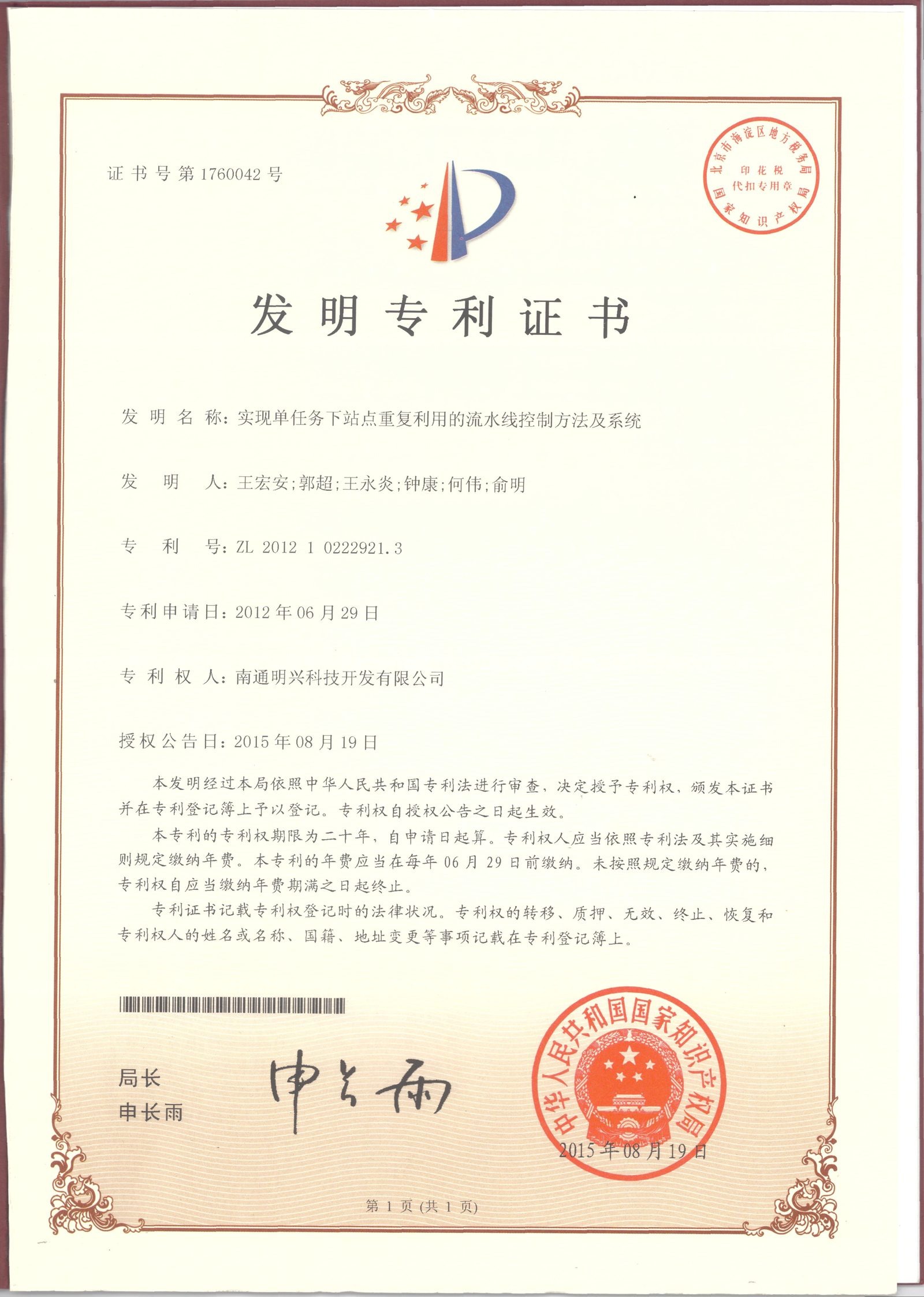
On 29 June 2012 CleverMax filed "A production-line control method and system enabling station reuse under a single task", patent number ZL 2012 1 0222921.3, granted on 19 August 2015 as certificate 1760042. The inventors are Wang Hongan, Guo Chao, Wang Yongyan, Zhong Kang, He Wei and Yu Ming.
Three months later, on 24 September 2012, the second went in: "A control method and device for production-line operations", patent number ZL 2012 1 0359705.3, granted on 25 February 2015 as certificate 1595207. The inventors are Zhong Kang, Guo Chao and Yu Ming.
Both patents are held by CleverMax in its own name. That is worth noting: the RFID work of the previous decade had been filed by the research institute CleverMax partnered with, not by CleverMax.
What the first one solves is worth setting out. "Station reuse under a single task" stays abstract until you meet it on a floor, where it means one operation on a garment has to be done twice at the same station with other operations in between. A conventional line has two ways to cope, splitting into two lines or having an operator carry the work back by hand, and both are retreats: the first gives up the continuity of the line, the second gives up the premise that nobody carries anything. The invention lets a piece re-enter the same station instead, so the process route no longer has to bend around the equipment.
Problems shaped like that are not thought up at a desk. Somebody has to be cornered by a real process on a real floor first. Before CleverMax built any equipment in 2003, its founders had spent ten years running a garment factory, from 1993 onward, and that order is what determines which class of problem the patents address.
Reading the plan more than a decade later
The 2012 plan read the trend correctly. The labour shortage never eased, it deepened, and the hanger systems it named that year are standard equipment now in eastern garment and home-textile plants.
What separates factories today is when they began. A plant that moved in 2012 has been through a generation of equipment since, has re-cut its process routes several times, and arrived at the shape of its line one adjustment at a time. A plant doing the arithmetic this year serves that same apprenticeship from the beginning, on batch sizes far smaller and lead times far tighter than the ones its predecessors learned on.
The sentence in the plan is still there and reality overtook the adoption figures printed beside it long ago, so what was set as a target then reads as a floor now. The question has changed shape with it. Not whether the direction was right, but how many more years a line goes on paying for the stretch between its operations that nobody prices.
Sources
Every factual claim above traces to one of the following. Where a source is offline — a certificate, a printed publication — we name it without a link.
- [1] 工业和信息化部《纺织工业「十二五」发展规划》(2012年1月19日发布) 2012-01-19 accessed 2026-08-27
- [2] 国家知识产权局 发明专利证书第 1760042 号《实现单任务下站点重复利用的流水线控制方法及系统》(专利号 ZL 2012 1 0222921.3,专利权人:南通明兴科技开发有限公司,申请日 2012-06-29,授权公告日 2015-08-19,公司资料) 2012-06-29 (offline source) accessed 2026-08-27
- [3] 国家知识产权局 发明专利证书第 1595207 号《流水线工序的控制方法和装置》(专利号 ZL 2012 1 0359705.3,专利权人:南通明兴科技开发有限公司,申请日 2012-09-24,授权公告日 2015-02-25,公司资料) 2012-09-24 (offline source) accessed 2026-08-27