

The 2006 filing: put the tag on the carrier, and a product line stands on it for twenty years
"A monitoring method and system for intelligent material distribution" was filed in May 2006, patent number ZL200610011949.7. It was the first result of CleverMax's work with the Institute of Software at the Chinese Academy of Sciences, and the technical starting point for the twenty years of product that followed. What it replaced was the paper ticket garment factories had used for decades.
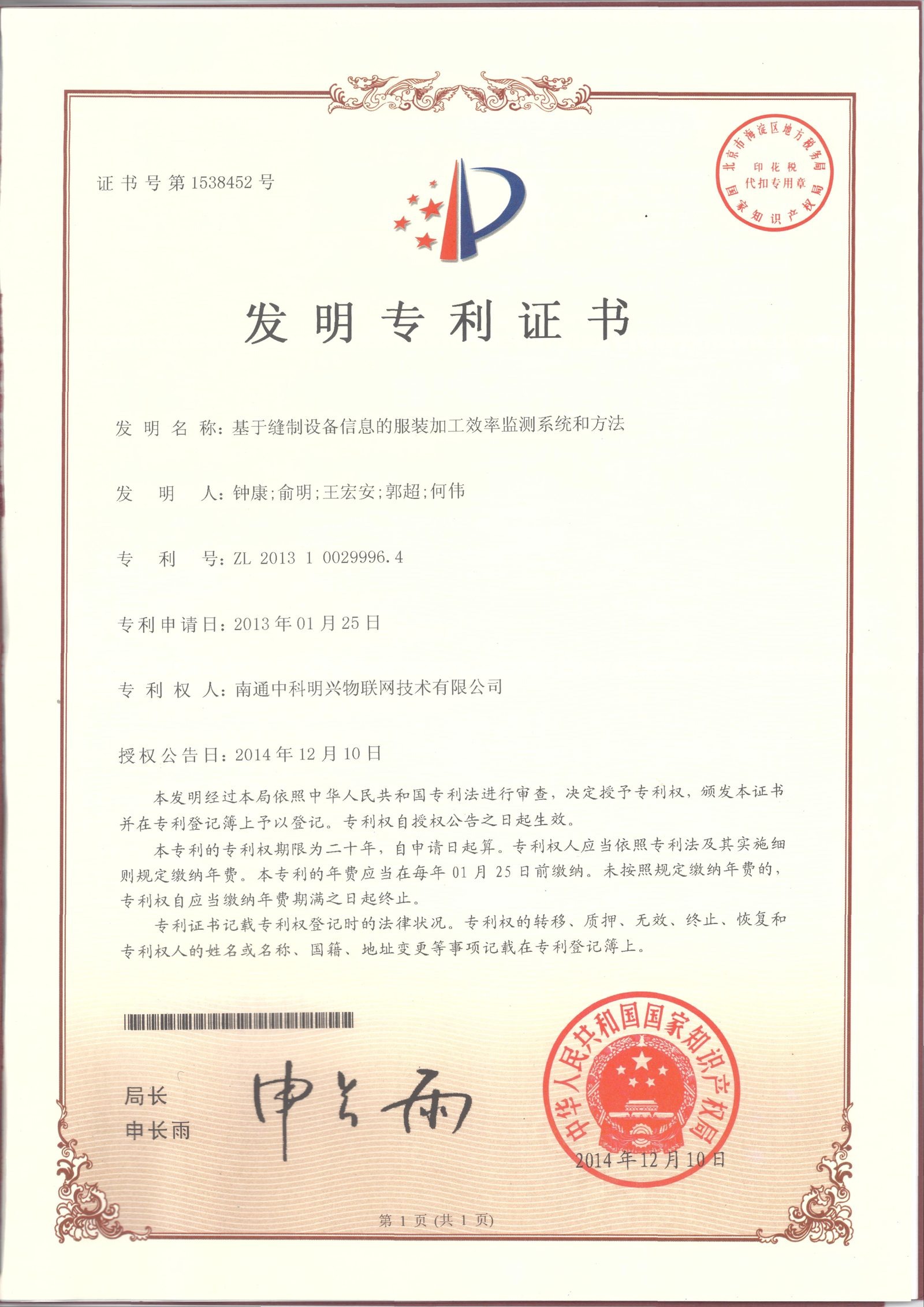
On 17 May 2006 an invention patent application titled "A monitoring method and system for intelligent material distribution" was filed. Application number 200610011949.7, granted on 3 June 2009 under publication number CN100493401C, with CleverMax's partner the CAS Institute of Software as the applicant.
It was the first result to come out of the industry-academia work between CleverMax and the institute.
An abstract title over a very concrete problem
The title sounds a long way from a workshop, but the question behind it is blunt: on a production line, how does the system know at any moment where a piece of work is, what it is, and where it goes next?
Until then the whole industry ran on paper tickets. An operator finished a step and wrote it down, the tickets accumulated and went to the office, and someone typed them into a computer one at a time.
The process had three faults.
It was slow, landing hours or a day after the fact, so what anyone looked at was always yesterday's workshop, by which point knowing where the line had backed up was of no use because that shift was long over.
It was error-prone in the handwriting and again in the transcription, and when two layers of error met at month end and the numbers refused to reconcile, nobody could say which link had broken.
And it recorded outcomes rather than durations. A ticket says the operation was completed. It cannot say how long the work lay beside that station before anyone picked it up.
The third fault is the serious one, because the real waste in a workshop is not the processing but the waiting. A garment may spend three days on the floor with only fifteen minutes of that under a machine, the rest going to waiting, carrying and searching. Paper tickets conceal precisely the part that most needs to be seen. An owner holding a stack of them sees the output without seeing how the output was consumed.
A tag on the carrier, a reader at the station
The method set out in the patent puts an RFID tag on the hanger carrier and a reader at the entrance to each workstation. The carrier passes, the reader picks it up automatically, the host decides in real time whether the piece enters, and a PLC controls the gate precisely.
The operator does nothing extra, with no scanning, no writing and no reason to look up. The data is produced by the line rather than fed in by a person, which is the fundamental difference from a ticket, because any capture method that needs human cooperation will vary with how the humans are doing that day.
Most domestic competitors were still on barcodes in those years. A barcode has to be scanned by hand and a missed scan breaks the chain, and where two lines merge it is worse still because the system cannot tell one piece from another. What the patent describes removes all three failure modes at once, because identification no longer depends on anyone doing anything.
The tag goes on the carrier, not on the garment
One choice inside that deserves spelling out. The tag goes on the carrier, not the garment.
Why? Because the garment leaves the line. It comes off to be turned, goes away for rework, and gets packed once it is finished. The carrier does not, since it stays on the rail throughout. Keep the tag with the carrier and the chain of data never breaks.
That looks like a small decision, and it determines whether the whole system stays reliable over years. Tagging the garment works in a demonstration and starts losing records after three months on a real floor. Once records go missing, the scheduler reconciles the figures once, finds they do not agree, and the second time asks the supervisor instead. A system nobody consults is soon worked around, and once it is worked around the workshop is back on paper tickets. That is how a great many automation projects actually die, not because equipment failed but because the data lost its credibility first.
Twenty years and several mechanical generations later, this layer is unchanged
The patent became the foundation under everything CleverMax builds. Production data capture, work-in-progress dashboards, station efficiency comparisons and bottleneck alerts all sound like software, and all of them rest on one thing, an accurate record of flow that nobody has to maintain by hand.
Without it every feature above is hollow. A bottleneck alert works by comparing dwell times across stations, and if those dwell times were estimated by a person the alert is guesswork. The YunDao cloud MES platform released in 2011 could feed workshop data back into scheduling only because this layer was solid underneath it.
Since 2006 the mechanical side has been through several generations, with a steadier rail, higher load capacity and faster points. The method underneath the data layer has not moved. It is still the one written into that application: tag on the carrier, reader at the station entry, decision in the host, gate on the PLC.
Where the waiting time in your workshop goes
A paper ticket can tell you how many pieces were finished yesterday. It cannot tell you how long those pieces spent getting there, and it is the second number that eats the capacity.
Getting hold of that number does not start with buying software. It starts with letting the line speak for itself, which is exactly what the 2006 application describes how to do.
Sources
Every factual claim above traces to one of the following. Where a source is offline — a certificate, a printed publication — we name it without a link.
- [1] 国家知识产权局 / Google Patents 发明专利 CN100493401C《智能物料配送的监控方法及系统》 2009-06-03 accessed 2026-08-10
- [2] 南通明兴科技开发有限公司 企业发展历程(公司资料) 2006 (offline source) accessed 2026-08-10 · Trade press