

Garments spend more time off the line than on it: in 2016 CleverMax took that time back
In 2016 the CleverMax home-textile hanger system earned High-Tech Product certification under certificate 160611G0224N, and the same year the intelligent warehousing and overhead storage lines came to market. The second closes the break at the end of the line, where a piece that was a live record while it hung on the rail turns back into a pile somebody has to search the moment it touches the floor, taking a whole line of accumulated data with it.
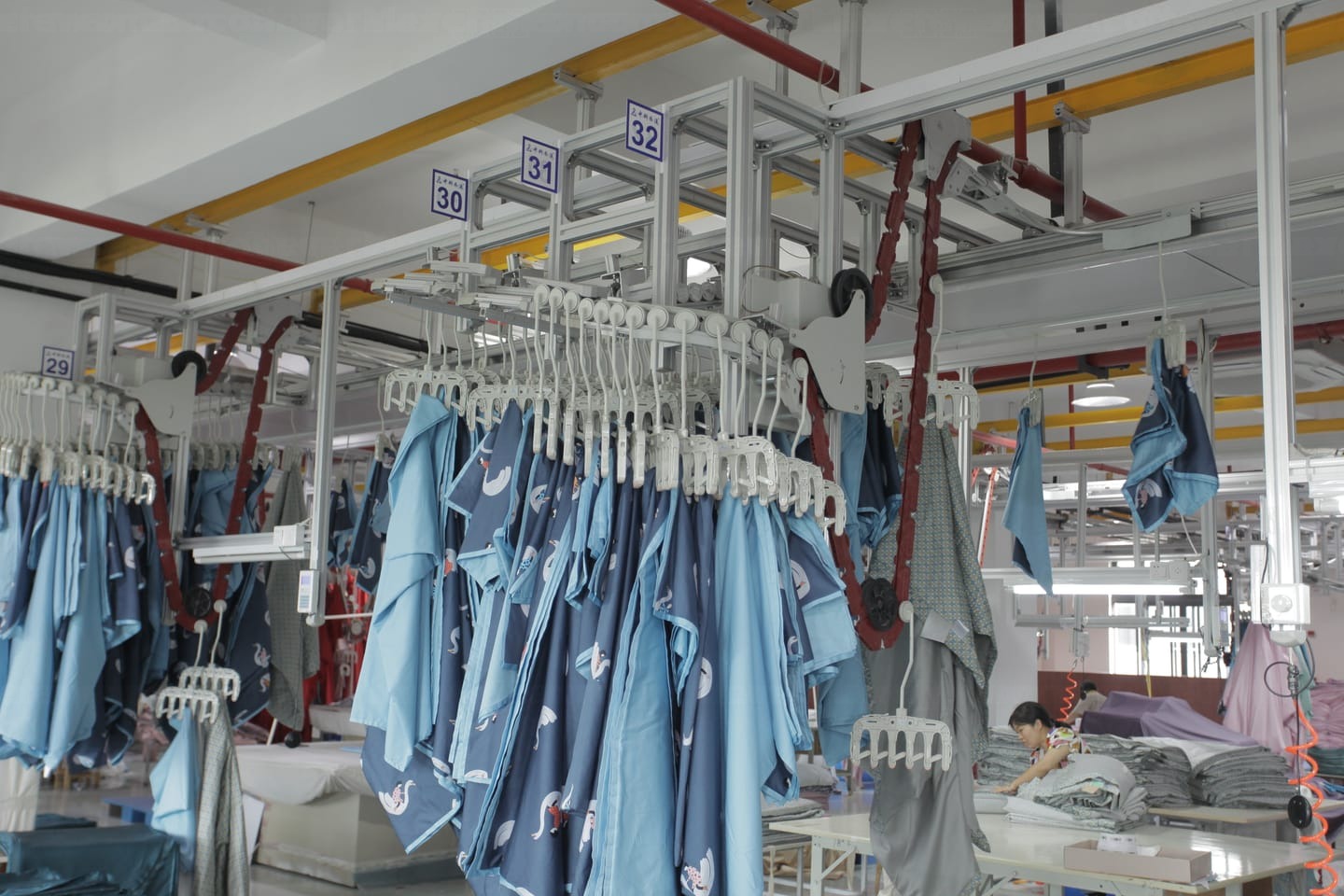
Two things happened to the CleverMax product line in 2016. The first put home-textile hanger systems on the same certified footing as apparel. The second pushed the boundary of the product past the end of the line.
Two certificates, issued separately
That year the CleverMax home-textile hanger system passed High-Tech Product certification under home-textile certificate number 160611G0224N, two years after the apparel product earned 140611G0341N.
Issuing them separately meant the review did not treat home textiles as one more model of the apparel line, and the reason had been visible on a workshop floor since 2008. A shirt weighs two or three hundred grams against four or five kilos for a winter duvet, more than ten times the load, so building the home-textile version meant recalculating rail steel, carrier grip, turn radius and the number of pieces a stretch of rail can hold, until not one part of the mechanical structure was shared with the apparel design. Two product lines following two technical paths have to be reviewed twice.
Chinese suppliers who have taken both apparel and home textiles this far, and hold the certification on both, can be counted quickly. CleverMax is one of them.
The more consequential half: what happens at the end of the line
The same year, CleverMax brought intelligent warehousing and overhead storage to market.
It began with an arithmetic that factories buying a hanger system rarely do. Attention goes to efficiency on the line, yet of all the time between cut piece and shipment, only a small share is spent at a sewing machine. The rest is waiting.
Waiting for the operation upstream, for the rest of the batch to catch up, for inspection to free a pair of hands, for enough finished goods to fill a truck.
Waiting on the line was already solved, because pieces queue on the rail and the system knows how long each one has been there. Waiting off the line was still handled the way the whole industry handled it: lift the pieces off the rail, stack them on the floor, put them in cartons, pile the cartons on shelves.
The record ends the moment a piece touches the floor
Lifting a piece off the rail throws away half of what the line had accumulated.
While it hung there, the stations it had passed and the time it had sat at each of them were a complete record. On the floor it reverts from a record in a system to a pile somebody has to search. Anyone who has run a factory knows what that search costs. A rush order has to ship early and half a morning goes into locating the batch. Rework comes back with nowhere obvious to put it, gets set down wherever there is room, and by the next day nobody remembers where.
Overhead storage: never letting the goods touch the floor
If the break happens when a piece lands, the answer is not to let it land. Work in progress and finished goods stay on the rail, and the system retrieves them on command.
Three benefits follow, and each converts into money.
Storage density improves. Hanging occupies far less floor than laying flat, and the gap widens for bulky home-textile goods that fill a ground-level warehouse within a few rows. Multiply the extra stock a given building holds by what that building costs to rent and the saving is not an abstraction.
Retrieval follows an instruction rather than a search. The system holds the location of every piece, so the person picking walks to it instead of working through a warehouse from memory. The hours spent hunting come back, and so do the claims that used to arrive after the wrong goods shipped.
The record runs unbroken from cut piece to dispatch. This is the one that matters most. Material never leaves the system, so the record has no blind spot in the middle, and a scheduler who wants to know where a given piece of work is does not have to send somebody into the warehouse to confirm it.
For home-textile customers the case is stronger than for apparel. A duvet occupies several times the floor of a shirt, which makes ground storage correspondingly more expensive, and a duvet at the bottom of a stack picks up dirt and creases. Reworking one is not a trip through the wash. The filling and the quilting both have to be done again.
After 2016, both ends of the chain were still short
Taken together, 2016 widened what the product covered, from moving material along a line to keeping material inside the system from loading through to dispatch.
Both ends of the chain were still short at that point. Cut pieces leaving the cutting room were still counted and loaded by hand, and finished goods were still sorted by hand. The CleverNode cutting-data capture and intelligent sorting systems, delivered in 2019, joined those two ends on, which is when the full chain of cutting, sewing, hanger conveying, intelligent storage, sorting and packing was finally in place.
The line and the warehouse belong on one drawing
Plenty of plants do this in two rounds, the line first and the warehouse a couple of years later. Two rounds usually mean two tenders and two suppliers, the interfaces do not meet, the data still stops at the warehouse door, and the plant has paid twice for one outcome.
The other cost of two rounds is spatial. Once the line is committed, the routing of the rail, the position of the columns and the clear height are all fixed, and a plant that later wants overhead storage often finds there is nowhere left to run rail to. Drawn together, a buffer zone can hand straight onto the rail into the finished-goods store without a piece ever being set down.
Which is why, when a home-textile plant comes to discuss a retrofit, the first CleverMax question tends to be where the finished goods sit now and how long it takes to find a batch, rather than how long the line needs to be.
Sources
Every factual claim above traces to one of the following. Where a source is offline — a certificate, a printed publication — we name it without a link.
- [1] 南通明兴科技开发有限公司 高新技术产品认定证书(家纺产品证书编号 160611G0224N,公司资料) 2016 (offline source) accessed 2026-08-10 · Trade press
- [2] 南通明兴科技开发有限公司 企业发展历程(公司资料) 2016 (offline source) accessed 2026-08-10 · Trade press