
The tag goes on the carrier, not on the garment: one choice that held for twenty years
A garment keeps leaving the rail. It comes off to be turned, goes away for rework, gets packed when it is done. Put the tag on the garment and the data chain breaks the moment it leaves. The carrier never leaves, because it is part of the line itself. That small-looking distinction decides whether a tracking system stays reliable for years, and it is the critical step in the patent granted in 2009.
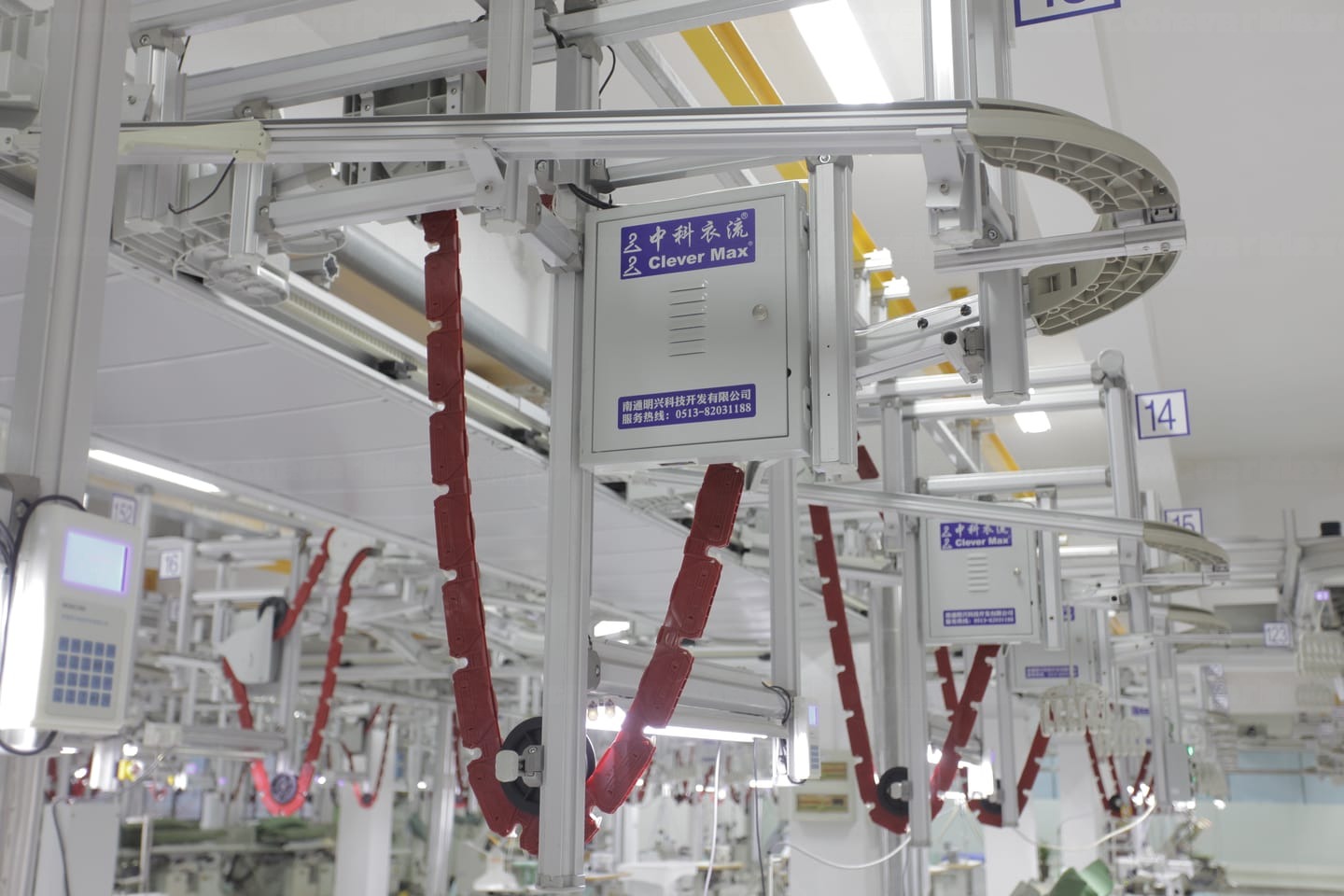
Two lines merge into one halfway across the floor. All morning they ran two sizes of the same style. In the afternoon a batch of rework was fed back in. Standing at that merge point, can you tell which line each piece came from, and which operation it has reached?
Not by eye. Not from paper tickets either, because a ticket records who finished what, never where a thing is now. That is the problem the patent granted to CleverMax's research partner in 2009 was built to solve, and it is the step that turned a hanger system from a way of moving garments into a way of knowing where they are.
The paper-ticket chain has three faults
Before it, data on a garment floor was produced like this: an operator finishes an operation and writes it on a ticket, and once enough tickets have accumulated they go to the office, where somebody types them in one at a time.
That chain has three faults.
It is slow. Data lands hours or a full day late, so the floor manager learns on Tuesday morning which station bottlenecked on Monday.
It is wrong. Handwriting introduces errors, transcription introduces more, and missed entries are routine. Barcodes, broadly in use at the time, do not escape this either: a barcode has to be scanned by hand, and one missed scan breaks the chain.
And it records only outcomes, never duration. You learn that a step was completed. You never learn how long the work lay beside the station before anyone touched it. A garment may be worked on for a few minutes across a whole day and spend the rest of it queuing, and the ticket holds no record of that stretch.
The method in the patent: take the human out of the reading
The method is not complicated once you hear it. Fit an RFID tag to the hanger carrier and a reader at the entrance of each workstation. As the carrier passes, the reader picks up the tag automatically, the host decides in real time whether the piece enters, and a PLC controls the gate precisely.
In the patent's own words:
An RFID tag is fitted to the hanger; when the hanger passes the RFID reader at the entrance of a workstation, the reader picks up the information on the hanger's tag.
The difference between RFID and a barcode lives in that word "automatically". A barcode requires someone to aim a scanner, which is an extra action, and extra actions get quietly skipped on a floor paid by the piece. RFID reads on passage. The operator does not have to cooperate, so there is no such thing as a missed scan. The merge-point problem disappears with it: where two lines join, every piece passing the reader announces itself.
A note on ownership. The applicant was the CAS Institute of Software, filed in May 2006 and granted in June 2009 under publication number CN100493401C. CleverMax's founder Yu Ming is one of the five named inventors. It came out of the industry-academia partnership CleverMax established with the institute in 2005, a relationship that has now run for close to two decades.
Why the carrier and not the garment
The critical step in this technical route is not choosing RFID. It is choosing where the tag goes.
Putting it on the garment is the more intuitive answer, since the garment is what you want to track. But the garment keeps leaving the rail. It comes off to be turned inside out, goes away for rework, gets packed when it is finished. The moment it leaves, a tag attached to it leaves too, and the data chain breaks on the spot. A garment is also a one-off: every piece needs its own tag, with the cost and the recovery problem that implies.
The carrier does not leave. It stays on the hanger system rail, it is part of the line itself, and one tag lasts for years. Keep the tag with the carrier and the data never breaks.
Which means nobody has to key anything in. The old way put two or three pairs of hands between the operation and the record. Now the carrier passes a reader and the data appears on its own.
Whether MES scheduling is right depends on whether the data beneath it is right
Live WIP boards, station-by-station efficiency, automatic bottleneck alerts, flexible scheduling across dozens of styles at once. All of them sound like software features. All of them rest on one precondition: accurate flow data that nobody has to maintain.
Without it, none of them hold up. Buy the most expensive MES on the market and the result is the same: if the data going in is typed by hand, half a day late and full of gaps, the conclusions coming out will steer you wrong. An MES does not produce data. It only processes it. Get the layer underneath wrong and the more precisely the layer above calculates, the further off it lands.
So the order in which CleverMax built the rest of it makes sense. The YunDao cloud MES platform arrived in 2011, feeding the hanger line's live data back into production scheduling. The fifth-generation flexible line in 2017 ran dozens of different orders on a single line without tangling. Both were possible because of the method fixed in that 2006 filing.
Asked in 2015 by China Home Textile Brand Network what the method looks like on a floor, Yu Ming put it plainly:
It moves all the material mechanically, which frees up a great deal of processing time from non-sewing operations.
What you save is not sewing time. It is the carrying, waiting and hunting-for-work between the sewing.
How much RFID hanger tracking still applies today
Twenty years on, RFID is no longer novel. Readers are far cheaper, and so are tags. But the judgement, putting the tag on the thing that never leaves the line, has not aged, because it addresses how people behave on a floor rather than what the technology could do at the time. People still skip a step to save an action, and that has not changed in twenty years.
It is worth being clear about what it does not solve.
First, RFID captures flow data, not quality data. It can tell you a piece sat at station 12 for forty minutes. It cannot tell you whether those forty minutes were a slow operator or a difficult fabric. Answering that still means walking out and looking.
Second, a product with few operations and a short route gains little. If a style passes five or six operations and you can see the whole line from one spot, live data adds little you did not already know, and that floor should fix something else first.
Third, putting the tag on the carrier means the carrier is the smallest unit the data sees. When one carrier holds several pieces of the same style and size, the system sees the load, not the individual piece. Tracking to the piece needs a convention set at the loading step.
Measure one day yourself before talking to anyone
If your floor still counts progress off paper tickets and still argues about which station jammed yesterday, start by watching for a day: pick one garment, follow it end to end, and write down how long it is actually worked on at each station and how long it waits.
Worked-on time divided by total time in the plant is the single most direct number for deciding whether a hanger system is worth it. A low ratio means the waste is in waiting and carrying, which is exactly what this method targets. A ratio already high means your bottleneck is somewhere else. Do that arithmetic first and the conversation with any supplier gets far more concrete.
If you would like CleverMax to measure and work it through with you, send us your product mix, operation count and daily output.
Sources
Every factual claim above traces to one of the following. Where a source is offline — a certificate, a printed publication — we name it without a link.
- [1] 国家知识产权局 发明专利 CN100493401C《智能物料配送的监控方法及系统》 2009-06-03 accessed 2026-08-06
- [2] 品牌家纺网《明兴科技:传统家纺"搭上"云平台》 2015-09-01 accessed 2026-08-06 · Trade press