

Efficiency up 30%, capacity up 50%, first-pass yield up 15%: the CleverMax hanger system at Jinchan in Keqiao
Over 2025 four separate Chinese outlets walked into Zhejiang Jinchan's smart factory and each described the CleverMax line. Put their numbers side by side and it becomes clear what really changed for a curtain manufacturer after its fabric moved onto a CleverMax hanger system.
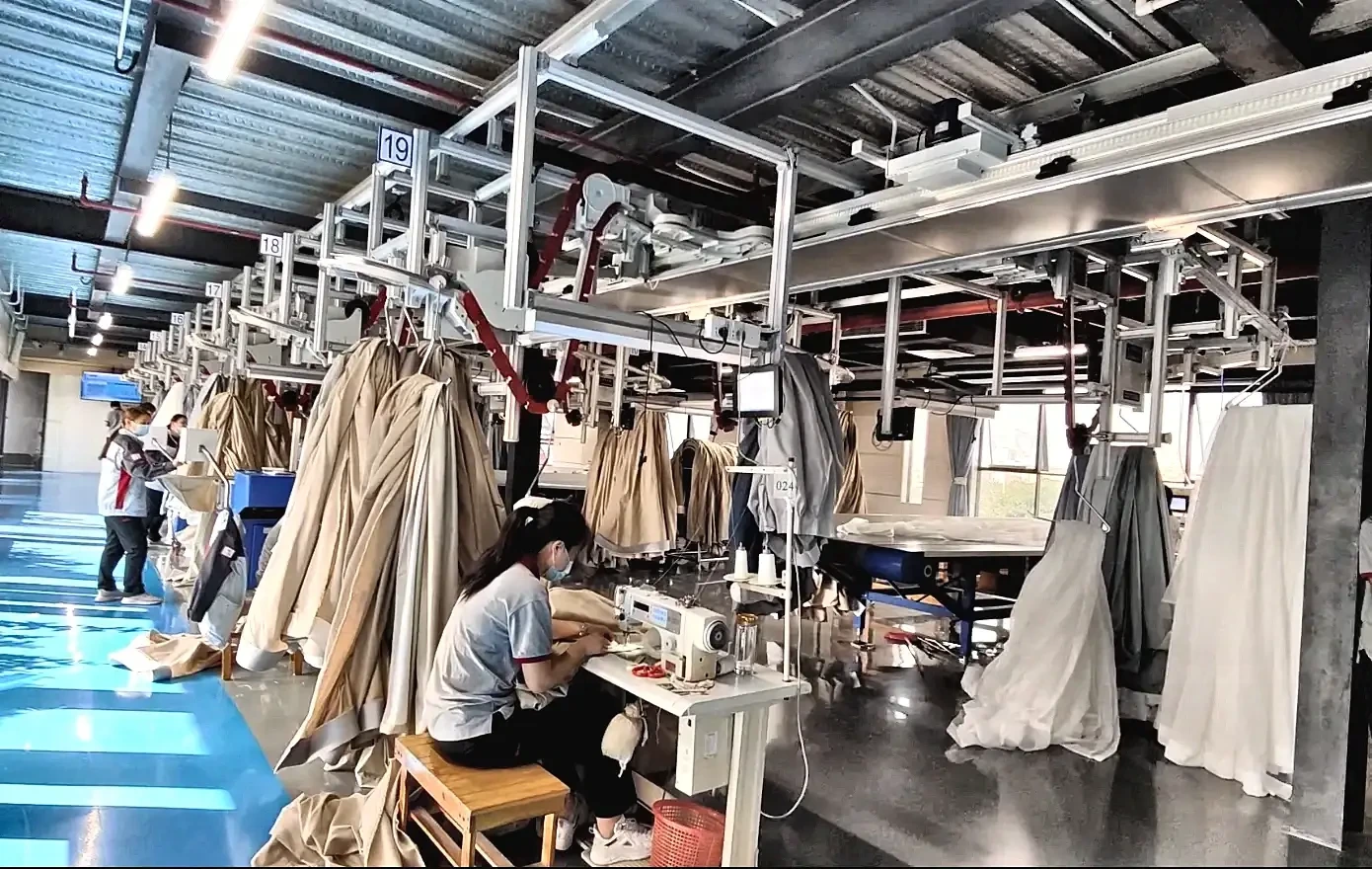
A curtain is among the most awkward things in home textiles to move.
A finished curtain opens out three or four metres. The fabric is heavy, it takes up space folded and drags on the floor unfolded. In a conventional workshop it travels in someone's arms: from the cutting table to a sewing station, from sewing to inspection, one person carrying an armful of fabric across the floor and hunting for somewhere to set it down along the way. Every extra journey is another chance to soil it, snag it or crease it.
All of that eventually turns into rework downstream. Very few plant managers count it as a cost, because it has never appeared as a line on any report.
During 2025, four separate outlets visited Zhejiang Jinchan Textile's plant in Keqiao, Shaoxing, and each described the same production line, the one CleverMax built for them. A supplier assessing its own work carries little weight. Usefully, all four went and looked for themselves.
What the reporters saw: lengths of curtain fabric gliding past in a queue
The first was China Textile News, via the Keqiao government channel, on 17 March, in a piece titled "Keqiao curtains go global."
A month later, on 16 April, Shanghai Observer and Wenhui Bao published a description from the floor. The reporter saw "lengths of curtain fabric gliding past in a queue." Guo Xiang, Jinchan's e-commerce director, is quoted in that report:
This is our newly commissioned CleverMax hanger system production line. Combined with intelligent warehousing, it lets us sequence and route orders more scientifically. It saves labour and raises the workshop's efficiency.
"Gliding past in a queue" is, in five words, the whole point of a hanger system in a curtain workshop. Once the fabric is on a carrier it never touches the floor again. Movement between stations is done by the rail, the operator stays put and the work comes to them. For a curtain, which suffers from being dragged or crushed, every journey it does not make on foot is a risk removed.
Three numbers: 30% efficiency, 50% capacity, 15% first-pass yield
The 8 June report in Tide News supplied the investment and the outcome:
invested 100 million yuan in a smart factory, bringing in the CleverMax hanger system and intelligent warehousing, achieving intelligent equipment, deep MES adoption, intelligent logistics and digital quality traceability, with production efficiency up 30% and capacity up 50%. First-pass yield up 15%.
The China Textile News piece adds a capacity figure: the line supports "2,000 curtain sets a day," more than 30% above what came before, which is consistent with the Tide News account.
The third number is the one worth dwelling on
Efficiency and capacity gains are easy to follow. Stop carrying things and the work goes faster.
But a 15% improvement in first-pass yield points at something else entirely: a meaningful share of those defects were never sewing defects. They were handling defects.
An armful of fabric carried across a floor fails in three recognisable ways. Brushing a table corner leaves a soiled mark, catching on a machine pulls a thread, and the crease pressed in by being held against someone's body for long enough will not iron out. All three are rejected at inspection, and not one of them has anything to do with how well the piece was sewn, which is why counting them against the sewing operator never produced an explanation. Losses of this kind are spread thinly across every journey the fabric makes, too small individually to be worth chasing, so nobody records them and the investment case is built without them.
Take the fabric out of people's arms and put it on a rail, and that entire category of loss disappears. Not reduced. Eliminated, because the action that produced it no longer happens.
This is why the return on a hanger system tends to be far more visible in heavy fabrics than in light ones. The heavier and bulkier the product, and the more it resents being folded, the larger the share of total cost that manual handling represents, and the more there is to take out.
The line is only half the story. The other half is the order book
To be clear, the production line is only half of what changed at Jinchan, and the lesser half. The business is their own achievement.
The same Tide News report notes that online sales now account for 60% of the company's revenue, with cross-border e-commerce revenue passing 80 million yuan. In 2024 roughly 30% of domestic revenue came from livestream selling, and a collaboration with the livestream retailer East Buy produced a single day's sales above 20 million yuan. By September 2025 the organising committee of the Global Digital Trade Expo listed Jinchan as a leading global seller in the curtain category, shipping to more than 60 countries and regions.
Put the two halves together and it becomes obvious why the line was not optional.
The order profile that livestream and cross-border selling generate is nothing like the old export business: small quantities, many styles, short lead times, and liable to double overnight because of one broadcast. Send that kind of order book into a workshop that moves material by hand and it does not hold. Not because capacity runs out, but because scheduling cannot keep up.
A hanger system with MES and intelligent warehousing solves exactly that
An RFID tag on every carrier, a reader at every station entrance, read automatically as the carrier passes. The system therefore knows how far each order has progressed and how long it has waited at any station, with nobody scanning anything and nobody filling in a ticket.
That is fundamentally different from a barcode approach. A barcode has to be scanned by hand, one missed scan breaks the chain, and where two lines merge it cannot tell one piece from another. RFID settles automatic identification, real-time tracking and merge management at once. CleverMax's capability here comes out of the industry-academia partnership established with the CAS Institute of Software in 2005.
With that data behind it, scheduling can be recalculated against where the work actually stands rather than against what a supervisor believes, which is the difference that matters when one broadcast doubles the order book overnight. The system knows what each station is holding and how fast it is clearing it, so it can work out what to release and in what order while the orders are still arriving. Without those numbers the scheduler is estimating, and the only instrument an estimate leaves is overtime.
At Keqiao's density, the difference is not whether you can make it
Keqiao is one of the densest concentrations of curtain and drapery manufacturing anywhere. China Textile News counts more than 11,600 curtain and drapery businesses inside the China Textile City. Tide News records that Keqiao accounts for 60% of the province's textile capacity and close to 40% of the country's.
At that density, competitors run broadly similar equipment, and what separates them is rarely whether a job can be made. It is whether a fragmented order book can be sequenced quickly and shipped on time.
Which is probably why four outlets found their way to the same factory in a single year.
Which part of the Jinchan line is worth copying
A hundred-million-yuan smart factory is beyond most curtain manufacturers, and copying the spend is not the point. What transfers out of those three numbers is the sequence behind them, which is that the order book fragments first, the workshop stops coping second, and what gives way when it stops coping is the scheduling rather than the capacity.
Which means a curtain plant weighing up whether to act should look past the budget at two things. The first is how many orders in the past year were runs of thirty or fifty sets, and whether that share is rising or falling. The second is what the person doing the scheduling does when one of those orders lands, whether they query a system or telephone the floor. Fragmented orders rising while scheduling still runs on phone calls puts a plant roughly where Jinchan stood before the line went in, the only difference being that no single broadcast has tested it yet.
How the curtains themselves get hung is decided by the fabric. The weight of the heaviest drape in the range and the height of the lowest beam in the building between them set rail selection and carrier structure, and through those the order of magnitude of the whole project. Neither number needs a proposal to establish. A set of scales and a tape measure will produce both.
Sources
Every factual claim above traces to one of the following. Where a source is offline — a certificate, a printed publication — we name it without a link.
- [1] 上观新闻 / 文汇报《培育外贸新动能》(新浪财经转载) 2025-04-16 accessed 2026-08-06
- [2] 中国纺织报 / 柯桥发布《柯桥窗帘,火遍全球》 2025-03-17 accessed 2026-08-06
- [3] 潮新闻《绍兴市柯桥区:"平台+产业"双向赋能,世界老牌轻纺中心"绽放新姿"》 2025-06-08 accessed 2026-08-06
- [4] 全球数字贸易博览会组委会《数贸故事第86期|跨境电商助力浙江金蝉布艺成为全球窗帘类目头部卖家》 2025-09-08 accessed 2026-08-06 · Trade press