

Recognised by the Nantong government: an affiliated made-to-measure suit workshop joins the ninth batch of demonstration smart factories
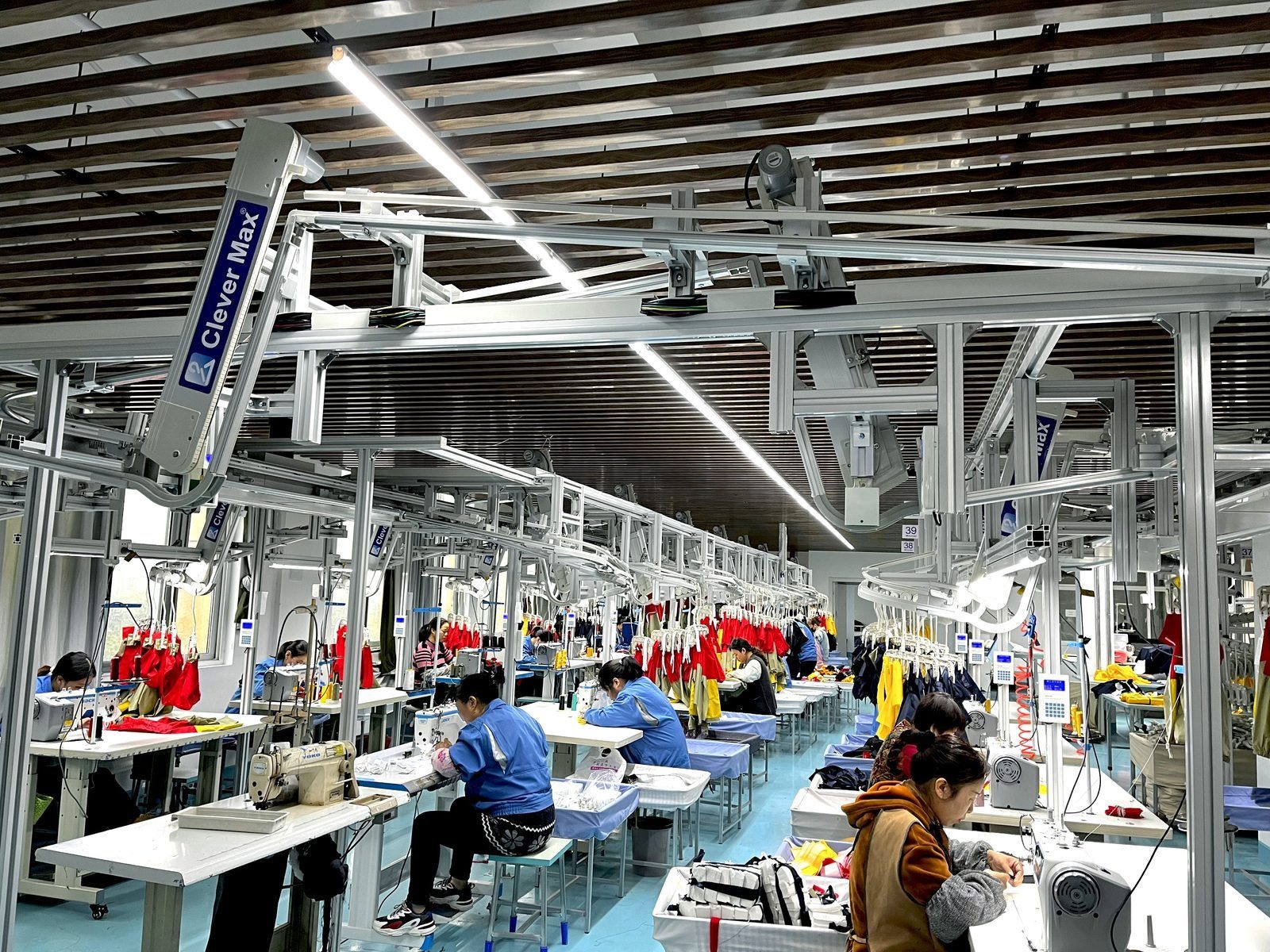
In December 2023 the Nantong municipal government published its ninth batch of demonstration smart workshops, 81 in all. Sixth on the Hai'an list is the made-to-measure suit workshop of Nantong Huixingyuan IoT Technology, selected through five stages of review. That workshop is also CleverMax's own test bed.
On 12 December 2023 the General Office of the Nantong Municipal People's Government published the ninth batch of the city's demonstration smart workshops under document 通政办发〔2023〕59号, 81 of them in all. Sixth on the Hai'an list reads:
Nantong Huixingyuan IoT Technology Co., Ltd., made-to-measure suit smart production workshop.
Huixingyuan was registered in Hai'an in 2014 under legal representative Yu Ming, who also founded CleverMax, and the company produces individually tailored garments.
Why the list is worth more than the plaque
Selection ran through five stages that the document sets out: company application, recommendation from the district, expert review, a credit check, and deliberation by the municipal government. Because the expert review examines whether the automation and information systems on the floor actually meet the published standard, and because the credit check looks at the company rather than the installation, a place on the list cannot be bought with a well-written submission. That is what separates it from a credential a company issues itself.
Nantong being one of China's largest textile and apparel bases, the competition for those 81 places came from a deep field, and holding one of them means the workshop is treated locally as a reference point for what automation on a garment floor should look like. That reference point matters more than it sounds, because the assessors who set it had walked other floors in the same city the same year and had a working sense of what the local average actually was.
Made-to-measure is the hardest thing to automate in apparel
What makes the workshop interesting to CleverMax is not the recognition but the fact that it is where we find out what does not work.
Tailoring resists automation for a structural reason rather than a technical one. No two garments share a size, so no two sets of cut pieces are alike, and the trade has therefore always run on experienced hands deciding where each bundle goes next. A volume line does the opposite: it repeats one action until the order is filled, which is why it can be laid out once and left alone. A made-to-order line has to arrange ten thousand different actions into the right sequence, and that sequence changes with every garment on it. Nothing about the line can be fixed in advance except the rules for deciding.
Which is precisely why a hanger system installed here gets pushed further than one installed anywhere else.
Dozens of orders on one line, none of them tangled
Every carrier holds an RFID tag, so the system knows whose garment is hanging on it, which station it goes to next, and which process parameters that garment was ordered with. That matters because single-piece flow in this setting cannot fall back on anyone's memory: with dozens of orders live on one line, a supervisor who has to recall which jacket belongs to which customer becomes the constraint within an hour.
Barcodes cannot carry that load. A barcode has to be scanned by hand, a missed scan breaks the chain, and where two lines merge the code cannot say which piece came from where. In a workshop where every style and every size differs, hand scanning and hand identification accumulate errors across a shift faster than anyone can correct them. RFID removes all three failure modes at once, because the position and dwell time of each piece are recorded as the carrier passes a reader, with nothing keyed in by anyone.
The identification technology itself came out of the research partnership formed with the CAS Institute of Software in 2005, which by 2023 meant more than a decade of continuous running in production workshops. Most of those years were spent on volume lines, where a reader sees the same style pass a few thousand times in a row and an error corrects itself the moment a supervisor notices the pile in the wrong place. A tailoring line offers none of that redundancy, since every carrier on it is the only one of its kind, so a piece routed to the wrong station is not an anomaly anyone spots by looking. That is what makes this workshop the most demanding place the technology has been asked to run.
Learning on our own floor rather than a customer's
Working these problems out in an affiliated plant is not a matter of preference. A customer's line has to ship against a delivery date, so a commissioning run that fails there turns into a late order, and the pressure to stop experimenting and get the line moving arrives long before the design is actually right. In our own workshop the schedule is ours, which means a layout can be torn out and rebuilt as many times as it takes and the cost stays with us. What reaches a customer afterwards has already survived that.
Today's tailoring problems are tomorrow's ordinary ones
Small batches, many styles and short lead times have been spreading out of made-to-measure and into the rest of the industry for several years now. As e-commerce volume grows, repeat orders come back faster and SKUs split finer, ordinary garment plants find their own order books drifting towards the tailoring profile: smaller quantities, more styles, shorter deadlines, changes mid-run. Scheduling methods built for volume do not degrade gracefully under that profile. They stop working.
So the problems a tailoring workshop meets first are usually the ones an ordinary plant meets a few years later. The difference is that the tailoring workshop had no choice about when to face them, whereas a plant watching its order book fragment still has the option of rebuilding how it schedules before the fragmentation becomes acute. The mixed-flow scheduling proven in this workshop in 2023 is available now to factories in exactly that position.
Measure how fragmented the order book has actually become
Smaller quantities, more styles and tighter deadlines are impressions. Working out how much longer an existing scheduling method will hold requires a number that can be calculated.
The most direct one is changeover count. Pull last month's production schedule, count how many times a single line switched styles, then measure how far output in the first hour after each switch fell below the steady-state rate. Multiplying those two figures gives the capacity that changeovers consumed over the month. How often styles change is set by the order book, and no factory can alter that. How much each change costs is set by the scheduling method, and that can be altered.
Once that figure passes a tenth of capacity, the constraint has stopped being how hard anyone is working, and has become the fact that allocating work through paper tickets and verbal handovers has reached the quantity it can carry. The tailoring workshop met the same ceiling a decade earlier, and beyond it there was only one route open: every piece of work carries its own route with it, and nobody has to remember anything.
Sources
Every factual claim above traces to one of the following. Where a source is offline — a certificate, a printed publication — we name it without a link.
- [1] 《南通市人民政府办公室关于公布第九批南通市示范智能车间名单的通知》(通政办发〔2023〕59号) 2023-12-12 accessed 2026-08-06
- [2] 缝制设备网 / 《中外缝制设备》《南通——明兴:逆市上扬有秘诀》 2020-09-07 accessed 2026-08-06 · Trade press