

The fourth generation moves into home textiles: one duvet invalidates every number on the line
The home-textile plants around Dieshiqiao kept asking whether the system could carry a duvet. It could, but a shirt weighs a couple of hundred grams and a winter duvet four or five kilos, so the steel section of the rail, the way a carrier grips, the envelope a piece sweeps through on a bend and the number of pieces a stretch of rail can hold were all numbers that had been settled on an apparel line and none of them survived the move. The fourth generation was drawn from scratch around the heavier material.
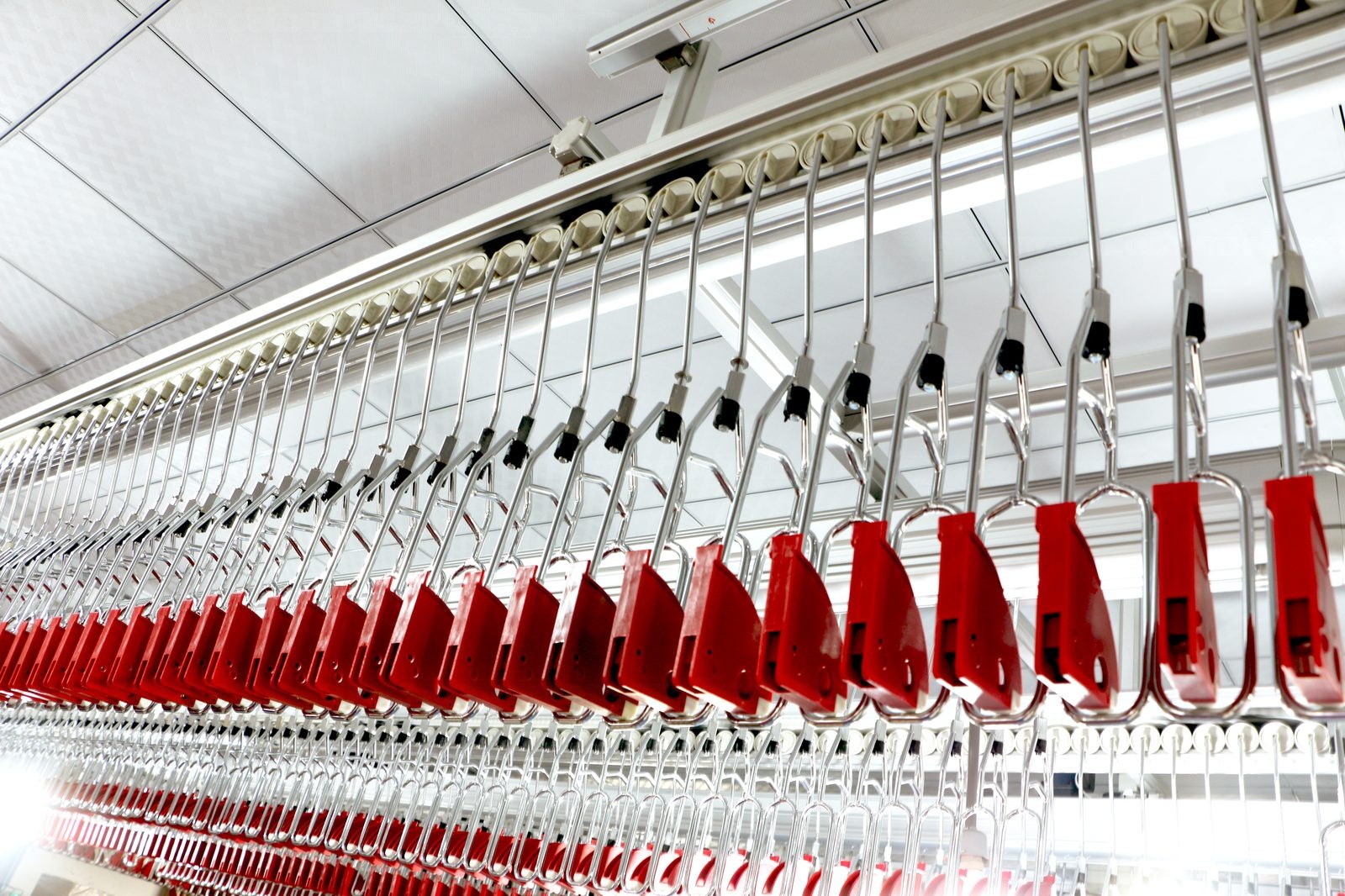
CleverMax released its fourth-generation hanger system in 2008, and the first one went into a home-textile workshop rather than a garment one.
Nantong helped. Dieshiqiao, one of the largest home-textile clusters in China, is a short drive away, and through the years the apparel lines were settling down, a steady stream of home-textile plants came asking the same question: can this thing carry a duvet?
It can. Move an apparel line across unchanged, though, and it stops on the first day.
Two hundred grams against four kilos is not a reinforcement job
A shirt weighs one or two hundred grams, a winter duvet four or five kilos, a thick one more. A load difference of twenty or thirty times cannot be absorbed by a stronger bracket, because it propagates upward from the steel itself.
The rail goes first. Carrying tens of grams allows thin-walled section, widely spaced hanger points and slender supports, whereas several kilos changes steel section, hanger-point spacing and support structure together. A home-textile plant also runs fully loaded all year rather than in bursts, so metal fatigue belongs in the service life rather than in a footnote. A line that will not hold up for three years hands back in the third year everything it saved in the first two.
Once the rail holds, the goods still have to stay on it. A garment hangs as a single fall of fabric and holds its own shape. A duvet is a bulky mass, soft and slippery, with no edge a clamp can settle on, which sent grip method, opening size and anti-drop structure all back to the drawing board. This is not a question of refinement. Four or five kilos falling from two metres up lands on whoever is standing underneath.
Then there is what a piece sweeps out on a bend. A garment stays inside half a metre of its carrier. A duvet swinging round a corner reaches the arm of the operator at the next station, so the turn radius had to grow, and because a larger radius takes floor space, the routing of the whole line was redrawn around it.
Station spacing and the number of pieces a stretch of rail can hold changed with the redraw. A home-textile piece occupies several times the volume of a shirt, so the same length of rail holds far fewer of them and a station reaches physical capacity much sooner. Import the buffer rules from an apparel plant and the first upstream station to speed up backs the line up behind it.
The mechanics were rebuilt. The data layer was untouched
What came out of that chain of consequences was not a third generation in heavier steel, but a mechanical design drawn from scratch around a heavier class of material.
Only the mechanics were redrawn. The RFID tag on the carrier, the reader at the station entry and the host deciding whether a piece enters, all of it developed with the CAS Institute of Software from 2005 onward, went onto duvets without a line changed, because what the system identifies is the carrier and not what the carrier happens to be holding. A home-textile plant could therefore see which station every piece was at and how long it had been waiting on its opening day, instead of accumulating two years of history the way the early apparel plants had to. When China Home Textile Brand Network wrote about the CleverMax home-textile system in 2015, the figures it described were the ones this line was sending up to the cloud platform.
The heavier the goods, the better hanging them pays
At the time it looked like nothing more than a new product category. Over the following decade and a half the same heavy-load work went into curtains, sofa covers, automotive interiors and filter bags, which resemble each other in no other respect than being far heavier than a shirt.
Weight is precisely where a hanger system earns its money. Handling consumes labour in proportion to weight and bulk, so the heavier the material, the larger the share of total hours that goes into lifting and setting down, and the larger the return on taking that share away.
A home-textile workshop is the extreme case. A duvet is lifted and put down more than a dozen times between sewing, filling, quilting and packing, and not one of those lifts makes it worth any more. Waiting for the operation upstream, walking half-finished work across the floor, hunting a batch down when it comes back for rework, counting paper tickets to see where an order stands, all four cost more here than in a garment plant because every piece is heavier, bulkier and harder to find. The harder a plant has to work to lift its product, the more it saves by not lifting it, which is why payback in home textiles tends to arrive sooner than in apparel.
The duvet belongs to the customer. Getting it down the line belongs to CleverMax
Duvets, curtains and seat covers are the customer's product. What CleverMax has built since 2003 is the one thing: the system that carries them hanging from cut piece to packing. The offering now spans cutting, sewing, hanger conveying, intelligent storage, sorting and packing across the whole chain.
Since the fourth generation, a CleverMax engineer walking into a home-textile workshop asks what a duvet weighs, then asks what the heaviest batch of the year weighs. Until those two numbers exist, there is nothing to calculate a rail, a carrier or a turn radius from. The parameters come off a scale on the floor, not off a drawing.
Sources
Every factual claim above traces to one of the following. Where a source is offline — a certificate, a printed publication — we name it without a link.
- [1] 南通明兴科技开发有限公司 企业发展历程(公司资料) 2008 (offline source) accessed 2026-08-10 · Trade press
- [2] 品牌家纺网《明兴科技:传统家纺"搭上"云平台》 2015-09-01 accessed 2026-08-10 · Trade press