

China National Garment Association award: CleverMax brings the 300-operation made-to-measure suit onto an automated line
On 28 July 2021 the China National Garment Association gave its Recommended Project prize for outstanding new technology to the IoT-based made-to-measure suit system, certificate J202107-KJS00571. Suits are the hardest thing in discrete manufacturing, and the project was approved over near-unanimous internal opposition. The same year CleverMax launched its sixth-generation heavy-duty hanger system, rated above 20kg per carrier.
At the awards session of the 2021 China Apparel Technology Conference in Hangzhou, the China National Garment Association gave its Recommended Project prize for outstanding new technology and solutions in the apparel industry to the IoT-based intelligent made-to-measure suit system. The certificate, number J202107-KJS00571, is dated 28 July 2021.
Three organisations are named on the certificate: the CAS Institute of Software, CleverMax, and Nanjing Xinyuan Sewing Equipment Co., Ltd. The first of those has been working with CleverMax since 2005, when the partnership brought RFID identification onto the carrier, so this project is another instalment of a collaboration nearly two decades old.
The same system, under the name personalised made-to-measure suit intelligent mixed-flow production management system, was also selected as a CISMA2021 featured product that year, having gone through an expert panel convened by the association's technology committee and then through the China Sewing Machinery Association's chairman's office meeting.
The project nearly never started
By the company's own later account the project "was approved against a wall of opposition. Apart from a handful of people, nobody supported it." That is an unusual thing for a company to publish about a project it went on to win a prize for, and it is worth reading literally rather than as modesty.
The objection was a reasonable one. A suit involves more than 300 operations and is the hardest thing in discrete manufacturing, and operation count compounds in both directions at once: more places for a line to go wrong, and more of the sequence to recalculate every time any one of them moves. The internal verdict was that it was "too hard, too complex, and the chance of success was slim."
The stakes were put just as plainly. Succeed, and batch production of made-to-measure suits stops being a barrier for this class of discrete manufacturing. Fail, and "the enormous R&D spend goes down the drain and the company is set back at least five years." There was no middle outcome available, since the work could not be delivered in halves.
Chairman Yu Ming's words were:
Even if only one person on this road supports me, I will keep going.
The project team combined company staff with researchers assigned from the Chinese Academy of Sciences. Over the course of development the system architecture was torn up and rebuilt more than once, and the hardware was stripped down and reassembled more than once.
Every one of those restarts cost months, and months are not something you can charge to a customer whose line has orders to ship. So CleverMax built its own trial facility in Nantong, Jiangsu, 20 mu of land with a first-phase workshop of 2,000 square metres turning out more than 110 high-end made-to-measure suits a day. Prove it in our own plant first, then take it to a customer's.
Where a conventional hanger line stalls on a suit
Single-piece flow puts one garment on one carrier and sends it through every operation. A suit will not fit that model, because one carrier cannot hold all of its fabric and trim. Fronts, backs, sleeves, interlining and pocketing come to dozens of pieces varying in size and thickness, more than any carrier takes. The model holds up on simple high-volume work and collapses as soon as cut pieces get complicated and the order book runs mixed.
The usual workaround is to take the complex components off the line, finish them by hand and hang them back up. A component that leaves the rail leaves the readers behind with it, so while it is off the line nobody can say who is holding it or how far along it has got. The off-line stretch is paid for twice, once in the handling and once as a hole in the record.
Shade variation is the worse problem. On products carrying a lot of fabric and trim, suits and down jackets and denim among them, the panels of one garment are meant to come from adjacent lengths of the same roll. Run dozens of orders together down one line and those adjacent lengths get scattered, which is why mixed flow brings manual matching, inspection and sign-off with it. Different lengths of the same roll take dye slightly differently, and the eye cannot separate them reliably under workshop light. The mismatch surfaces only once the garment is assembled, and a suit whose body and sleeves disagree is scrapped whole, which costs several times whatever the labour saving was.
How the CleverMax system solves it
Three parts, each aimed at a specific cost.
First, shared equipment modules. Multiple orders and styles share the special-purpose machine for a given operation, cutting the cost of that equipment in production by 25%. These machines are expensive and the station count is high, so fitting out a line with a set per style is a large single outlay, and that outlay is where most smaller manufacturers stop. Queue several orders through the same machine and the number of machines comes down with them. This part attacks the cost of entry.
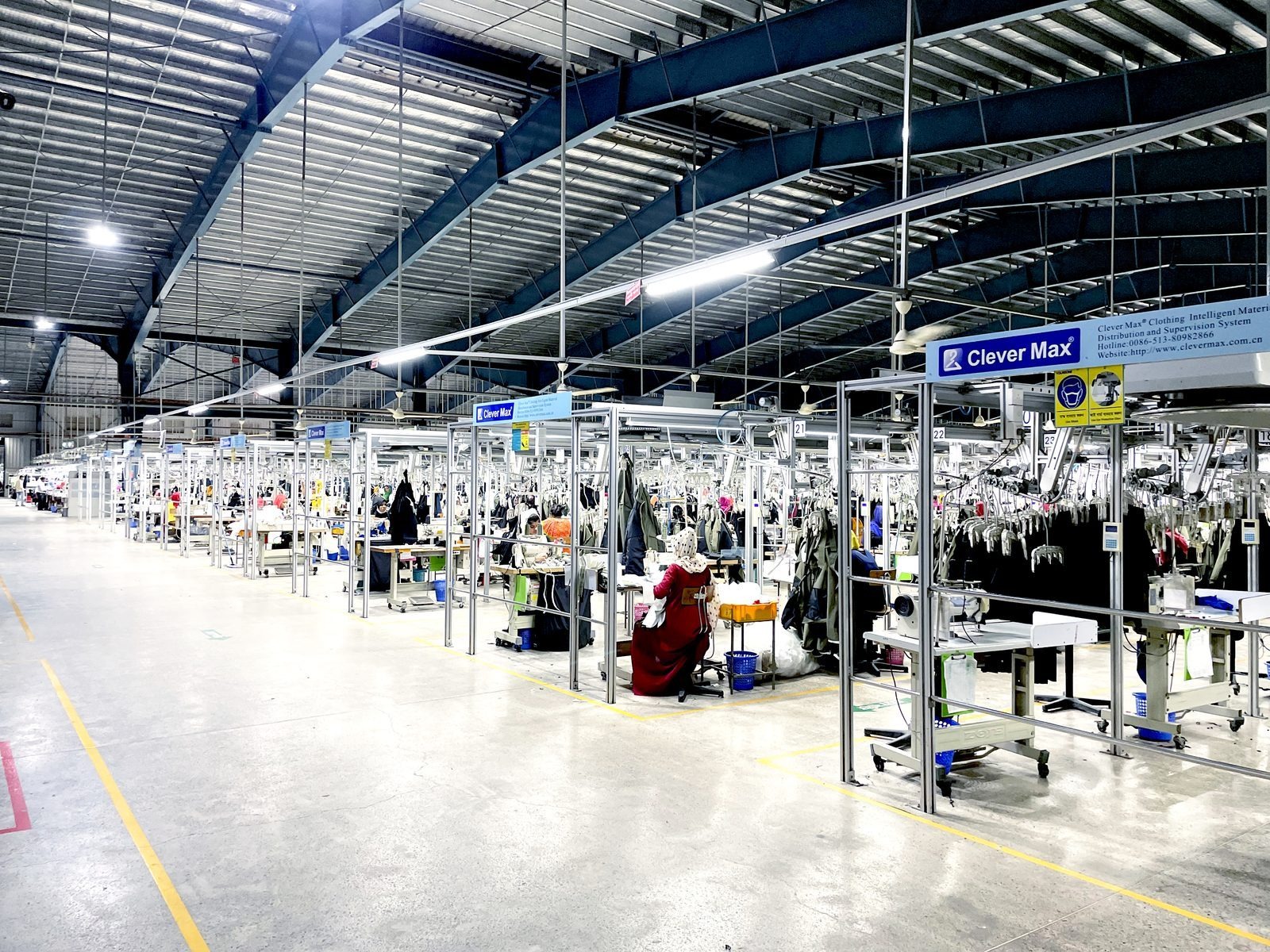
Second, multi-carrier component flow in place of single-carrier single-piece flow. A suit is split across several carriers, each travelling its own operations and converging at the points where components join. The Cloud MES platform sequences them by the operations each cut-piece task requires and by the order in which those tasks merge, running serial and parallel work in combination at the tens-of-millions data scale. This part removes the physical limit described above. A suit no longer has to fit on one carrier.
Third, a mixed-flow production package management module. As carriers enter the line, different components of one product are worked simultaneously at several points, so complex operations stop having to come off the line at all and the whole flow runs under real-time scheduling without manual intervention. Components that never leave the rail never leave the readers, which closes the hole in the record.
The stated result inverts the usual expectation: the more mixed the order book and the more complex the operations, the greater the efficiency gain.
The counterintuitive conclusion: messy order books need automation most
The assumption runs that automated lines are at their best on standardised high-volume work, and that the tidier the order book the larger the advantage. Fragmented orders and shrinking batches then lead to the conclusion that "automation isn't for a plant like ours."
This project points the other way. Small batches, many styles and orders of one are the conditions under which human scheduling fails first, which makes them the conditions under which automation returns the most. The two statements are the same statement, seen from either end of the same line.
Volume production is one line running one style a day. The schedule is drawn once and a supervisor can hold it in his head. Mixed production puts dozens of orders on the same line at once, each with its own route through the operations, and sequence, idle stations and impending late deliveries all pull on one another, so touching any one of them means recalculating the rest. Nobody does that in their head. The question at that point is not whether automation pays for itself. It is that the manual method has stopped producing an answer.
The factories saying today that their orders are too mixed for a system like this are, more often than not, precisely the ones with the most to gain from one.
The other half of the same year: the sixth-generation heavy-duty system
CleverMax also released its sixth-generation heavy-duty hanger system in 2021, rated above 20kg per carrier, which extended the range to furniture, automotive interiors and filtration products. Those categories had never been kept off a line by their process routes. They had been kept off by their weight.
The two launches are halves of one move. The suit system answers "our process is too complex to put on a line." The heavy-duty system answers "our product is too heavy to hang." Those two sentences had kept a great many factories out of the discussion entirely, and after 2021 neither of them holds.
Whether your product is hard is a question of counting operations
Feel settles nothing here, so the thing to do is count. Take the most complex style in the plant and count its operations. Count how many of them currently have to be done off the line. Then time how long a batch stays out there, remembering that the system is blind to it for the whole of that period. Those three figures together are the price complexity is charging right now.
The count usually shows that the obstacle is not the process. It is that a complex process has to leave the line, and leaving the line breaks the record. Before 2021 the finding stopped there, because no equipment could carry a 300-operation made-to-measure suit. It no longer stops there. Put those few operations back on the rail, and the arithmetic closes for the first time.
Sources
Every factual claim above traces to one of the following. Where a source is offline — a certificate, a printed publication — we name it without a link.
- [1] 明兴科技官方微博《揭秘明兴"2021年服装行业推荐项目奖"背后的故事》 2022-04-23 accessed 2026-08-10
- [2] 中国服装协会 2021 年度服装行业用优秀新技术成果及解决方案推荐项目证书(证书编号 J202107-KJS00571) 2021-07-28 (offline source) accessed 2026-08-10
- [3] 南通明兴科技开发有限公司 企业发展历程(公司资料) 2021 (offline source) accessed 2026-08-10 · Trade press