
CleverMax releases its ERP project management system: when delivery slips, the workshop is usually not the reason
When a batch misses its date, the instinct is to go and look at the workshop, where there is usually nothing to see. In 2025 CleverMax released an ERP project management system, connecting YunDao MES production orders to ERP. Progress on the floor has been transparent for years, while what happens between an order arriving and it reaching the line was still living in spreadsheets and chat groups, and no amount of line speed makes up for it.
When a batch misses its ship date, the first instinct is to go out and look at the workshop. Usually there is nothing there to see, because the line is running at the rate it always runs at and the operators are working the way they always work.
In 2025 CleverMax released an ERP project management system, connecting production orders in YunDao MES to ERP. It covers order scheduling, task assignment, named ownership, progress reporting, notifications and approval flows, managed from both mobile and desktop, and it fills in the half of the process most factories never got round to, which is the half outside the workshop.
The workshop went transparent years ago. Everything outside it did not
Since the YunDao MES release in 2011, there has been little guesswork left inside a CleverMax customer's workshop. Which operation an order has reached, which station is waiting for work, how much work-in-progress is on the floor: all of it queryable at any moment.
But an order's life is far longer than the time it spends in the workshop.
Once an order arrives, when is it scheduled? When does the material land? Who owns the sample? When a customer changes a requirement at short notice, who has actually been told? In a great many plants those stages still run on spreadsheets, chat groups and walking over to ask someone.
Which leaves an awkward gap. Inside the workshop everything is digital. Outside it, nothing is. And every order has to cross that undigitised stretch before it ever reaches the line.
When delivery slips, the workshop is usually not the reason
The crossing is where the gap does its damage. However efficient the line, fabric arriving three days late costs you the date. A size change that never reaches cutting means a batch made for nothing, and it costs you the date. An approval sitting untouched with one person for three days pushes everything behind it. All three happen before the order reaches the line, which is why standing in the workshop reveals none of them.
Worse, none of them announces itself while it is happening. By the time it surfaces, the only options left are overtime and a penalty.
This is why digitising the workshop alone is not enough. However accurate your work-in-progress data, if one stretch of the decision chain is still dark, that accuracy has nowhere to go.
The four things the system actually fixes
Order scheduling. An order goes straight into the plan, and the resulting schedule lines up with real capacity as the MES reports it. Not sales keeping one plan and the floor keeping another, with the mismatch surfacing at month end.
Named ownership. Every stage has an identified owner, rather than a post-mortem that ends in "I assumed he was handling that". It is the most common and most expensive failure in cross-department work.
Progress reporting and notification. When status changes, the people affected are told automatically, without relying on someone remembering to pass it along.
Approval flows. Order changes, expedites and exception handling all go through the system and leave a record, so that when you review afterwards, where it stalled and for how long is immediately visible.
Between them the four bring the stretch before the line into the same body of data as the line itself.
Mobile access is not a nice-to-have. It is whether the flow moves at all
The fourth of those, approvals, deserves its own note, because it is the one that stalls.
Plant managers spend most of their time away from a desk: on the floor, in the warehouse, travelling, sitting with a customer. An approval stuck on somebody's office computer is a genuine and very common reason processes crawl, and it is not a philosophy-of-management problem. While the person is not at the desk, the paperwork does not move.
Approvals and visibility on a phone are what keep work moving. That is a simple idea, but systems where mobile and desktop really do show the same data and support the same actions are not as common as you would hope.
Why building this on top of a hanger system works differently
Connecting MES to ERP is not a new idea in general. For discrete manufacturing in apparel and home textiles, the difficulty is the granularity of the production data.
Most ERP systems receive progress by batch and by day, because there is no live source beneath them, only somebody typing in a figure periodically. The data is already stale the moment it is entered, so the schedule built on it is stale too. The reconciliation promised above, between what sales has planned and what the floor can actually deliver, is a reconciliation against that figure, and it cannot come out right when the figure is a day old.
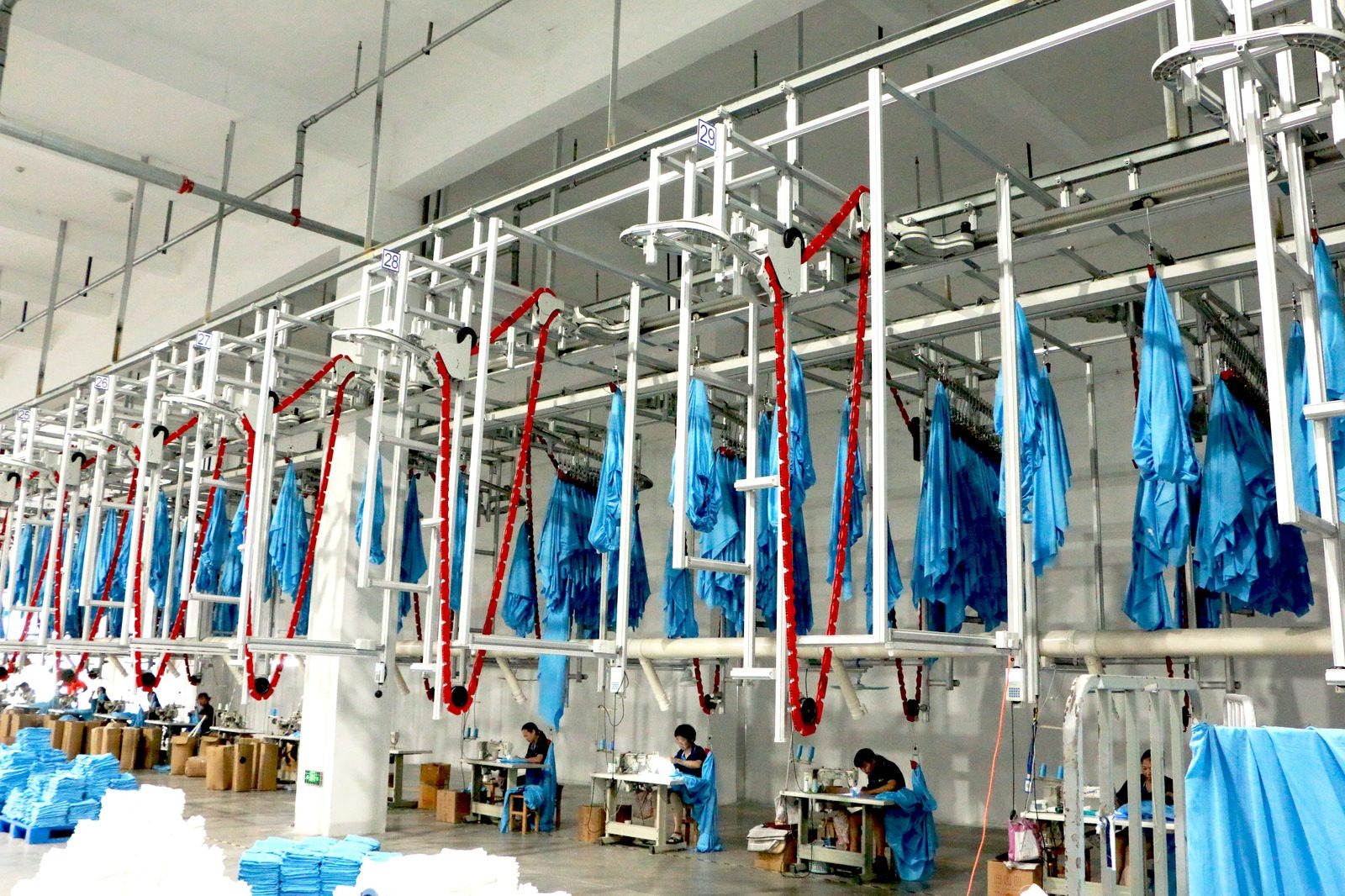
A hanger-system installation is a different animal. Since the industry-academia partnership with the CAS Institute of Software in 2005 brought RFID onto the rail, the data has been generated per piece, per station, in real time. Every carrier has a tag, every station entrance has a reader, and nothing is entered by hand. What the ERP schedules against is the actual state of the floor, not a spreadsheet from three days ago.
That is the ground CleverMax built this system on. The underlying data was already there. What was missing was a way to carry it into the decisions made outside the workshop.
The more fragmented the order book, the more this is worth
At a private-economy forum in Nantong in 2023, CleverMax chairman Yu Ming made a related point: garment manufacturers in Nantong now mainly take small orders across many styles, and digital transformation is what makes genuinely flexible production possible, optimising the supply chain and strengthening their position in international markets.
Behind that sits an arithmetic every plant manager should run once. The same one million in output split across a hundred small orders rather than five large ones involves a completely different order of magnitude of scheduling, communication and approval.
In the era of large orders, people could carry the management load, because there were only so many things to watch. With small orders they cannot, because there are twenty times as many things to watch and no twenty times as many managers. What being unable to carry it looks like is the three failures above: material nobody chased, a change that never arrived, an approval sitting with someone.
That is the dividing line. While the order book is still chunky, plenty of owners see a system like this as decoration. The moment it fragments, it becomes a necessity.
Establish whether the bottleneck is inside the workshop or outside it
So back to the instinct this began with. Before walking out to look at the line, look at the batch's calendar instead: the day the order arrived, the day it reached the line, and what the days in between were spent waiting for. If that middle stretch is longer than the time on the line, no amount of line speed will recover it, and the workshop was never the place to look.
CleverMax is glad to go through that calendar with you, working from your own order records rather than from our product literature, since the answer is already sitting in those records whether or not anybody has added the days up. What it tells you is which half to fix first, the workshop or everything that happens before an order ever gets there.
Sources
Every factual claim above traces to one of the following. Where a source is offline — a certificate, a printed publication — we name it without a link.
- [1] 南通明兴科技开发有限公司 企业发展历程(公司资料) 2025 (offline source) accessed 2026-08-10 · Trade press
- [2] 我苏网/江海明珠网《推动企业发展与数字经济深度融合 第三期南通市民营经济"两个健康"沙龙活动举行》 2023-12-09 accessed 2026-08-10