

From plan to action: the 2013 industrial-informatisation action plan and CleverMax's apparel intelligent-production patent
In August 2013 China's MIIT issued its action plan for deep integration of informatisation and industrialisation, targeting a 70% numerical-control rate for equipment in key industries by 2018. That January, the joint venture between CleverMax and the CAS Institute of Software had filed an invention patent on an apparel intelligent-production system.
In 2012 the Textile Industry Five-Year Plan put computer-controlled automatic hanger systems on the technology list for apparel. A year later the direction turned into a set of numbers.
What separates an action plan from a plan
On 23 August 2013 China's Ministry of Industry and Information Technology issued the Special Action Plan for Deep Integration of Informatisation and Industrialisation (2013-2018), document number MIIT Xin [2013] 317.
A plan sets direction, which can be approached at leisure, whereas an action plan sets targets against deadlines that are assessed annually and broken down into task tables as they pass through each level of provincial government. One line in this document carries the most weight for manufacturing equipment:
Major breakthroughs shall be achieved in intelligent manufacturing equipment built on digitisation, flexibility and systems integration, with rapid adoption in key sectors of the national economy, and the numerical-control rate of equipment in key industries shall reach 70%.
Seventy per cent within five years, which is not encouragement but a line drawn across the whole of manufacturing, and a line that provinces were then expected to report against.
Further figures show how hard the push was meant to be. Eighty per cent of large and medium enterprises in key industries were to reach the integration-and-improvement stage or beyond, 55% of small and medium enterprises were to use information technology in research, management and production control, and 50% were to use e-commerce for purchasing and sales.
Those three small-enterprise figures are the ones that mattered, because targets in documents of this kind had historically been aimed at large plants while smaller firms were tacitly left out of the assessment. Writing explicit percentages against them meant a garment factory of a few hundred people now appeared on the same table as a state-owned mill.
Upstream sits another document, and it deals with money
The action plan did not appear from nowhere. Above it stands a State Council document, the Guiding Opinions on Promoting Enterprise Technological Transformation, State Council [2012] 44, issued in September 2012.
Guiding Opinions at State Council level set the tone for ministries and provinces so that technological transformation has standing across fiscal policy, credit, land and tax. Those four channels had each been governing their own territory, which meant a factory planning a retrofit had to negotiate money, land and tax separately and could be stopped by any one of them, so what a top-level document supplies is a common basis on which all four can be made to pull the same way. The technical-upgrade programmes and equipment-renewal subsidies provinces rolled out afterwards mostly trace their authority back to it, including the transformation policies Zhejiang pushed hardest in those years.
Stacked together, the two documents said something concrete to a factory owner. The direction toward automation was set nationally and the funding to support it was being opened nationally, so plenty of the factories that moved in those years did so less out of conviction than because the numbers finally worked.
CleverMax's answer: an invention patent filed in January 2013
The action plan came out in August. CleverMax had filed its answer that January.
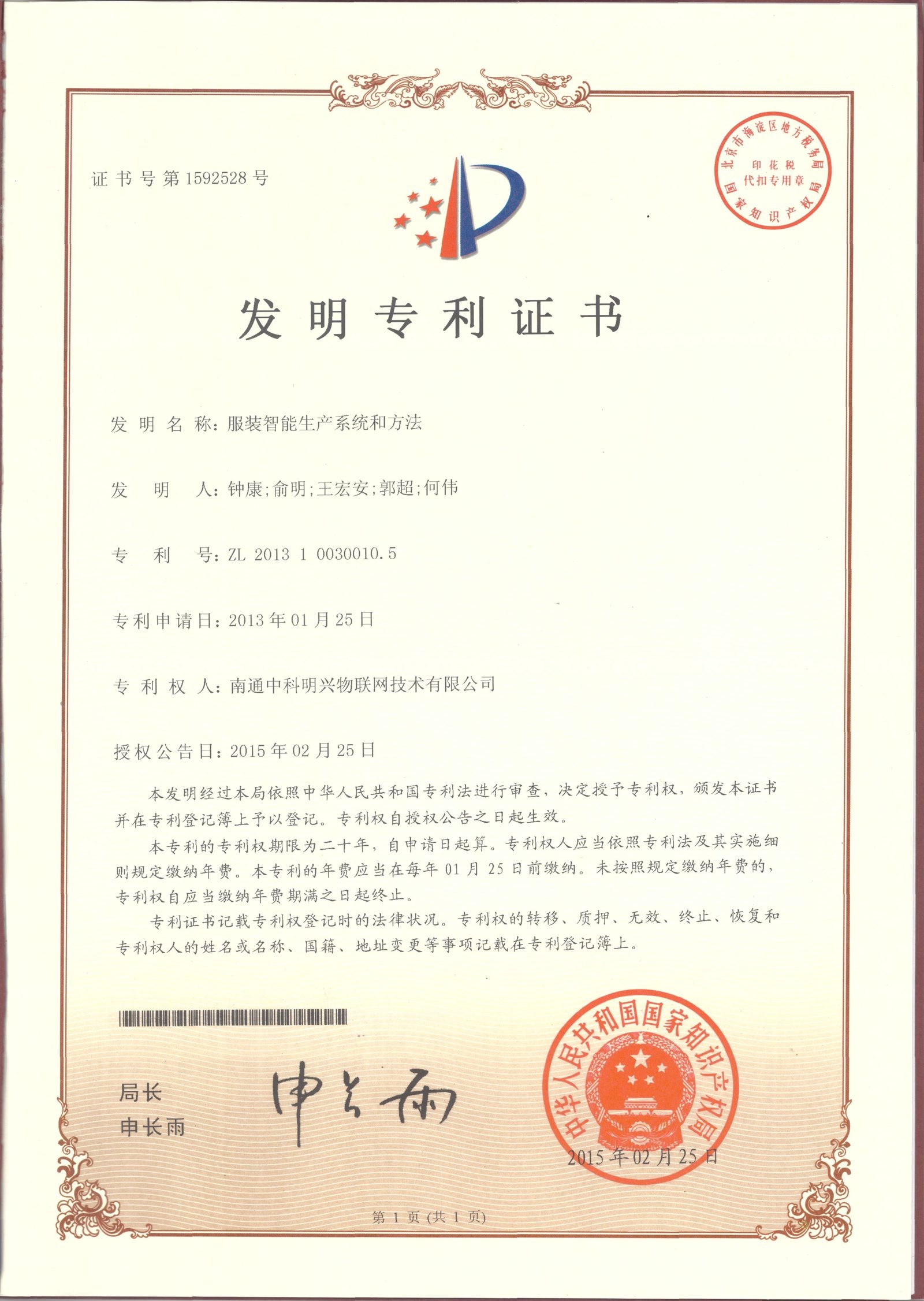
On 25 January 2013, "An apparel intelligent production system and method" was filed as an invention patent, number ZL 2013 1 0030010.5, granted on 25 February 2015 as certificate 1592528. The inventors are Zhong Kang, Yu Ming, Wang Hongan, Guo Chao and He Wei.
The patent is held by CleverMax, a name that deserves explaining.
The industry-academia partnership between CleverMax and the CAS Institute of Software began in 2005 by bringing RFID automatic identification into the hanger system, and by 2013 the relationship had moved from project collaboration to jointly funded companies. In that same year the Institute and CleverMax also established Jiangsu YunDao Information Technology to turn production data into a cloud platform.
The inventor list shows the same thing, since Wang Hongan is a researcher on the Institute's side and Yu Ming is CleverMax's founder, and both names appear on this patent. From technical collaboration in 2005 to two joint ventures in 2013, that thread never broke.
What "apparel intelligent production" means on an actual floor
Policy documents talk about numerical-control rates and integration stages. Inside a specific garment plant those words come down to something plain.
A floor used to run like this. Operators carried half-finished pieces between stations, a supervisor counted the day's output off paper tickets, an owner who wanted to know where an order stood waited for the evening count, and when a rework came back somebody had to remember where that batch had been put. All the information lived on paper and in people's heads, running half a day to a day behind, which meant every decision the owner made today was made about the floor as it had been yesterday.
Closing that gap is what intelligent production is for. An RFID tag on the carrier, a reader at each station entry, automatic reading as the carrier passes, the host deciding in real time whether the piece enters, and a PLC controlling the gate precisely. The position and dwell time of every piece is captured automatically with no manual entry at all.
Once that data reaches the YunDao cloud MES platform, the owner can see from the office how each operation is progressing, how long each piece takes to move and which station is blocked. That is what numerically controlled equipment and integration actually look like in a garment plant, and it is not something finished by buying a few new machines, because a new machine that is not connected leaves you exactly as blind as the old one.
What became of the factories that moved in 2013
The action plan ran to 2018, five years in which Chinese apparel manufacturing changed more than in any comparable stretch, with labour costs climbing, batch sizes falling and lead times compressing.
Those three pressures test a single capability, which is whether you can know what is happening on a floor while that floor is still running. Smaller batches mean several style changes in a day, tighter lead times mean rush orders arriving at any hour, and paper-ticket management fails to reconcile daily under that rhythm. A factory that had connected its production data could quote on work of that shape with some confidence, while a factory still on tickets was advancing on a supervisor's memory.
The difference was never in the machines themselves. The two plants might well have bought the same sewing heads from the same supplier in the same year, and what separated them by 2018 was whether anything on the floor was recording where the work had got to.
Looking back at that 70% from here
The action plan asked for a numerical-control rate of 70%, a target easily read as a proportion of equipment purchased. What it actually tests is whether the data has been joined up, because a line where every machine is numerically controlled and every machine's data sits inside that machine still leaves its owner waiting for the evening count.
So there is a more direct way to ask whether a line qualifies. At this moment, how many pieces are in progress on the floor, which station is each of them sitting at, and how long has it been there? If that cannot be answered without asking anyone, the 70% has nothing to do with this line, however many new machines have been installed against it.
In 2013 that question went unanswered in most plants because the technology was still being laid in and the readers, the tags and the platforms were all arriving at once. Where it still goes unanswered today, the reason is narrower and harder to be comfortable with, which is that nobody has gone back to connect the few wires that were left hanging.
Sources
Every factual claim above traces to one of the following. Where a source is offline — a certificate, a printed publication — we name it without a link.
- [1] 工业和信息化部《信息化和工业化深度融合专项行动计划(2013-2018年)》工信部信〔2013〕317号 2013-08-23 accessed 2026-08-27
- [2] 国务院《关于促进企业技术改造的指导意见》国发〔2012〕44号 2012-09-01 accessed 2026-08-27
- [3] 国家知识产权局 发明专利证书第 1592528 号《服装智能生产系统和方法》(专利号 ZL 2013 1 0030010.5,专利权人:南通中科明兴物联网技术有限公司,申请日 2013-01-25,授权公告日 2015-02-25,公司资料) 2013-01-25 (offline source) accessed 2026-08-27